Amanda Michelle Gomez
John Guggenmos, the owner of gay bars Trade and Number Nine, declines to speak about ending the tipped minimum wage in absolutes. He doesn’t support Initiative 82, the upcoming ballot measure that would do that, but he believes it will likely prevail. Rather than fight it, he’s thinking about how he’ll pivot when he can no longer rely on patrons’ tips to top off his workers’ wages.
D.C. voters will weigh in on the controversial initiative in November which, if passed, will phase out the tipped wage system. Currently, employers can pay specific workers, such as servers and bartenders, just $5.35 an hour with the expectation that their tips will bring their total earnings up to the District’s minimum wage of $16.10 an hour. If they don’t, by law employers have to make up the difference. If Initiative 82 passes, employers would have to front the full minimum wage by 2027.
The owners of bars and restaurants, and the people working for them who account for the overwhelming majority of the city’s tipped workers, have spent recent months grappling with how the elimination of the tipped wage system will affect them and their work. There is substantial disagreement within the industry, which employs tens of thousands of people, about how disruptive the change will be — or whether the industry should undergo this change at all.
Guggenmos favors the current system to the proposed alternative. He says the tipped minimum wage allows him to keep labor costs low because the gratuity his patrons add get his workers well above $16.10 an hour. Operating a restaurant in a high-cost city like D.C. is expensive, and it’s only gotten more so during the pandemic. For example, he says the cost of heavy trash bags has doubled due to inflation, so he spends an extra $250 on the five cases his bars use per week.
But Guggenmos thinks there’s a good chance voters approve the initiative this November because 55% of D.C. residents voted for a similar proposal in 2018. The Council overturned Initiative 77, which is why the issue is on the ballot again, but lawmakers have said they wouldn’t interfere again. While Guggenmos spent significant time and money trying to defeat Initiative 77, he hasn’t donated at all to the “No to I82” campaign. He says it’s a losing game when his side has been inaccurately reduced to anti-worker and his resources are better spent responding to the initiative if it does pass.
Guggenmos has been considering his options should this happen. “If you cut back staff, you cut back service on your product and you can’t do that,” he tells DCist/WAMU, adding that he thinks that instead, restaurants are likely to increase menu prices. A likelier option, he says, is adding a service charge, an automatic fee added to every tab that’s a percentage of the total bill. Unlike gratuity, which goes to workers, service charges go to the business owner and how to spend it is at their discretion.
“A service charge really is the easiest for establishments. That’s probably the way that we’re going to go,” Guggenmos continues. “And you hear me with a raised voice saying ‘probably’ because I just don’t know.”
Owners eye a post-tipping future
In an industry that encompasses both bartenders who work at trendy establishments, where well-heeled Washingtonians might spend $20 on a cocktail and tip generously, and servers who work at more casual restaurants where $4 beers are still possible, opinions on the initiative vary greatly — even amongst restaurant workers. Workers’ wages vary widely, with servers earning anywhere between $17,000 and $45,000 annually. That picture is complicated somewhat by the fact that restaurant workers often don’t have health insurance because businesses with fewer than 50 employees aren’t required to provide it.
Workers who favor the initiative say they want the security that employees in other industries enjoy, including a predictable, livable wage that’s not dependent on patrons, who can be fussy or worse. Opponents believe the tipped wage system is necessary in an industry run by small businesses with razor-thin profit margins and a relatively high closure rate.
Whether the passage of Initiative 82 will make service charges ubiquitous is also up for debate. An increasing number of owners have already used a 20-22% upcharge to help cover payroll and benefits, as well as other pandemic-incurred costs like masks. But these fees can be unpopular. Some workers reject it because patrons are less likely to tip on top of the additional charge, and some patrons are sour on it because they don’t understand why it’s there.
Initiative 82’s effects are intended to be gradual – requiring businesses to pay $6 per hour by January, then $8 per hour by July, and $2 more every year until 2027 – but the co-owner of Farmers Restaurant Group, Dan Simons, says many restaurants would respond to the change all at once, likely by instituting a service charge. Changing menu prices each time the law requires them to pay more in wages would worry owners, he says, because customers are sensitive to price increases.
“It’ll put some restaurants out of business. It would be insane to say that it wouldn’t,” says Simons, of the initiative passing, while also acknowledging that some restaurants will close regardless. “Is it the end of the world? No, of course not. The businesses will adjust.”
Simons’ restaurants have collectively spent nearly $40,000 trying to defeat Initiative 82, as have a few others in the industry, including José Andrés’ ThinkFoodGroup, which contributed $10,000. Part of why Simons says the tipped wage system has worked well in D.C. is because 96% of restaurants are independently owned, a fact he believes makes businesses less likely to exploit their workers. Critics might question his labor practices, however, given a 2018 wage theft lawsuit against his locally-based restaurant group. Simons denies the allegations, saying his restaurants agreed to pay $1.49 million to settle the class action suit because fighting in court would have been costlier. Farmers Restaurant Group has since offered some benefits to workers, including counseling services.
Simons is adamant that a service charge is likely necessary because a business could only raise menu prices by so much, but he says he doesn’t want to predict how many restaurants will go in this direction.
“I’m not sure what I’ll do,” he says.
“If I thought I could charge $45 for an entree and that people would be totally fine with it, I’d already be doing it right [now],” he continues. “When I hear someone say ‘just raise prices and take less profit,’ like, we’re not the oil industry. … It’s a blue-collar, hands-on industry with low margins.”
How the service charge works at some D.C. restaurants
Ever since the first attempt to eliminate the tipped wage in 2018, the owner of 2 Amys, Peter Pastan, says he’s seriously questioned the current system. When he reopened after the COVID-19 shutdown of nonessential businesses, Pastan decided to stop using it. He says she’s managed to pay his staff above $16.10 an hour without instituting a service charge by increasing menu prices and, he admits, making less profit.
“This is just a math problem. If it actually happens,” he says of 82 passing. “It’s not going to be hard to figure out.”
A margherita pizza at 2 Amys went for $13.45 in December 2019; it’s now priced at $18.50. Pastan also had to raise prices because food costs are up 3% over 2019 due to inflation. Some of his patrons have questioned the prices, he says, but they were understanding once they learned workers earn a higher wage and got benefits like health insurance and paid time off. The new compensation model certainly didn’t scare away employees — he says nearly all his pre-pandemic staff is still with 2 Amys.
“I’m a lot happier,” says Pastan. “This is the way the future is going to be. I just don’t want to have to be dragged, kicking and screaming.”
Hollis Silverman pays her staff at The Duck & the Peach between $18 and $30 an hour, plus benefits. She opted against using a tip credit when she opened the restaurant last year because of the pay disparities between customer-facing staff and kitchen staff that often occurs.
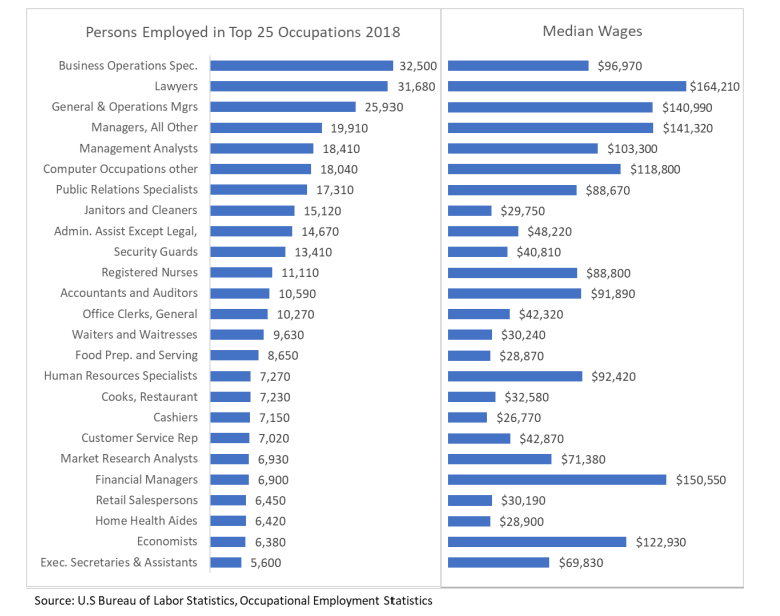
Silverman says her system enabled her to have higher wages for all staff, while Initiative 82 only raises wages for tipped workers like bartenders and servers — not the rest who aren’t, namely kitchen staff, whose earnings can be less and stagnant. In D.C., servers earn an average of $23 per hour according U.S. Department of Labor statistics, while dishwashers, often referred to as a restaurant’s backbone, earn an average of $16.61.
“Service charge is really the only way you can do it if you want to pay them a higher hourly wage,” Silverman says, adding patrons are less likely to balk at that than a pricier menu.
Cane and St. James owner Jeanine Prime agrees, saying “I think sometimes it’s hard for diners to reconcile a price they see on a menu with what they think the main ingredients cost.” She also believes a service charge is more transparent because her business tells patrons exactly where the dollars go, which is to pay workers a living wage.
Both owners concede their setup isn’t easy and that it would be difficult for businesses currently using a tip credit to suddenly pivot. One reason is that, unlike tips, service charges count toward sales. When sales go up, so do other expenses tethered to it, like taxes and liquor liability insurance. Some restaurants even have rent connected to sales.
“Even my accountant is like, ‘Why are you doing this?’” Silverman says. “So I’m making a choice not to do as well as a business because I’m trying to pay my people more.”
Silverman is evaluating and adjusting her business every six months to make it work. She just added commission to the $18 an hour for service-facing staff to improve sales and attract talent. She says she’s struggled to hire experienced bartenders because they are accustomed to earning sometimes $40 to $50 an hour with tips. Paying her staff that much, however, would put her out of business, she says. Her business discourages patrons to tip on top of the service charge, and she estimates that only about 8% do. But with the new commissioned-based system, she says The Duck & the Peach servers can make an average of $35 to 45 an hour.
Employees fall on either side of debate
Maxwell Hawla, a bartender for the last seven and a half years, called any claims of service charges becoming the norm should 82 pass “bullshit.”
“That was a big scare tactic [from the restaurant industry] back during 77 as well,” Hawla says. “I was against Initiative 77 because I was falsely under the impression that 77 would have mandated a service charge on all checks and they would all go to the house and people would stop tipping on top of that.”
Hawla says he gleaned those views from his management. He started to reassess during the pandemic, however — a time when people couldn’t tip because businesses were closed or when some would unreliably tip because they were bothered by safety protocols.
Hawla did a 180-degree turn after a trip to Washington state, one of the few states that have historically prohibited the tipped wage system. He says he saw a robust restaurant scene where workers get tips on top of the state’s minimum wage, with no added service charge. “People just tip on top because this is the United States, we are a tipping culture,” he says.
Hector Hernandez has worked in the restaurant industry for over a decade, starting as a dishwasher and now as a server at Mandu and bartender at Little Miss Whiskey’s, and he worries about a post-Initiative 82 future. He doesn’t think patrons will tip if they know he’s earning at least minimum wage, or if his work adds a service charge — or at least not to the degree they’re tipping now.
On a “really good weekend,” he says he can earn enough to afford half of his $1721 in rent and that he’s “straight up leaving” the industry if Initiative 82 passes. He’s concerned he’d no longer be able to afford to live in Columbia Heights, where he grew up.
Jordyn Barone, who currently works three part-time service jobs, sees more workers gaining stability if Initiative 82 passes.
“I guess I theoretically get why they do it,” Barone says of businesses that use tip credit. “But the idea of the customers essentially paying their salary as opposed to the place you work is kind of insane.”
Barone typically makes the most at a restaurant that doesn’t rely on tip credit, and which pays her $26 an hour, as compared to a comedy club and brewery that pays her $5.35 an hour plus tips. The restaurant has a service charge that goes toward workers’ pay and benefits, she says.
“People don’t tip all the time,” says Barone, 33, who’s worked either part- or full-time as a server since she was 14 years old. “Which is why I just like don’t trust people to tip at all. … I’m just a little jaded.”
Just last week, Barone says a regular at the brewery spent $50 and didn’t leave a tip. She’s inclined to work full time at the restaurant, where she would earn $54,000 annually if she decided to become a salary worker there, plus a likely $200 monthly bonus and benefits.
The restaurant’s annual salary is comparable to what she earned working for nearly a decade at the Smithsonian Institution, which required a master’s degree. She recently quit her office job to work full time in the restaurant industry.
“That speaks more to how underpaid people are in all walks of life,” says Barone.
This post has been updated to correct an editing error: The Duck & the Peach workers earn at least $18 an hour.