Callan Tansill-Suddath
Puedes leer este artículo en español aquí.
In a state where registered Democrats outnumber Republicans 2 to 1, many of the main contests happened in the primary. In Prince George’s County, for example, most of the countywide races in the general election are Democrats running unopposed. But you’ll find plenty of interesting races and referendums on your ballot.
At WAMU/DCist, our coverage area is the Washington metropolitan region, which includes Prince George’s and Montgomery counties. We’ve focused on the three statewide contests (governor, attorney general and comptroller), statewide ballot measures, and congressional level races for the Washington region, as well as highlights from county races in Prince George’s and Montgomery Counties.
Top issues
An October poll conducted by the Washington Post and the University of Maryland found that the economy was overall the top issue for voters in Maryland. “Threats to democracy” was second, with crime coming in third. However, those issues did not break down evenly along party lines. The economy was the top concern for 43% of Dan Cox supporters, but only 16% of those supporting Democrat Wes Moore. More than a quarter of Democrats cite “threats to democracy” as their top issue, while just 8 percent of Republicans say the same. Concerns about crime were more evenly split between the two parties.
Education, abortion, and taxes followed as issues voters care about. During the past few months, as more conservative states have enacted restrictive abortion laws and loosened gun restrictions, Maryland passed a bill that will expand abortion access and (with bipartisan support) banned ghost guns in the state.
Maryland voters will also be asked to decide on their November ballot whether to legalize recreational marijuana for adults 21 and over. The Post-UMD poll confirms earlier polling, finding that nearly three-quarters of voters support legalizing recreational marijuana.
Governor – Attorney General – Comptroller – U.S. Senate – U.S. Congress – Statewide Ballot Measures – Montgomery County Countywide Races – Montgomery County Council –Montgomery County Board of Education – Prince George’s County – Prince George’s County Council – Prince George’s County Board of Education
Voting in Maryland
Before heading to the polls, check your registration status on the state Board of Elections website. There, you can also find your voting districts (which may have changed after redistricting) and view a sample ballot. Another handy tool is Ballotpedia’s sample ballot lookup.
You can request a mail-in ballot online until Nov. 1, which then must be returned in person or postmarked by election day.
All ballot drop boxes across Maryland are now operational. Find ballot drop box locations in Montgomery County here, and Prince George’s County here.
If you aren’t registered yet, you have until Oct. 18, and can do so online at the state Board of Elections website, or same-day at an early voting site.
In-person early voting is Oct. 27 – Nov. 3, 2022, 7 a.m. to 8 p.m. You can find a list of early voting centers for Prince George’s County here, and Montgomery County here. On the Montgomery County Board of Elections website, you can find your polling place. For Prince Georgians, find that and other useful voter information here.
Statewide races
Governor
Dan Cox and Gordana Schifanelli (R)
Wes Moore and Aruna Miller (D)
David Lashar and Christiana Logansmith (L)
Nancy Wallace and Patrick Elder (G)
David Harding and Cathy White (Working Class Party)
Kyle Sefcik (I-Write-in)
The state has long been predictably blue in presidential elections, but Maryland voters have shown an independent streak when choosing their governor. Currently, Republican Larry Hogan is finishing out his second term and is one of the country’s most popular governors. Hogan won as a moderate by focusing on economic issues, appealing to independents and even many Democrats.
The current matchup features not a moderate, but Trump-aligned Republican state Delegate Dan Cox. In the primary, the Democratic Governors Association poured $1 million into ads boosting Cox, assuming the far-right candidate would face an uphill battle in November. He’ll face non-profit executive and bestselling author Wes Moore. The two candidates meet for a televised debate on Oct. 12 on Maryland Public Television.
Republican Dan Cox says he is running to “restore freedom to the free state.” This proudly right-wing candidate has been endorsed by former President Trump. (Cox organized a group to go to the Capitol on Jan. 6, 2021 to support Trump in his claims the 2020 election was stolen.) Crime is a top issue for Cox, and he says he would push to double the pay of police to address public safety. Cox promises to lower taxes, increase funding for state police and expand collaboration with ICE, enact a constitutional carry policy, and remove critical race theory from public schools. While Cox appeared to be moderating some of his positions ahead of the general election, including deleting his account on the far-right social media platform Gab, he is still closely aligning himself with Trump, who will hold a fundraiser for him at Mar-A-Lago. Cox’s running mate, Gordana Schifanelli, is an attorney and former law professor. Her husband is a disabled veteran. She is an immigrant, having come to the U.S. from war-torn Yugoslavia in the 90s, where she has “seen the evils of communism unfold before my eyes.”
Despite Republican Dan Cox’s promises to support law enforcement, the generally conservative Maryland Fraternal Order of Police, the state’s largest police union, surprised many by endorsing Wes Moore.
Democrat Wes Moore, a first-time candidate for office, beat out former U.S. Secretary of Labor Tom Perez and eight other candidates in a crowded Democratic primary. He is a Marine Corps veteran, bestselling author, a Rhodes Scholar, and the former CEO of the anti-poverty organization Robin Hood. Moore promises to raise the minimum wage to $15 per hour by 2023, fully fund the Blueprint for Maryland’s Future, set limits on prescription drug prices, enshrine the right to an abortion in the state Constitution, and expand access to mental health services. Moore also plans to convert the state’s fleet to electric vehicles by 2030, expand public transit, legalize cannabis and expunge the records of those convicted of simple possession.
Moore’s running mate, Aruna Miller, spent eight years in the Maryland House of Delegates representing Montgomery County, where she focused on STEM education, support for working families and cutting bureaucratic red tape for small businesses. Her other issues included the environment and help for survivors of domestic abuse. She also worked for Montgomery County in transportation for twenty-five years.
Third-party candidates
Third-party tickets for governor include Libertarian candidates David Lashar and running mate Christiana Logansmith. Lashar promotes his ticket as an alternative to the two major parties, and the promotion of libertarian solutions, including legalizing drugs, more school choice, tax relief, and term limits for all branches of government.
Green Party candidate Nancy Wallace and running mate Patrick Elder promote the need for a “major economic transformation” around renewable energy and green jobs. She also says she would promote social justice and a single-payer health care system. She is a former environmental lobbyist.
Working Class Party candidates David Harding and Cathy White worked to gather signatures in order to certify the Working Class Party in Maryland in 2020. Harding says the two major parties have failed the working class, and in order to make real change, working class people a party to represent their interests and to gain access to the wealth they produce. Harding spent years working in various jobs, including in shipyards and as a steelworker. White worked in a photofinishing factory for the past 35 years.
Independent candidate Kyle Sefcik did not make the ballot and is running as a write-in candidate.
Attorney General
Anthony Brown (D); Michael Peroutka (R)
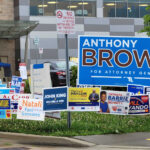
Anthony Brown represents Maryland’s 4th District in Congress. He was the state’s lieutenant governor for two terms, after which he ran for governor and lost to Republican Larry Hogan. In his run for Attorney General, he says his focus is on justice and equity, including expanding voting access and decriminalizing cannabis at a federal level. He wants Maryland to be a “backstop of the nation” when it comes to abortion rights, and supports mandating background checks for firearm purchases.
His opponent, Republican Michael Peroutka, is a former Anne Arundel councilmember who ran for president in 2004 with the Constitution Party, which promoted conservative Christian values. He says he’s running because the pandemic engendered extreme government overreach and infringement on personal rights, including the right to gather and worship. If elected, Peroutka says he would focus on election integrity, including investigating “recent anomalies” in Maryland’s elections. He is a staunch advocate of gun rights, and he believes abortion is murder and “against the law of God,” and thus unconstitutional. He does not assert the 2020 election was stolen, but says “we don’t know.”
Comptroller
Brooke Lierman (D); Barry Glassman (R)
The comptroller is the chief financial officer for the state, overseeing tax collection and the appropriations for state agencies. Maryland is one of just 19 states with an elected comptroller, and one of only ten with a partisan comptroller. Current comptroller Democrat Peter Franchot has been in the role since 2006; he ran this year for governor, losing in the primary and leaving the comptroller race wide open.
Democrat Brooke Lierman is a civil rights attorney who has been a state Delegate since 2015. She has served on the Appropriations Committee and chaired the Joint Committee on Pensions. Throughout her campaign, Lierman has emphasized that she wants the role of comptroller to be seen as an advocate for residents. Her website says she plans to “reimagine what the Comptroller’s office can do to help ensure financially stable families, growing businesses, and thriving communities.”
Republican Barry Glassman has been County Executive of Harford County since 2014. He has served in the Maryland General Assembly, as a delegate and a state senator. From the start, he has distanced himself from the far-right ideology of fellow Republican Dan Cox. Instead, he touts his endorsement from Gov. Hogan, and cites his decades of experience in government and his appeal to rural Marylanders.
Statewide ballot measures
There are five proposed constitutional amendments that will appear on the ballots of every Marylander. Question 4 has gotten the most attention. If passed, it would legalize recreational marijuana for adults 21 and over and would task the General Assembly with setting up a system to tax and regulate sales. Polling has consistently shown Marylanders are on board; a recent Washington Post/UMD poll shows nearly three-quarters of voters support legalization. The state legalized medical marijuana in 2013, but stumbled over racial equity in the licensing process. Lawmakers have vowed to do better this time around. Here’s the full list of referendum questions and what they mean:
Question 1: Would rename the Maryland Court of Appeals to the Supreme Court of Maryland and the Maryland Court of Special Appeals to the Appellate Court of Maryland.
Question 2: Voting “yes” means you support requiring state legislators reside primarily in the district in which they wish to represent for six months prior to the date of election starting in 2024.
Question 3: Increases the amount of money a plaintiff seeks in civil proceedings in which the right to a jury trial may be limited by legislation from $15,000 to $25,000.
Question 4: Answering yes on this question means you support amending the state constitution to legalize adult-use recreational marijuana and direct the legislature to pass law for the use, distribution, regulation, and taxation of marijuana.
Question 5: The Howard County Circuit Court would require judges to serve on the Orphans’ Court.
U.S. Congress
There are eight congressional districts in Maryland; we focused on the Washington region, including those incorporating areas of Montgomery and Prince George’s Counties. After redistricting, your representative and district may have changed. (The 3rd district, for example, long represented by John Sarbanes, no longer has portions of Montgomery County.) You can check your district here.
Maryland’s 4th congressional district
Glenn Ivey (D); Jeff Warner (R)
Republican Jeff Warner describes himself as a “public servant, not a politician.” He cites skyrocketing inflation and gas prices, and the need to improve the economy, which he says can’t be done through government subsidies. Warner connects rising crime and homicide rates to efforts to defund the police. He feels the nation needs to return to its “spiritual foundation as a nation.” He notes his is a military family, his wife having served as a nurse in the Army.
Democrat Glen Ivey says he’ll bring strong leadership, with a focus on creating well-paying jobs, access to affordable healthcare, and making the criminal justice system more just. Ivey is well-known in Prince George’s County, previously having served as State’s Attorney. He’s also had a number of advisory roles to members of Congress, as well serving as an assistant U.S. Attorney in Attorney General Eric Holder’s office.
Maryland’s 5th congressional district
Steny Hoyer (D) (incumbent); Chris Palombi (R)
Maryland’s 5th district includes St. Mary’s and Calvert counties, as well as portions of Prince George’s and Anne Arundel counties. Democrat Steny Hoyer has represented Maryland’s 5th congressional district since 1981 and has served as the House Majority leader since 2019. He’s a proponent of stronger gun safety laws, and has sponsored background check bills. He wants to promote racial justice and equity, and he has been a strong advocate for federal workers. He leads an agenda in Congress called Make it in America, which launched in 2010 to promote job growth and recovery after the Great Recession.
His challenger, Republican Chris Palombi, is a former U.S. Capitol police officer. Palombi currently works in a high school overseeing technology, as well as teaching and coaching. Palombi advocates free-market principles and pro-growth policies. He says a bi-partisan immigration reform bill is needed to address border security and process the backlog of applications. He is concerned about the debt and inflation and says Congress must balance the budget. He believes term limits for Congress would increase accountability and put an end to ‘career politicians.’ He strongly supports the Second Amendment, and says the current handling of immigration at the border is making Americans less safe. He believes the Affordable Care Act led to overregulation and higher healthcare costs.
Maryland’s 6th congressional district
David Trone (D) (incumbent); Neil Parrott (R); David August (I)
This newly redrawn district now includes more conservative Frederick County and less of heavily Democratic Montgomery County. It also incorporates a corner of western Maryland, which is also more Republican-leaning.
Republican Neil Parrott, currently a state Delegate, is hoping a more conservative demographic might offer the chance to unseat incumbent David Trone in this newly redrawn district. Parrot is anti-abortion, and he opposes vaccine mandates. He’s in favor of parental control of education, and he’s a strong supporter of gun rights.
Democrat David Trone is not only the incumbent in this race; he has pockets deep enough to have poured $10 million of his own money into his primary campaign earlier this year. He touts being on the powerful House Appropriations Committee and getting funding to expand access to broadband. His priorities include universal pre-K education and closing the achievement gap, gun safety laws (including background checks and banning assault rifles), criminal justice reform, and abortion rights. Independent candidate David August doesn’t appear to have a campaign Website, but on Twitter he has advocated for cutting federal spending and reducing the deficit, and simplifying the tax code. He points to inflation and high gas prices, saying government “handouts” are not the answer, but part of the problem.
Maryland’s 8th congressional district
Jamie Raskin (D) (incumbent); Gregory Coll (R); Andrés Garcia (L)
This district includes portions of Montgomery County, including Takoma Park, where Democratic incumbent Rep. Jamie Raskin lives. Raskin became nationally known for his involvement with the U.S. House Select Committee to investigate the January 6 2021 attack on the Capitol. Before running for Congress, Raskin was a three-term state Senator in Annapolis. In July, Raskin won his primary with nearly 94% of the vote. The outspoken liberal Democrat advocates for affordable housing, expanded transit options, and combating climate change.
Republican Gregory Coll is a rocket scientist who supports reducing taxes, increasing funding to the military, supporting police officers, and removing critical race theory from school curriculums.(Critical race theory is not currently taught in public schools.)
Libertarian Andrés Garcia was in the software industry as a federal contractor, where he says he saw firsthand the problem of government waste. He touts having “no political experience, establishment connections or personal wealth to fund a run for office.” He is the child of Colombian immigrants, and he says it taught him to value the opportunities he had here. He is running on a platform of reducing taxes and lowering spending.
U.S. Senate
Each state has two U.S. Senators in Congress serving six-year terms elected on a staggered schedule. In Maryland, Sen. Chris Van Hollen is up for re-election in November; Maryland Sen. Ben Cardin won’t be up for re-election until 2024.
Chris Van Hollen (D) (incumbent); Chris Chaffee (R)
Democratic Senator Chris Van Hollen is running for a second term. In 2018, he succeeded longtime Maryland Senator (and noted glass ceiling-breaker) Barbara Mikulski. Van Hollen previously served as the U.S. Representative for Maryland’s 8th congressional district. Van Hollen talks up his experience, including serving on the powerful Senate Appropriations Committee and touting his role in passing Build Back Better, the massive funding package aimed at supporting universal early education, affordable child care, and tax cuts for middle and lower income families.
Republican Chris Chaffee has thrown his hat in the ring for various races in Maryland over the past decade, including previous runs for Congress. His priorities include tax reform, a smaller, more efficient government, and support of Second Amendment rights. His campaign signs read “Keep your faith. Fight for freedom. Save the unborn.” At publishing, Chaffee does not have a campaign website, but he is active on Twitter and Facebook.
Montgomery County
Montgomery is the most populous county in Maryland, and registered Democrats outnumber Republicans 4 to 1. Some of the fiercest contests happened in the crowded primaries. In addition to countywide races noted here, there are a handful of smaller local races and initiatives you may see on your ballot.
General Assembly
At the state level, Montgomery County is represented by eight state senators, one for each Legislative district, and 24 delegates (three per district.) The Montgomery County incumbent state Senators – all of whom are Democrats – won their primary elections. You can find out which district you are in and who your candidates are by entering your address here.
Montgomery County Executive
Marc Elrich (D) (incumbent); Reardon Sullivan (R)
The July primary featured a rematch between incumbent Marc Elrich and challenger David Blair. What was a close matchup four years ago with Elrich eking out just 80 more votes narrowed further, in a race so close it led to a recount which Elrich won by just 32 votes. Marc Elrich, a Democrat from Takoma Park, touts his progressive bona fides, his years on the Montgomery County Council, and his leadership during the pandemic, including achieving the state’s highest vaccination rates. He cites his long history as an affordable housing advocate, and he touts having created the county’s first Chief Equity Officer. He removed school resource officers from county schools, the first county in Maryland to do so (though a year later, amid pushback and a rise in youth violence, SROs were replaced with Community Engagement Officers). Elrich is frequently at odds with the county council, particularly over THRIVE 2050, the county’s general plan and blueprint for its growth over the next 30 years. He has said the process was not undertaken with enough transparency and cites concerns about increased density that might allow lawmakers to rezone areas currently designated for single-family homes.
The passionate divide over development among Democrats and the fact that Elrich beat his Democratic rival David Blair by a mere 35 votes is how Republican Reardon Sullivan hopes to prevail in the race. Sullivan, who lives in Gaithersburg, founded and heads an engineering consulting firm in Rockville. In 2021, he served as chairman of the Montgomery County Republican Party. His top three issues are invigorating the county’s economy, increasing public safety, and improving transportation. The county’s economy, he says, has lagged behind neighboring jurisdictions, including Prince George’s County and Northern Virginia, and he faults policies enacted by the current county leadership. Sullivan would also increase funding for law enforcement and reinstate school resource officers in county schools.
Montgomery County Council
The county’s new district map, drawn by a bi-partisan group of citizens, added two seats to the council and changed some district boundaries. One of the bigger changes on the new map involved shifting North Bethesda to District 4, which also includes Takoma Park and Silver Spring. Some North Bethesda residents objected to the change, preferring to be in the same district as Rockville or Bethesda. The total number of councilmembers is now 11, with seven district representatives and four at-large members. You can check the county’s official voter guide and voter lookup tool, to see if your district has changed.
At-Large Council Races
Montgomery County residents vote for up to four candidates.
Gabe Albornoz (D) (incumbent); Evan Glass (D) (incumbent); Will Jawando (D)(incumbent); Laurie-Anne Sayles (D); Christopher P. Fiotes (R); Lenard Lieber (R) ; Dwight Patel (R); Dan Robinson (G)
At-Large members of the council represent the entire county. Three of the four incumbent At-Large councilmembers – Gabe Albornoz, Evan Glass, and Will Jawando – won their primary elections to retain their seats. The fourth incumbent, Hans Riemer, ran for County Executive (he lost in the primary).
Elected in 2018, Gabe Albornoz currently serves as Council president and chairs the Health and Human Services Committee. He channels this experience specifically in his reelection bid by highlighting the number of residents who continue to feel the impacts of COVID-19 on their daily lives. Albornoz’s platform includes strengthening the county’s public and mental health resources, particularly for communities of color, striking a balance between meaningful police reform and keeping communities safe, and expanding residents’ access to both transportation and affordable housing.
Evan Glass currently serves as the Council vice president and is its first openly LGBTQ+ member. He serves on the Transportation and Environment Committee and is the Council’s Lead for Homelessness and Vulnerable Communities. All of the campaign priorities listed on Glass’ website build on past accomplishments. He cites a desire to do more work toward achieving pay equity and Vision Zero programs – which aim to eliminate traffic deaths – within the county.
Will Jawando, also elected for the first time in 2018, serves on the Education & Culture committee, where he works on issues related to schools, the arts and humanities, and public libraries. On the Planning, Housing, and Economic Development (PHED) committee, Jawando works, among other things, on zoning and urban planning. The top three issues highlighted by Jawando’s platform are increasing affordable housing, addressing education and youth mental health challenges exacerbated by COVID-19, and preparing better for the effects of climate change.
Republican Christopher Fiotes is a Navy veteran and business owner who formerly worked in the U.S. Senate. His chief priorities are making the county more business-friendly by reducing taxes and controlling spending, preserving agricultural resources, and making the county more affordable.
Democrat Laurie-Anne Sayles is a former member of the Gaithersburg City Council. Sayles would not only be the only female at-large councilmember, but she also hails from upcounty, which many residents say needs more representation in county government. Sayles’ policy plan is laid out on her website using the acronym S.M.A.R.T. Her priorities are “strengthening 21st century learning from cradle to career and beyond, making a living in Montgomery County more affordable, advancing sustainable local food production in the Ag Reserve, revitalizing the economy while recovering from the pandemic, [and] tackling climate change through multi-modal transportation infrastructure.”
Republican Lenard Lieber’s chief reason for running for county council is because he objects to the handling of the COVID-19 pandemic, namely vaccine mandates. Based on a survey he completed for The Duckpin, he ascribes to a number of alt-right ideas, including that President Joe Biden was not legitimately elected. He is active on Twitter under the username @PurplePursuer.
Republican Dwight Patel, who owns Bethesda Architects, is a longtime member of the Montgomery County Republican Central Committee. His concise list of campaign priorities includes “kids-first education; road and highway funding; law & order; lower taxes; help businesses succeed.”
Green Party candidate Dan Robinson is a former two-term Takoma Park councilmember. His campaign priorities focus on the environment and combatting climate change. He supports the country’s planning proposal, THRIVE 2050, and wants to change zoning codes to build more affordable housing. Above all, he believes voters are being disenfranchised by a two-party system.
Montgomery County Council – District 1
Andrew Friedson (D); unopposed
Andrew Friedson ran unopposed in his primary and is poised to maintain the District 1 seat on the council, which he has held since 2018. His priorities for the next four years are to attract more businesses to the county, create more affordable housing and living conditions for residents, and modernizing government and public services. District 1 includes most of Bethesda, Chevy Chase, and Travilah, as well as all of Cabin John, Glen Echo, Potomac, and the Maryland side of the Palisades.
Montgomery County Council – District 2
Marilyn Balcombe (D); Dan Cuda (R)
Marilyn Balcombe bested two other candidates by wide margins during the primary election to win the Democratic nomination for the District 2 Seat, likely succeeding term-limited Craig Rice. She has served as President and CEO of the Gaithersburg-Germantown Chamber of Commerce for 17 years, and cites improving public schools and housing access as top campaign priorities.
Dan Cuda is a military veteran whose chief focuses are on job growth and community safety.
District 2 includes most of the areas referred to as upcounty. These include Barnesville, Beallsville, Boyds, part of Cedar Grove, Clarksburg, Darnestown, Dickerson, Germantown and Poolesville. Part of North Potomac and Travilah are also included in District 2.
Montgomery County Council – District 3
Sidney Katz (D); George Hernandez (R)
Incumbent Sidney Katz is likely to retain the District 3 Council seat for a third term. The lifelong Gaithersburg resident served on the Gaithersburg City Council, later becoming mayor of the city. Among Katz’ top priorities are advocating for seniors, and improving the county’s economy; he worked on legislation to raise the minimum wage to $15.
His challenger, Republican George Hernandez, offers little information on his campaign website but says he wants to lower county taxes, fully fund and support police and crime victims, and prioritize STEM education.
District 3 includes all of Gaithersburg, Rockville, and Washington Grove, and parts of Darnestown, and North Potomac.
Montgomery County Council – District 4
Kate Stewart (D); Cheryl Riley (R)
If Democrat Kate Stewart wins in November, she’ll be another new face on the Council. She won the Democratic primary in District 4 left vacant by Nancy Navarro, who did not seek re-election (she ran for lieutenant governor alongside Rushern Baker, losing in the primary). Stewart has been the mayor of Takoma Park since 2015. She works in communications at ConwayStrategic, where she focuses on reproductive rights.
Cheryl Riley, describes herself as “not a politician” and says her goal is to reunite the people of Montgomery County. She wants to “restore” the economy, “reverse the destruction” caused by the current County Council, and improve community safety. She is against THRIVE 2050, and mask mandates; she wants to abolish diversity training for police officers, and wants to remove critical race theory from public school curricula (critical race theory is not currently taught in public schools.)
District 4 includes parts of Bethesda, Chevy Chase, Garrett Park, Kensington, Long Branch, North Bethesda, Silver Spring, West Silver Spring, and Takoma Park.
Montgomery County Council – District 5
Kristen Mink (D); Kate Woody (R)
Republican Kate Woody is running on a platform of supporting small businesses and encouraging smaller government. She wants to fully fund police, but hire them locally and she opposes THRIVE 2050.
Democrat Kristin Mink dominated the crowded primary field to secure the Democratic nomination for District 5, the only one in the county to have a plurality of Black residents, left vacant by Tom Hucker, who ran for governor. Mink is a former teacher in MCPS who currently serves as a Senior Legislative Organizer for the Center for Popular Democracy. Mink’s platform includes many of the progressive housing and environmental policies of her co-candidates, but she also highlights fighting to make pre-K universal, growing labor unions, and has a slew of plans to make abortion care more accessible.
District 5 includes parts of Bel Pre and Strathmore, Burtonsville, Calverton, Colesville, Cloverly, Fairland, four corners, Hillandale, Layhill, leisure world, northwest park, Spencerville, White Oak, and most areas on the northeast side of the county that border Prince George’s County.
Montgomery County Council – District 6
Natali Fani Gonzalez (D); Viet Doan (R)
Running for one of the two new districts, District 6, Democrat Natali Fani Gonzalez secured more than 56% of the vote in a pool of 8 candidates and was endorsed by a slew of progressive organizations, labor unions, and the Washington Post to potentially become the first District 6 Councilmember. She formerly served as the vice chair of the Montgomery County Park and Planning Commission and on the Montgomery County Planning Board.
Republican Viet Doan’s main priority pertains to reevaluating parts of THRIVE 2050 before going ahead with the plan. He says certain environmental protections, confirmed growth for schools, and greater transparency before it is put into place. This is the only concrete policy highlighted on his website.
District 6 includes Aspen Hill, Forest Glen, Glenmont, Kemp Mill, Rock Creek, and Wheaton.
Montgomery County Council – District 7
Dawn Luedtke (D); Harold Maldonado (R)
Republican Harold Maldonado’s platform prioritizes “fixing” the economy above all else, and says the budget for police and school resource officers should be increased. He voices concerns about LGBTQ+-inclusive curricula in schools.
Democrat Dawn Luedtke works in the office of the Attorney General in Baltimore. Luedtke says she wants to use her experience as a first-generation college student to elevate the needs of public school students, and her experience as a certified law enforcement trainer to craft nuanced public safety legislation. She has also voiced a specific interest in working to expand upon existing transit legislation with a focus on pedestrian safety in her district. Her husband is state Del. Eric Luedtke.
District 7 includes the Northernmost parts of the county, as well as Ashton, Brookeville, Brighton, part of Cedar Grove, Damascus, Derwood, Goshen, Laytonsville, Montgomery Village, Mt. Airy, Norbeck, Norwood, Olney, Upper Rock Creek, and Woodbine.
Montgomery County Board of Education
Montgomery County voters will elect four members to the school board in November’s election, one At-Large member and members representing Districts 1, 3 and 5. School board races are non-partisan.
Montgomery County Board of Education At-Large
Karla Silvestre (incumbent); Mike Erickson
Karla Silvestre has spent her entire career devoted to education and currently works as the Director of Community Engagement at Montgomery College. She has experience working with a diverse array of student communities including at-risk youth and non-native English speakers. She told The Washington Post in July she values social workers and other mental health support staff over police in schools in order to keep all students–some of whom may have faced police violence in the past–feel safe, but says law enforcement is needed in the event of violent crime. She feels higher salaries, more support, and better benefits are needed to retain teachers.
At publishing, Mike Erickson has no campaign website and has not responded to a request for comment via phone or email.
Montgomery County Board of Education District 1
Grace Rivera-Oven; Esther Wells
Grace Rivera-Oven’s platform builds on her experience as the founder and CEO of UpCounty Hub, a nonprofit organization that tackles food insecurity in northern Montgomery County. She wants to end student lunch debt and shift the Board’s primary focus to Title 1 schools, where low-income families comprise at least 40% of enrollment. She is against the installation of school resource officers and wants to prioritize student mental health, particularly during the COVID-19 pandemic.
Esther Wells, an accountant, is the mother of a special needs son and is using that experience to help shape her approach should she land a seat on the Board of Education. Some of the ideas she brings to the table, she told The Washington Post, are flexible school times (including Saturday school), security services that utilize technology, and teacher mentoring programs. Wells says her extensive business experience has given her the tools needed to be a fiscally nuanced leader.
Montgomery County Board of Education District 3
Scott Joftus (incumbent); Julie Yang
Scott Joftus was appointed to the seat in Dec. 2021 after the death of Patricia O’Neill, who served on the Board for more than two decades, the previous Sept. Joftus is an educator and the co-founder and president of FourPoint Education Partners, an education consulting firm. He wants to expand students’ access to educational opportunities. He favors the shift to Community Engagement Officers in schools over School Resource Officers, and he supports the Blueprint for Maryland’s Future.
Julie Yang has taught at various levels within and outside of MCPS and has worked as a college and career counselor. Among her top issues are recruiting and retaining staff, addressing mental health issues for students and staff, and mitigating the impacts of COVID learning disruption. She wants to expand STEM learning and internship opportunities. She believes police should not be involved in disciplining students.
Montgomery County Board of Education District 5
Brenda Wolff (incumbent); Valerie Coll
Brenda Wolff spent much of her career with the U.S. Department of Education and the National Assessment of Educational Progress before becoming a member of the Board of Education; this would be her second term. Wolff is running on a platform to prioritize equal access to a quality education, close opportunity gaps, offering more mental health support options, and making pre-k universal for 4 year olds.
Valerie Coll taught elementary school in MCPS for three decades before running for a seat on the Board of Education. She says her experience as a teacher prepared her to make decisions about teaching and assessment, as well as understanding instructional, emotional and physical needs of students. Her platform highlights four main focus areas: improving communication; expanding opportunities for students and educators; more accountability and efficiency; and improving school resources.
Other races in Montgomery County:
There are a handful of other local races, including Montgomery County State’s Attorney and Montgomery County Circuit Court judge. You can find out what’s on your ballot by entering your address here.
Prince George’s County
Until recently, Prince George’s was known as the wealthiest Black majority county in the country (that honor now goes to neighboring Charles County). It is heavily Democratic, with registered Democrats outnumbering Republicans roughly 12 to 1. This means a number of races decided in the primary, and many candidates are heading into the general election unopposed, including County Executive Angela Alsobrooks and State’s Attorney Aisha Braveboy. Only one Republican is in the running for a county council seat.
As is the case for all jurisdictions, redistricting changed boundaries in many places. If you’re not prepared, you may see some names you don’t recognize on your ballot. Find your voting district and a sample ballot here.
We’ve highlighted most of the countywide races below. In addition, you may see additional local races and initiatives on your ballot.
General Assembly
Prince George’s has eight legislative districts, with 24 representatives in the Maryland House of Delegates and eight state senators in the state Senate. All serve four year terms and all are up for reelection in 2022. We aren’t able to include the dozens of General Assembly candidates in this guide, but you can find your district and see which candidates are on your ballot here.
Prince George’s County Executive
Angela Alsobrooks (D);(unopposed)
Incumbent Prince George’s County Exec. Angela Alsobrooks is a native Prince Georgian who dominated her primary race, receiving more than 90% of the vote. With no Republican in the general election, the seat is effectively hers. In 2010, Alsobrooks was the first woman elected to the office of State’s Attorney – the county’s top prosecutor – for Prince George’s County, a role she held until throwing her hat in the ring for County Executive. She is the first Black woman to hold the role of County Executive in the state. In response to an increase in violent crime and carjackings, Alsobrooks announced in September the county would begin enforcing a curfew for people under age 17 for the first time in three decades. In terms of handling the COVID-19 pandemic, Alsobrooks was generally proactive in handling the COVID-19 pandemic. At one point, however, the positivity rate in the county was the highest in the state, and vaccination rates lagged.
Alsobrooks says improving the county’s troubled public schools is a top priority. Since 2013, the schools CEO has been appointed by the county executive and run by the CEO and the school board. (Current schools CEO Monica Goldson was selected by Alsobrooks’ predecessor, Rushern Baker.) Student performance has been impacted by the pandemic, with preliminary assessments showing only slight improvement, and most students testing below grade level. Alsobrooks is a vocal supporter of the Blueprint for Maryland’s Future, which emerged from the statewide Kirwan Commission, a multi-year initiative driving policy and funding reform.
State’s Attorney
Aisha Braveboy (D) (incumbent); (unopposed)
Aisha Braveboy, a native of the county, has a long history in Maryland politics. Prior beginning as interim State’s Attorney in Dec. 2018 (then assuming the position full-time the following month,) she represented Prince George’s County in the House of Delegates for two terms. Braveboy’s current platform focuses on offering more opportunities to young people transitioning out of the criminal justice system; reducing the jail population; ensuring pre-trial detainees and inmates have the right to vote; raising awareness about domestic violence; and reducing gun violence.
Prince George’s County Council
The Prince George’s county council is poised to have a new liberal majority after July’s primaries advanced incumbents and new faces to the general election. Eric Olson, Wanika Fisher, Wala Blegay, Thomas Dernoga, Jolene Ivey, and Edward P. Burroughs III are all running unopposed and would tilt the council further to the left.
At-Large Council Races
Voters choose two At-Large candidates, so both candidates will retain their seats.
Mel Franklin (D) (incumbent); Calvin S. Hawkins Jr. (D) (incumbent)
Mel Franklin is up for his fourth consecutive term on the council. The attorney, who previously worked as the Assistant Attorney General with the state, is running on the “Empower Prince George’s” agenda includes goals focused on revitalizing public schools, criminal justice and mental health reform, offering more resources to seniors, building a new Adventist Fort Washington Hospital Center, and expanding the use of clean energy in the county.
First elected in 2018, Calvin S. Hawkins has served as a chair on the county council the last four years. He previously served as a Senior Advisor to former County Executives Rushern Baker and Wayne K Curry. Hawkins, who has been open about his past experience with the prison system, has been heavily involved with the county’s efforts to reform criminal justice, prisoner reentry, and mental health.
Prince George’s County – District 1
Tom Dernoga (D) (incumbent); (unopposed)
Tom Dernoga, the incumbent, ran unopposed and won the primary for District 1. His main vision for the county centers on “accountable, transparent government,” and in office, he worked extensively on infrastructural projects including the Laurel-Beltsville Senior Activity Center and Dinosaur Park. He has served on the council in some respect for the better part of the last 20 years. District 1 includes areas in Adelphi, Beltsville, Calverton, College Park, Laurel, Montpelier, South and West Laurel, and Vansville.
Prince George’s County – District 2
Wanika Fisher (D); (unopposed)
Wanika Fisher, an attorney who won the Democratic primary for District 2 with a little more than half the vote, was most recently in Annapolis representing legislative district 47B in the House of Representatives. As a representative, Fisher was heavily involved in legislation related to police reform and racial justice. In the county, she looks to address areas that don’t receive equal services, advance the technology available to residents, and expand parks and recreation. District 2 includes areas in Adelphi, Avondale, Brentwood, Carole Highlands, Chillum, Green Meadows, Hyattsville, Langley Park, Lewisdale, Mount Rainier, and North Brentwood.
Prince George’s County – District 3
Eric Olson (D); (unopposed)
Eric Olson, who leads a community development corporation, helped residents sue after a redistricting map was pushed through the council last year, cutting him out of the district he’d lived in for 20 years (the courts ultimately tossed the map out). Prior to that, Olson served on the College Park City Council. His priorities include continuing to prioritize COVID-19 recovery, reducing inequity among neighborhoods in the county, making areas more walkable, tackling climate change, expanding mental health resources, and decreasing racial health disparities for illnesses like heart disease and diabetes among Black Prince Georgians. He is also against the proposed construction of a Maglev train in the county. District 3 includes Berwyn Heights, College Park, Landover Hills, New Carrollton, Riverdale Park, and University Park.
Prince George’s County – District 4
Ingrid Harrison (D); (unopposed)
Ingrid S. Harrison, the Government Affairs Manager for Children’s National Hospital in D.C., began serving as an At-Large Councilmember in Bowie in 2019, served on the county Democratic Central Committee, and previously worked in outreach for the District 4 office. Harrison’s platform prioritizes attracting businesses to the county to strengthen the local economy. She also wants to strengthen schools, provide more resources to vulnerable populations, and reduce the county’s carbon footprint. District 4 includes Bowie, Glenn Dale, Greenbelt, Westchester Park, as well as parts of Lanham-Seabrook and Upper Marlboro.
Prince George’s County – District 5
Jolene Ivey (D) (incumbent); (unopposed)
Jolene Ivey, the incumbent in District 5, ran unopposed During her first term, Ivey served as Vice-Chair of the Health, Human Services, and Public Safety Committee. She previously spent time in Annapolis serving District 47 in the House of Representatives, and served as Chair of the Prince George’s County House Delegation. Ivey platforms early childhood education initiatives like home visiting programs, more resources for seniors, cleaner neighborhoods, and more public spaces.District 5 includes Accokeek, Aquasco, Brandywine, parts of Camp Springs Clinton, Croom, Eagle Harbor, Marlton, Rosaryville, and parts of Upper Marlboro.
Prince George’s County – District 6
Wala Blegay (D); (unopposed)
District 6 was the most crowded of the council races and will have its third occupant in one calendar year come November. Wala Blegay, an attorney for the D.C. Nurses Association and an adjunct professor at American University’s Washington College of Law, ran on a platform of bringing more businesses to the county, increasing the number of public services (and transit) available to residents, and community-oriented policing. District 6 includes parts of Bowie, Capitol Heights,District Heights, Forestville, Kettering, Largo, Mitchellville, and Upper Marlboro.
Prince George’s County – District 7
Krystal Oriadha (D); Gary Falls (R) Democrat
Krystal Oriadha co-founded and directs the progressive foundation PG Changemakers, and ran on a platform that resembles the organization’s priorities. Topping the list are police reform, racial and social justice, affordable housing, and education reform. Should she be elected, she would be the first openly LGBTQ+ person to sit on the council.
Republican Gary Falls is a veteran whose platform appears deeply rooted in fundamentalist Christianity; he opposes abortion and throughout his website, he espouses anti-gay and trans rhetoric. He wants to fully fund the police budget, advocates for flexible jail sentences, and wants to increase mental health services. District 7 includes Capitol Heights, District Heights, parts of Forestville, Hillcrest Heights, Marlow Heights, Morningside, parts of Oxon Hill, Seat Pleasant, Suitland, and Temple Hills.
Prince George’s County – District 8
Edward Burroughs III (D) (incumbent); (unopposed)
Edward Burroughs III, the incumbent, maintained the District 8 seat with the widest margin of any candidate who faced opposition. He initially took office in February, assuming a seat left vacant by Monique Anderson-Walker, who departed to run on Peter Franchot’s gubernatorial ticket. Previously serving as the Legislative Affairs Director to County State’s Attorney Aisha Braveboy, Burroughs ran on a platform of ending corruption at a local level, opposing a property tax increase, and revamping education. District 8 includes Andrews Air Force Base, Camp Springs, Clinton, Forest Heights, Fort Washington, Glass Manor, Marlow Heights, Oxon Hill, and Temple Hills.
Prince George’s County – District 9
Sydney Harrison (D); (unopposed)
Sydney Harrison is poised to take a second term in office representing District 9. He previously served as Clerk of the Circuit Court for the county, as well as the former Vice Chair of the Maryland Clerk’s Association, and as a member of the local Democratic Central Committee. District 9 encompasses parts of Accokeek, Aquasco, Baden, Brandywine, Cheltenham, Clinton, Croom, Eagle Harbor, Fort Washington, Joint Base Andrews, Piscataway, and Upper Marlboro.
Prince George’s County Board of Education
The Prince George’s County Board of Education has 13 members; nine are elected to four year terms by district, three are appointed by the county executive, and one is appointed by the county council. The county is debating whether to return to a fully elected school board amid infighting on the board, and legal proceedings are underway that could lead to the removal of the current chair. School board races are non-partisan. Four seats were up for election, but only one had a primary, District 6. The other seats had two candidates each, which meant both candidates automatically advanced to the general election in Districts 2, 3 and 9. Here are the candidates in those races:
Prince George’s County Board of Education District 6
Branndon D. Jackson; Ashley Kearney
Branndon D. Jackson is an economist by training who works with the Prince George’s County Workforce Development Committee. He cites as priorities equity in education; a “village approach,” with more interaction between schools and the community; and more teacher support, including higher pay and addressing capacity issues. He would also focus on addressing the technological divide.
Ashley Kearney notes she is the only candidate with classroom experience; she taught mathematics for more than a decade. She highlights her education-related board leadership and legislative experience as the Albert Einstein Distinguished Educator Fellow on Capitol Hill. Her priorities include safety, including responsible technology use, school infrastructure and more funding for facilities; community schools that include community support systems; and increased teacher support and development.
Prince George’s County Board of Education District 2
Joshua Thomas (incumbent); Jenni Pompi
Joshua Thomas is a native Prince Georgian and former Teach for America corps member who now works in corporate recruitment. He advocates a budget that allocates money directly into classrooms, prioritizes raising teacher salaries and more opportunities for professional development, and wants to involve both parents and students in decision-making. Thomas also wants to increase the number of Advanced Placement, language immersion, and vocational opportunities offered to students.
Jenni Pompi, a multimedia journalist by trade, was inspired to throw her hat in the ring for school board after serving at PTA President for Riverdale Elementary School. Pompi’s platform has three central components. She wants to upgrade and modernize the schools and facilities in District 2; she wants to attract and retain more teachers to PGCPS by offering a solid support system and competitive benefits; and she wants to develop more specialized programs to ensure students are college and career-ready.
Prince George’s County Board of Education District 3
Pamela Boozer-Strother (incumbent); Varinia Sandino
Pamela Boozer-Strother, a marketing professional, would address bullying through “restorative justice” rather than punishment. She emphasizes the importance of building communities to surround every student both in and outside of schools. She supports raising teacher salaries and providing more resources.
Varinia Sandino previously served as the Chief of Staff for Wanika Fisher when she was a State Delegate. At publishing, the candidate does not have a website.
Prince George’s County Board of Education District 9
Lolita E. Walker; Kent Roberson
Lolita E. Walker, a motivational speaker and business professional, has crafted a platform based on connection. She says she wants to create links between students of different ages, between students and teachers, and teachers and parents to “bridge the gaps,” whether they be learning loss due to the pandemic, mental health needs, or school safety needs.
Kent Roberson is a minister who works at a lobbying firm. Chief among his priorities is returning to a fully-elected school board. He also promises to create policies to ensure casino funds, which are earmarked for education, are used in addition to the governor’s proposed budgetary allocations.