Martin Austermuhle
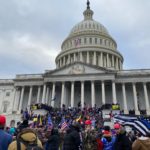
The first time I — and, by extension, much of America — heard of Mike Fanone was about a week after the Jan. 6 insurrection. Fanone, then a D.C. police officer, had been brought to a building overlooking the U.S. Capitol to speak to gathered reporters about the experience of fighting off hordes of Trump supporters as they sought to interrupt the certification of the 2020 election.
And speak he did.
In a frankness that’s unusual to find in city employees under the watchful eyes of their bosses, Fanone recounted being dragged into a crowd and threatened with his own gun; he was tased multiple times and later learned he had suffered a heart attack. He compared the day to Spartan battle and Black Hawk Down, and uttered a comment that made him something of a national folk hero.
“The ones in the crowd that somehow appealed to their better angels and offered me some assistance, thank you,” he said of Trump’s supporters. “But fuck you for being there.”
Fanone, a tattooed Virginia native with a noticeable southern drawl and tendency to drop the f-bomb, quickly became a national voice for what many police officers experienced on Jan. 6. He became a regular figure on CNN, testified to Congress, developed friendships with Joan Baez and Sean Penn, attended a Rose Garden ceremony to accept a Congressional Gold Medal on behalf of the 850 D.C. police officers who responded to the Capitol, and spent time trying to get Republican members of Congress to stop minimizing what happened that day.
Much of that, and plenty more, features in his new book, “Hold The Line: The Insurrection And One Cop’s Battle For America’s Soul.” He tells of being a rebellious local teen (with high school stints at both Georgetown Prep and Ballou in D.C.), his unconventional path to policing, and years of pursuing drug sellers and violent criminal in the city. He lays bare his opinions of Republican leaders who haven’t condemned what happened on Jan. 6, many of which he surreptitiously recorded during their meetings. (“Spineless fucks” is how he refers to the 21 Republicans who voted against the Congressional Gold Medal bill.) He also takes on many of the D.C. officials he answered to. (“Fucking disgraceful” is how he terms Mayor Muriel Bowser’s interactions with him; the D.C. Council doesn’t get much better treatment. But more on that later.)
In short, it’s exactly what you’d expect from Fanone, albeit in longform.
“I got tired of soundbite audio and trying to condense incredibly complex issues like policing, police reform, or even Jan. 6 and what was happening in our country into, you know, a three-minute interview,” he tells me. “It was frustrating for me. I’ve got a lazy Southerner’s brain. And, you know, it’s hard for me to just kind of rattle [things] off. And I’m not a professional at this. I’m not polished, as I’m sure everyone that’s familiar with me knows. But I thought I could get a different platform.”
Going long — with assistance from Reuters investigative reporter John Shiffman — gives Fanone, now gone from MPD, plenty of space to dive deeper into not just Jan. 6, but also issues of policing and the criminal justice system. And while he’s unsurprisingly unforgiving on the issue of the insurrection, he approaches the issue of policing and police reform with nuance, much of it drawn by his own experience in D.C.
The country boy-turned-punk rocker admits that he was looking for action when he joined the Metropolitan Police Department some two decades ago. “I spent my first years going balls out, drawn to the adrenaline and ego rush of pursuing and subduing suspects,” Fanone admits of his time working in the First District, which stretches from NoMa all the way to the east end of Capitol Hill. “Was I reckless at times? Yes.”
Fanone says he eventually adopted a more understanding approach to policing, opting to issue warnings instead of tickets for traffic violations (“I’d lived below the poverty line myself,” he writes), and choosing not to harass people for minor drug violations. He developed a close working relationship with Leslie Perkins, a Black transgender sex worker, and says he stewed when he saw white defendants like Marc Gersen — a Georgetown law student who sold large quantities of drugs — walk away with lighter sentences than Black suspects accused of much the same.

As the chapters pass, Fanone pulls the threads of his policing career together into a broader philosophy on the current state of policing and criminal justice:
I believe that Black lives matter and that criminals like Derek Chauvin deserve to go to prison for a very, very long time. I believe that crime and police brutality have roots in systemic poverty and racism. I believe police need to be more transparent and release body-cam footage as soon as possible after an officer-involved shooting. But the answer to these problems is not to “defund the police.” That’s about the dumbest fucking thing we can do. The reality is that when you reduce a police department’s budget, the pencil pushers cut training because it’s among the easiest things to cut. It’s what happened in my department.
When we chatted, Fanone dove deeper into these points. He believes that the spike in homicides D.C. is now seeing is in part caused by police officers being more hesitant and less proactive in the wake of the racial justice protests of 2020; he also faults the D.C. Council for not supporting the department. He says lawmakers “listen to the loudest voices in the room that didn’t necessarily represent the majority.” He concedes that MPD “has a long way to go to becoming truly transparent and accountable to the communities,” but adds that elected officials have to do a better job facilitating conversations.
“The future of policing in America is like the future of pretty much everything else in America. Unless we can stop being so polarized and start communicating in an honest way… politicians need to do a much better job of facilitating constructive conversations,” he says.
But it’s readily apparent Fanone doesn’t think those conversations will happen, whether it’s around policing or Jan. 6. And that’s in large part because of politicians, many of whom Fanone criticizes harshly in the book. While he reserves much of his fire for Republicans who continue to downplay what happened on Jan. 6, he also says the city’s elected leaders have shied away from tough conversations on crime, public safety, and policing.
In one revealing passage in the book, Fanone says an unidentified D.C. councilmember confided in him that “people hate the police in Washington, D.C.,” and that it would be “politically disastrous for any one of us on the city council to acknowledge the performance of MPD on Jan. 6.” (The councilmember in question told me that they did speak to Fanone, but deny saying what he claims they did. The council did eventually approve a resolution commending MPD for its actions.)
Fanone also says he did not receive “so much as a fucking handwritten note, text message, or phone call” from Bowser after the insurrection, which he calls “fucking disgraceful.” Bowser’s office did not respond to questions about these claims, which is not the only time Fanone takes aim at the city’s executive in the book. (He says her “image-obsessed aides” eventually pressured MPD to limit his media appearances, and refused to share footage from his body-worn camera with the Democratic managers of Trump’s second impeachment hearing.)
“Chief [Robert] Contee has always been incredibly supportive, at least privately,” Fanone told me. “And, you know, I respect the constraints that his job places on him. But to say that the city council and the mayor’s office were supportive would just be an out-and-out lie.”
But where the issues of police reform and Jan. 6 come together is in police unions, which Fanone holds in even lower regard than he does many politicians. In a chapter titled “Betrayal,” he recounts attending a D.C. meeting of national and local union leaders and pointedly asking why they’d been so reluctant to criticize Republicans playing down the attacks on police on Jan. 6. Fanone says he was pulled aside by Gregg Pemberton, chairman of the D.C. Police Union, which represents the city’s police officers. Pemberton told him that he couldn’t say much publicly on Fanone’s behalf, largely because many of the city’s police officers support Trump. (In a statement to Politico, Pemberton declined to directly address Fanone’s accusations.)
It was partly those pro-Trump leanings that ultimately drove Fanone out of MPD, he tells me. “I realized that my job [had] become untenable. I’m not going to continue to subject myself to the hallway whispers and officers disparaging me behind my back. So I decided to resign,” he says.
Fanone tells me he remains angry about how things have gone for him since Jan. 6. He says he’s proud of the time he spent policing D.C., and it “sucks” that his career ended as it did. He doesn’t know what his future will bring, but he says he wants to remain a part of the conversation around reforming policing. To that end, he dedicates much of the book’s epilogue to how that can happen: instituting national standards for training, dramatically improving and ramping up firearms training for officers, eliminating arrest quotas, restoring plainclothes units, and expanding resources for mental health.
“To be successful, police leaders, politicians, and neighborhood residents must learn to exercise patience, and avoid knee-jerk reactions,” he writes.
And on the insurrection, the very event that thrust Fanone in the national limelight, he says it’s much more simple.
“To me this is not political. This is a president, albeit a Republican president, who committed crimes, and the result of those crimes was police officers, namely Metropolitan Police officers and U.S. Capitol Police officers, who were injured, some gravely, some who lost their careers and others who lost their lives,” he tells me. “His future should be determined by a jury, just like any other American.”