 Jordan Pascale
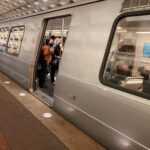
If you’ve ridden on a Metro train since Labor Day, you’ve probably noticed they’re getting more packed during peak periods.
Trains are 35% more crowded during the 8 a.m. hour and 13% more crowded during the 5 p.m. hour, Metro officials said during a Thursday board meeting. The Red Line (between NoMa and Metro Center and between Farragut North and Van Ness) and the Orange and Silver lines (between Virginia Square and Farragut West) are seeing the brunt of the crowding — despite Metro adding 1-2 extra trains during peak periods on those lines. The amount of time customers have spent on crowded trains has doubled, officials report.
But Metro says it’s running all the trains it can.
The crowding is a symptom of the year-long sidelining of the 7000-series trains. A derailment last October uncovered a wheel issue that appeared more than 50 times in recent years. The Metrorail Safety Commission removed them from service for more than half a year. They’ve now authorized Metro to run 20 of those trains at any given time, but Metro General Manager Randy Clarke said various and overlapping requirements mean Metro only can do 16 trains at once.
“Ridership is escalating quickly and we have little optionality to address that,” Clarke said Thursday. “We are focused on [bringing back 7000-series trains] all day, every day. And we’re working closely as possible with the [Washington Metrorail Safety Commission] on that.
So far, Metro has averaged about 10-12 of the newer eight-car trains per day, according to the independent MetroHero app, which tracks statistics about the Metrorail system. Metro still has no timeline for when all 93 of the new trains might return. Meanwhile, Metro is relying on shorter, six-car trains, whose limited capacity can make crowding worse.
Metro had its highest regular weekday ridership day since the pandemic Wednesday, with 308,000 riders. Wednesday is already the week’s usual busiest commute day (along with Tuesdays and Thursdays) — additionally, the Washington Capitals played their season opener downtown last night, and a convention brought more travelers to town, both of which contributed to the spike in ridership. Before the pandemic, Metro was averaging about 626,000 riders on a weekday in 2019, but was doing so with many more trains available. About 100-120 passengers crammed onto trains pre-pandemic, but that number dipped down to 50-80 people per car last November.
All these issues underscore another trend shared at Thursday’s board meeting: unhappy riders.
https://twitter.com/kriscurtiss/status/1580173586039701504
@wmata, your ad campaign is inconsistent with your service, which forces rush hour crowding. As your ad says, the solution is “obvious.” @unsuckdcmetro @better_metro 🙄 pic.twitter.com/mo3DeDiCld
— Philip Moore (@philipbmoore) October 12, 2022
Metro reports that overall rail customer satisfaction is just 69% in the last year, according to surveys. Metro hopes to have that metric at about 84%.
Clarke says he often hears riders asking for more service.
“I know our passengers are frustrated, we share their frustration,” he said. “We are doing everything we can. Ridership is only going to continue to grow. And the math will not add up. We have no more trains.”
It appears Metro wants authorization to run more trains, but it doesn’t have enough staff to manually measure the wheel movement every four days for all 93 trains, as is required by an agreement with WMSC. Metro previously measured the wheels every 90 days. Metro is also in the process of installing automatic sensors to take measurements along six places in the system, but it’s unclear when those sensors will be ready and approved for use. Metro could also request to decrease the intervals of inspection to a week or more.
Metro is hiring customer service workers to help spread people out on the platform, according to new Chief Operating Officer Brian Dwyer.
“I would say that that will be probably the best we can do,” he said. “Because with the growth in ridership we talked about today, we really are strained to do much more than that right now.”
Board Chair Paul Smedberg said running older rail cars from the 1980s could lead to other problems.
“I’m really concerned about the continued reliance on these older legacy vehicles and the safety issues that may come down if we were just continually running these cars,” he said. Clarke has said he thinks the 7000-series trains are safer, despite the wheel issue, than the older trains.
Board member Matt Letourneau expressed frustration toward the Metrorail Safety Commission, saying that crowding resulting from fewer trains is a safety issue, too.
“I know we’re looking at (safety) holistically, but I’m not so sure everyone else is,” Letourneau said.
In a statement, WMSC spokesperson Matt Smith said the commission, for its part, has offered Metro ways to increase service but has yet to hear back.
“The WMSC has highlighted paths that Metrorail could take today to run 7000 Series trains in passenger service on the Blue, Orange, and Silver lines then, based on further data, could provide for further plan revisions that could significantly increase the number of trains in passenger service,” Smith wrote. “The WMSC has not yet heard back from Metrorail on these paths or other steps that Metrorail may take to ensure that changes are only made in a controlled manner that is supported by a holistic safety process.”
Metro says it has submitted all requested data to the WMSC.