Margaret Barthel
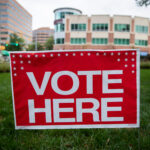
With less than three weeks until Election Day, early voter turnout in Virginia for the November midterms appears to be on pace to surpass the last midterm election in 2018, itself a comparatively high turnout year.
Early turnout is lagging a bit behind last year’s highly competitive gubernatorial race, though returned mail-in ballots are tracking similarly to 2021, per the Virginia Public Access Project.
It’s difficult to compare turnout this year to previous midterms because of significant changes in the structure of Virginia’s elections and the changing landscape of the pandemic. This is the first midterm election in Virginia since a historic expansion of early voting access in 2020, which gave voters the opportunity to cast a ballot early without an excuse and also opened up 45 days of early voting.
“We can say that early voter turnout is relatively strong,” says Stephen Farnsworth, a professor of political science at the University of Mary Washington and the Director of the university’s Center for Leadership and Media Studies. “What we can’t say, though, is just how much we can attribute the increased early voting to the new laws.”
Since expanding early voting, Virginia has had two extremely high turnout elections, in the 2020 presidential race and the 2021 statewide contests for governor, lieutenant governor, and General Assembly seats. This year, there are no state elections on the ballot, only a handful of competitive races for U.S. Congress and a few local-level contests — but, as Farnsworth points out, it’s possible that deep political divisions over the economy, abortion, and the impact of the January 6th insurrection will motivate people to participate, and to do so early.
“The reality is that the Donald Trump era has generated a huge level of interest in politics, on both sides of the aisle,” he says. “We have had over the last several election cycles, much higher turnout in this country. And early indications are that 2022 may look a lot like 2018 in terms of motivated people turning out.”
At early voting sites, voters of both parties say they’re driven by deep political divisions.
“To be blunt, it’s not really about issues. It’s about keeping the other guys out,” said Tim White, who cast a ballot for incumbent Congresswoman Jennifer Wexton, a Democrat.
Ian Griffiths, a former organized crime police officer and longtime Republican, felt differently.
“When you have access to the kind of intelligence information that we have, you kind of form some opinions about people, especially the one at the top. He belongs in prison,” he said, alluding to President Joe Biden.
“It’s such a critical year. I think it’s the most important election that I’ve ever experienced in my lifetime,” said Kristine Condie, a Wexton volunteer, who said she was concerned about election denialism and abortion access.
All of the dynamics — expansions in voter access, high political interest, a changing pandemic landscape — make it difficult to predict the likely scale of early voting this year, says Prince William County registrar Eric Olsen. It takes years, he says, to establish a sense of what the voting baseline looks like after expansions in access.
“We had this massive jump [in early voting in 2020 and 2021] where they were going to clearly slide back from. But I don’t know how far that’s going to go,” he told WAMU/DCist. “We’ve seen in most jurisdictions that it usually takes like four or five or six years to sort of build up to a plateau of how many voters are going to consistently use early voting.”
Olsen also notes that the drop-off in concern over the pandemic is another factor which could affect whether people choose to vote early or to cast their ballot on Election Day.
More than 300,000 Virginians have voted early so far, just shy of the grand total for 2018 of about 345,000. If this year repeats patterns from 2020 and 2021, early voting will pick up significantly in the last few weeks leading up to the election.
“It’s always the last few days,” says Olsen. “You see the procrastination, and then people sometimes have to wait in a line.” He encourages people to vote as early as possible to avoid possible delays.
So far, Northern Virginia early turnout overall is slightly lagging behind the rest of the state, at 45.4 votes cast per 1,000 voters compared to the commonwealth average of 50.9 per 1,000, according to data from the Virginia Public Access Project.
But Prince William County, home of parts of the competitive 7th Congressional District and somewhat competitive 10th Congressional District, is slightly above the commonwealth-wide average, at 53.5 votes per 1,000. Manassas City is also surpassing the Northern Virginia and commonwealth-wide norm.
That’s not surprising to Farnsworth.
“For people in Prince William County, whether you’re in the 7th or the 10th Congressional District, you have a competitive election to consider,” he says. “Early voting numbers are always going to be better when there is a hard-fought campaign underway.”
This year is also the first year Virginia has offered same-day registration, enabling voters to register and cast a provisional ballot anytime after the Oct. 17 voter registration deadline.
Olsen says Prince William county elections officials have had to turn away voters in previous elections who hoped to do same-day registration, which has long been available in other states. With Virginia joining the list this year, Olsen, who used to work in elections in D.C., which has same-day registration, expects a significant increase in provisional ballots as a result.
“It does really amplify the number of provisional ballots anywhere from 4 to 10 times what you would normally expect for an election,” he says. “So we are expecting, you know, thousands of provisionals this election because of all those same day registrations.”