Colleen Grablick
When Steve Descano assumed the office of Fairfax County’s commonwealth attorney two years ago, one of the first things the self-described progressive prosecutor sought to do in Virginia’s most populous county was to end cash bail.
Instead of setting an amount that an individual would have to pay to be released before trial, prosecutors would only recommend release or detainment based on an individual’s risk to community safety – an attempt to address economic and racial disparities in the legal system and reduce unnecessary detentions.
Now, nearly two years after his office formally adopted that policy, Descano’s office has released new data analyzing prosecutors’ decision-making in recommending pretrial detentions and releases. The data, which spans six months, shows that on the whole and across most charge categories, Descano’s office still recommends detention more frequently than judges actually decide to hold individuals. According to Descano, the data show room for improvement in how his office determines whether someone should, or should not be, held until their trial begins.
“I think it’s important, because I think that we are not where we want to be,” Descano told DCist/WAMU in an interview. “But I think in broad strokes, we are where the community wants us to be, and we’re, I think, doing the right thing.”
Presented on an interactive dashboard, the data compares recommendations from prosecutors with the final decisions from judges, and illuminates how variable judge-imposed cash bond amounts can be. (While prosecutors no longer give bail recommendations, a judge can still set a bond release amount.) One highlighted instance shows a $2,000 bond set for a man allegedly in possession of drugs and drug paraphernalia at the time he was allegedly trespassing in a building. In a different case, a man allegedly shot into a crowded venue after a verbal altercation with security, and his bail was $5,000.
“All you’re doing with cash bonds is you’re giving somebody who’s a danger to the community an opportunity to buy their way out, and you’re giving somebody who’s not a danger to the community a hurdle that they may never pass,” Descano said. “That’s not good for community safety, and it’s also economically and racially unjust.”
Pretrial detention can have adverse impacts on an individual’s employment and housing stability, leading some to take plea deals in order to avoid those repercussions. Studies have linked pretrial incarceration to higher rates of recidivism and longer sentences, while others have shown that pretrial release is not commonly associated with a failure to participate in court proceedings.
The data presented in the dashboard released Wednesday only covers bond review hearings, or instances where a prosecutor made a recommendation on pretrial detention to a judge. These are just a fraction of all arrests made in the county; often bail or pretrial decisions are handled by a county magistrate and most do not require a recommendation from the prosecutor.
When a case is brought to a bond review hearing, the commonwealth’s attorney’s office (OCA) – no longer setting any bail amounts – reviews the case to determine whether the individual poses a danger to the community, and should either be held until their trial or released. The office uses a presumption-based approach: individuals accused of non-violent crimes are presumed to not be a danger to the community, and prosecutors look at specific evidence like criminal history, police reports, and the nature of the of the offense to make a determination that would rebut the presumption that the individual should be released.
Of the 802 defendants included in the dashboard (which includes more than 1,100 hearings), judges were more likely to release individuals across all charge categories, while the OCA recommended detainment more frequently – except in the instance of non-violent misdemeanors. Descano’s office recommended release in 77% of non-violent misdemeanor cases, while the court ruled for release 73% of the time – meaning a majority of individuals arrested for lesser, non-violent offenses, would not be spending time in jail until their trial.
In all other categories of offenses, however, the court ordered release more often than OCA recommended it. For example, the court ordered for release in 75% of cases involving misdemeanor sex offenses, while the commonwealth’s attorney recommended release only 42% of the time. For violent, non-sexual misdemeanors, Descano’s office recommended detainment in 49% of cases, while the judge ruled in favor of a hold only 28% of the time.
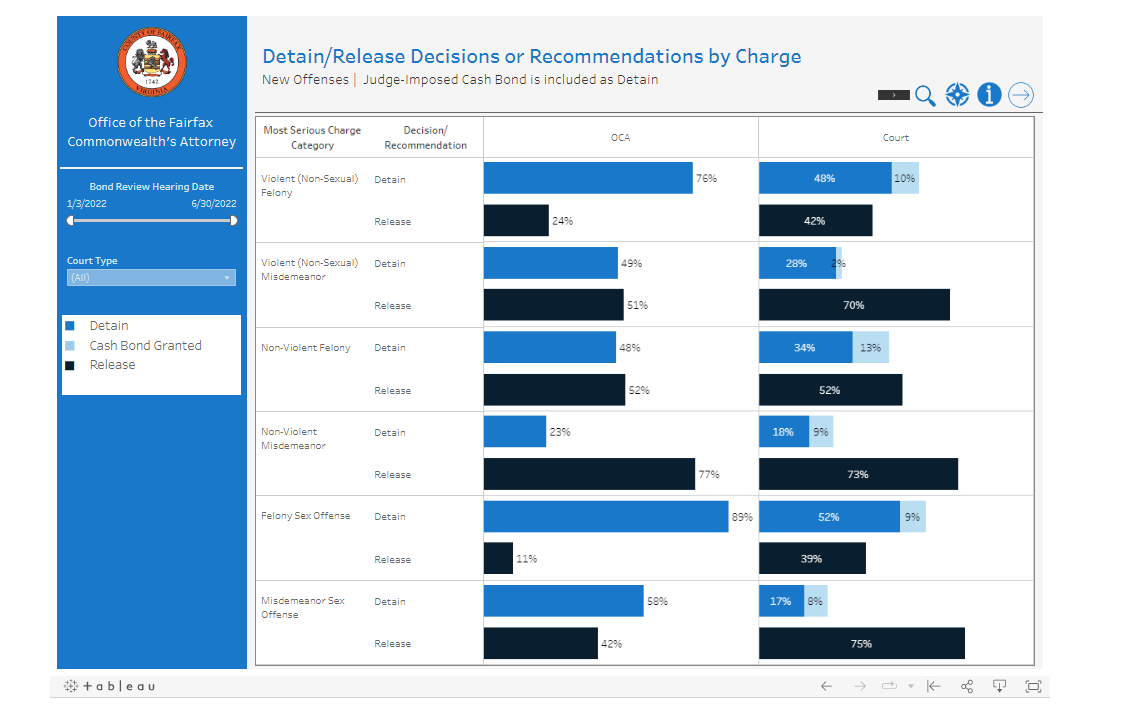
Descano said the numbers – and the gaps they illustrate between a prosecutors’ recommendation and the judge’s final decision – are useful to reform training and guidance, and mark a significant step towards transparency behind prosecutorial decision making.
In 2019, New York’s General Assembly passed legislation eliminating the use of cash bail for most misdemeanors and some nonviolent felony charges, and as a part of the legislation, court administrators are now required to collect and publish data on pretrial detention. In a 2021 report, “What Doesn’t Get Measured Doesn’t Get Done,” the New York City Criminal Justice Agency said this type of data collection is key to building systems that improve prosecutor practices and decrease jail crowding.
Locally, Prince George’s County courts have come under scrutiny for allegedly detaining individuals unlawfully, and failing to provide transparency in the pretrial decision making process. Nine people who were held at the county’s jail filed a lawsuit this summer claiming they were detained illegally, even after a judge ordered or allowed their release. The lawsuit alleges that judges were ordering pretrial release, but then sending the final decision back to county officials, where decisions would then be reversed without giving a defendant or their attorney a chance to weigh in. Courtwatch PG, a group that observes bail-related cases in the county’s court systems, says that the county is now denying the public remote access to some court proceedings as retaliation for the lawsuit. (A spokesperson for the Maryland courts denied those accusations.)
Descano noted that publishing insight into his office’s decision-making in pretrial proceedings opens the office up to scrutiny, but said that the data serves as a measure of accountability.
“Prosecutors don’t tend to release their decision making data, because they know they’re going to come in for criticism from every angle,” Descano said. “Our goal is not to be in line with the judges, that is explicitly not our goal. Our goal is to build both immediate term and long term safety.”
Fairfax’s new dashboard also includes a breakdown of the potential reasons why a prosecutor may recommend detainment. For example, in instances of violent felonies where the court ordered release and the prosecutor recommended a hold, the prosecutor’s reasoning was “danger to family or or household members,” 37% of the time.
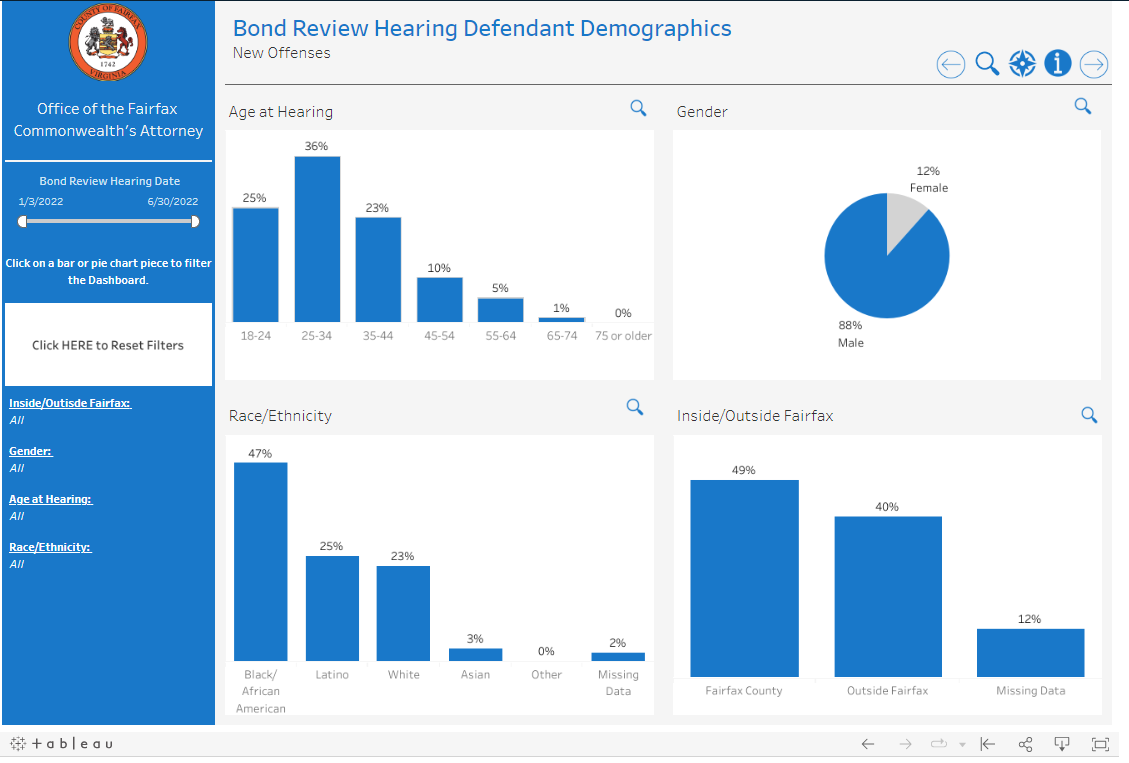
Of the 802 cases included in the data, 47% of cases involved Black residents. Latino residents made up 25%, and white residents 23%. Those who received bond reviewing hearings also skewed younger, with 36% of cases involving individuals 25-34, and 25% involving 18-24 year olds.
The dashboard, the first publicly available and comprehensive data-based look at the OCA’s handling of pretrial release, comes as Descano faces attacks from state Republicans for what they view as his “soft on crime” approach to prosecuting.
On the campaign trail, Republican Gov. Glenn Youngkin repeated refrains of “skyrocketing” crime rates thanks to Democratic leadership, and Republican Attorney General Jason Miyares has been pushing a bill that would allow his office to prosecute alleged sexual crimes against minors — offenses that, like most violent offenses, currently fall under the purview of commonwealth attorneys. Numerous times since taking office, Miyares has criticized local prosecutors (often singling out Descano) for a “far left liberal pro-criminal mentality.” (Miyares’ office did not immediately return DCist/WAMU’s requests for comment on the released data.)
The data release from Descano’s office comes not only as amid criticism from top Republican officials in Virginia, but also as he faces a political challenge.Descano is one of three Northern Virginia prosecutors facing a recall effort by the conservative group, Virginia for Safe Communities, which claims that Descano, Praisa Dehghani-Taft in Arlington, and Buta Biberaj in Loudoun County have not prosecuted misdemeanor cases. In Sept. 2020, Descano’s office stopped prosecuting cases of non-felony assault and other low-level fines, amid a staffing crisis that he attributed to insufficient funding from the state.
The data shows that Descano’s office was recommending an individual be detained pretrial more frequently than judges were following that recommendation. Those in Miyares’ camp also frequently cite rising rates of crime and particularly violent crime as results of criminal justice reforms. Overall crime fell by 9.6% in Fairfax from 2020 to 2021, but homicides did increase slightly, with six more recorded in 2021 than in 2020.
Descano said that reviewing prosecutorial decision is only one piece in a much larger and more complex puzzle of overlapping socioeconomic and systemic factors.
“What we’re doing through trying to focus in and really being cognizant of the cost of over-incarceration pretrial, is we’re trying to not put people in that tailspin where it pushes them towards more crime in the future,” Descano said. (Nationally, the U.S. spends $13.6 billion a year on pretrial detention.)
Going forward, the OCA will examine its review process for determining an individual’s risk to community safety, and add more support from leadership when prosecutors are making detainment recommendations. As the reporting process smooths out, the dashboard should be updated dynamically on a regular basis, not just annually or every six months.
“Shining a light on how we make decisions, how other actors in the system make decisions, and what those decisions are, I think is really useful for making better decisions,” Descano said. “Being data driven and informed, but also really communicating to the community in a way that they can appreciate and use about what goes on in the system.”
This post has been updated with information on an effort to recall Steve Descano.