Jacob Fenston
Fairfax County now has a plan to become more resilient in the face of a warming planet. The County Board of Supervisors voted today to adopt the plan, which lays out a roadmap to help residents and infrastructure adapt to a warmer and wetter climate.
The Resilient Fairfax plan analyzes the impacts climate change will bring to the county in coming decades. Among the biggest threats: an increase in number of days with extreme heat, as well as longer, hotter summers. Currently, the county experiences an average of seven days a year where the temperature reaches 95 degrees or higher. That’s projected to grow to around 30 days a year by 2050 and as many as 70 days a year by 2080.
The county will also become wetter – while there may not be higher annual rainfall totals, rain is expected come in heavier doses. These more frequent, intense storms are more likely to cause flooding, especially when combined with sea level rise on the Potomac River – projected to elevate between 1.1 and 3.6 ft. by 2050. With a higher Potomac, storm surge flooding from hurricanes will reach farther inland in neighborhoods like Huntington and Belle View.
Flooding can occur far from the river too, caused by inland streams overflowing, or heavy rain overwhelming storm drains that were designed for a different climate normal.
The climate is also projected to get weirder, according to the resilience plan, making tropical cyclones and severe thunder storms more likely, bringing along with them flash flooding, hail, high winds, and tornadoes.
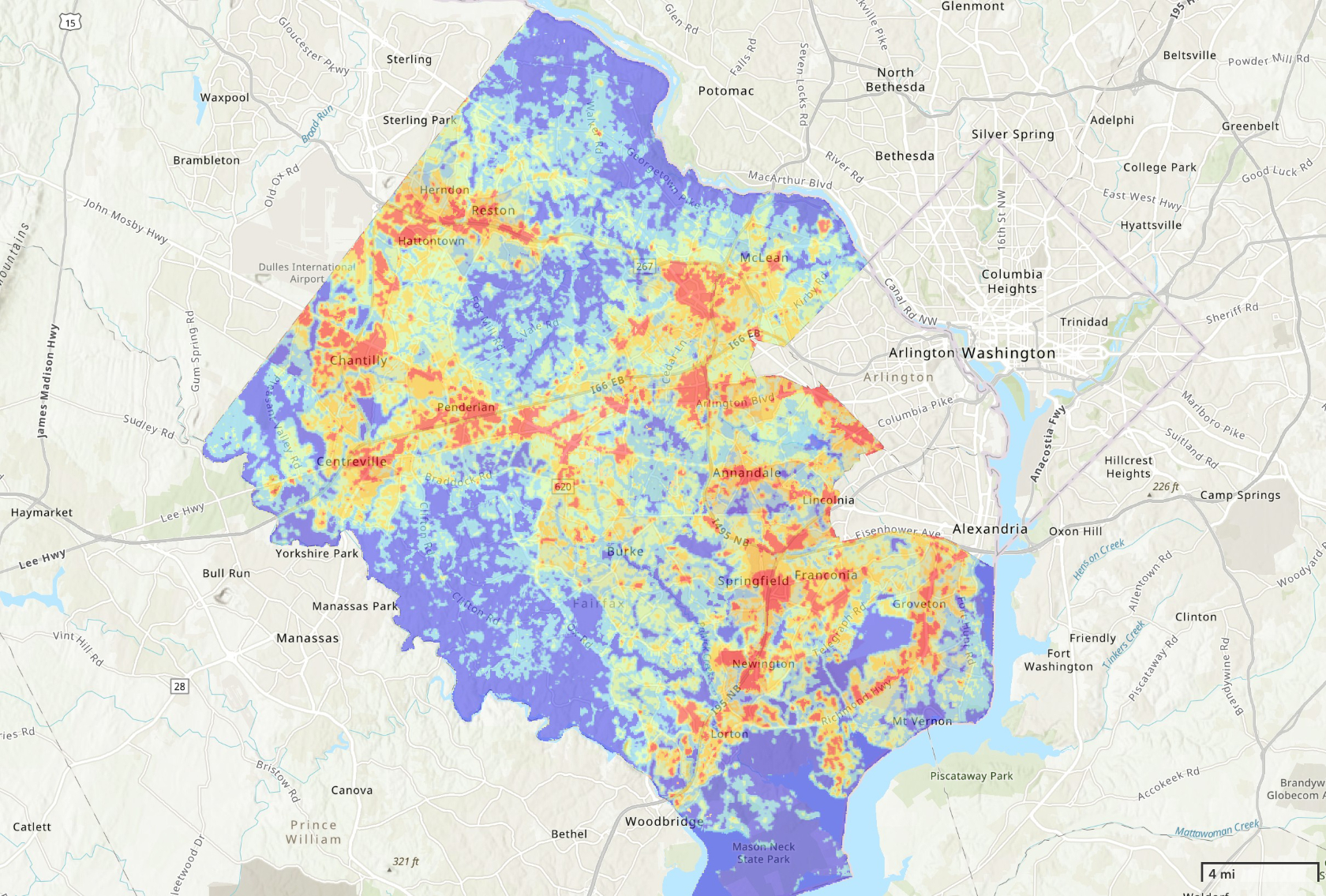
The plan includes an assessment of how vulnerable different parts of the county are to the various climate threats, and how vulnerable different populations are. “Exposure to the impacts of climate change can exacerbate existing vulnerabilities and disproportionately impact vulnerable populations within Fairfax County,” the assessment reads.
Those most at-risk to the impacts of climate change in the county include low-income households, people with disabilities, people experiencing homelessness, people without access to healthcare, older residents, and people who work outdoors, according to the assessment.
The plan includes 11 goals, with 48 strategies to help achieve them. Goals include: creating safe and resilient spaces, pursuing climate ready development, integrating resilience into general planning, and protecting natural resources that enhance resilience.
Strategies in the plan include creating a network of climate resilience hubs where residents can cool off in a heat wave or stay warm in a power outage, building more green infrastructure to absorb storm water, and conducting more targeted tree plantings to cool off hot neighborhoods.
Many aspects of resilience are not within the purview of county government, the plan acknowledges. For example, the county cannot change building codes to require more resilient construction – that’s controlled at the state level. Likewise, the county does not have jurisdiction over much of its energy, transportation, and drinking water infrastructure. Numerous strategies listed in the plan amount to advocating for state-level action in the General Assembly.
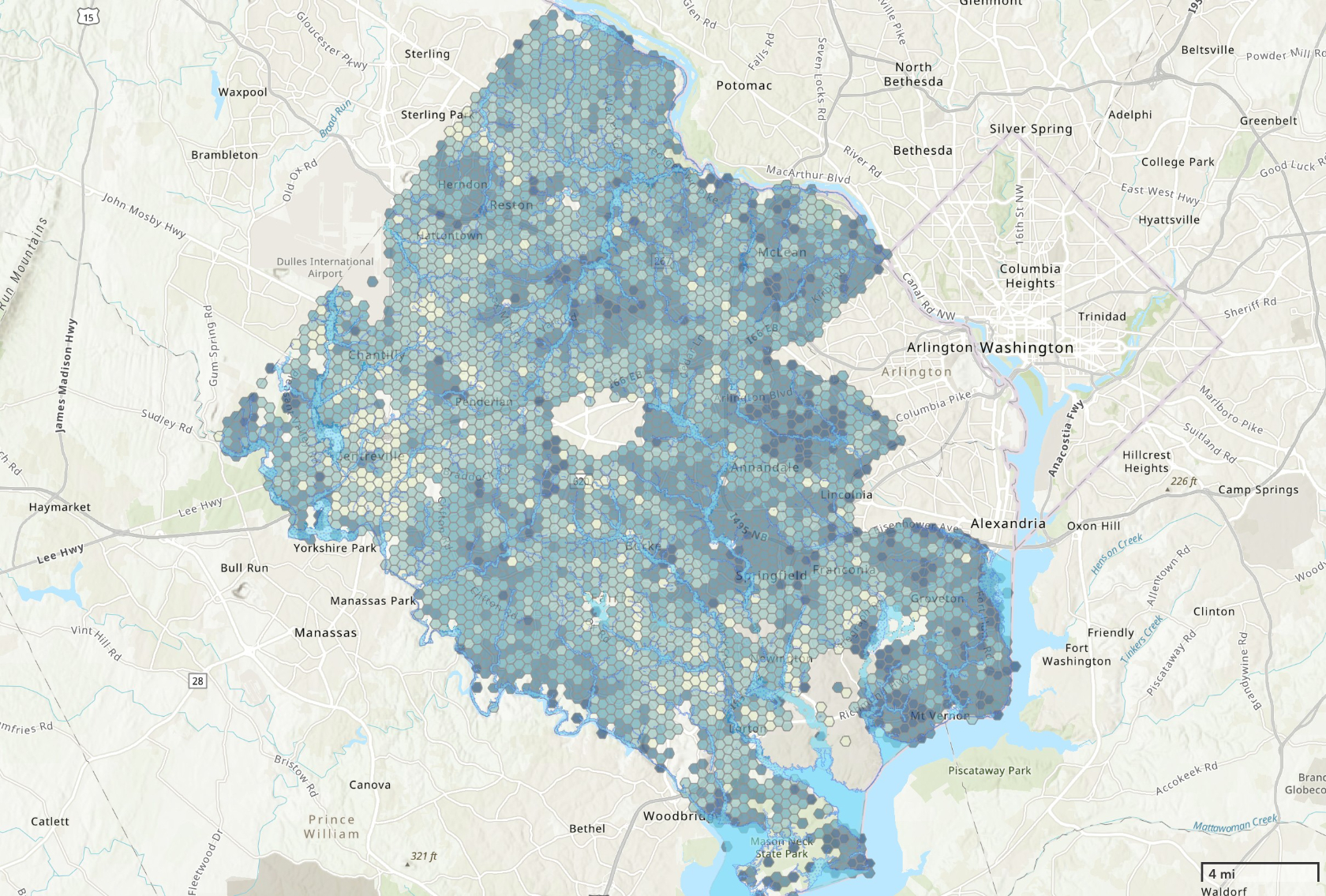
The plan includes an interactive map, where users can toggle layers that show the hottest and coolest parts of the county, the areas most at-risk for flooding, and where the most vulnerable populations live.
The plan was adopted with 9 yes votes and one abstention. The lone abstainer, Supervisor Pat Herrity (R-Springfield), said he supported a lot of what was in the plan, but had “critical concerns.”
“I’m concerned this isn’t a fiscally constrained plan. I’m concerned there’s no real prioritization of these on a cost-benefit analysis basis,” Herrity said ahead of the vote.
Jeff McKay (D), chairman of the board, defended the plan.
“In terms of fiscal impact – the fiscal impact of not adopting this is is scary,” McKay said. “We’ve seen what some of these major storm events have done to the county and what the cost of those repairs are. And so this is a significant financial issue for the county besides the obvious environmental issue.”
The plan itself notes that financial cost. “At the local level in Fairfax County, responding reactively to individual climate-amplified hazards as they occur can be costly.”
These past events include: the 2010 North American Blizzard, which resulted in a $2 million loss; Tropical Storm Lee in 2011, which cost the county $10 million in repairs to bridges and roads; Hurricane Sandy in 2012, which cost the county more than $1.5 million; and the July 2019 flooding event that led to $14.8 million in damages.
Previously, in September 2021, Fairfax County adopted a climate action plan, setting an ambitious goals to cut greenhouse gas emissions county-wide by 50% by 2030 and to become carbon-neutral by 2050. Those goals are in line with the international climate goals adopted as part of the 2015 Paris Agreement. However, the world is way behind on those goals – currently on a trajectory to cut emissions by only 10% by 2030, according to a recent U.N. report.