 Jordan Pascale
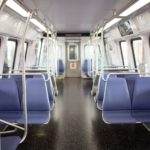
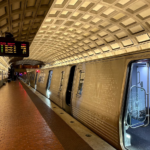
Metro says it will start to increase rail service in the next two months, now that it has more 7000-series trains available. It should help reduce crowding during peak periods, which has developed particularly on the Red Line.
Metro will lay out a roadmap to returning to full service at its board meeting on Thursday.
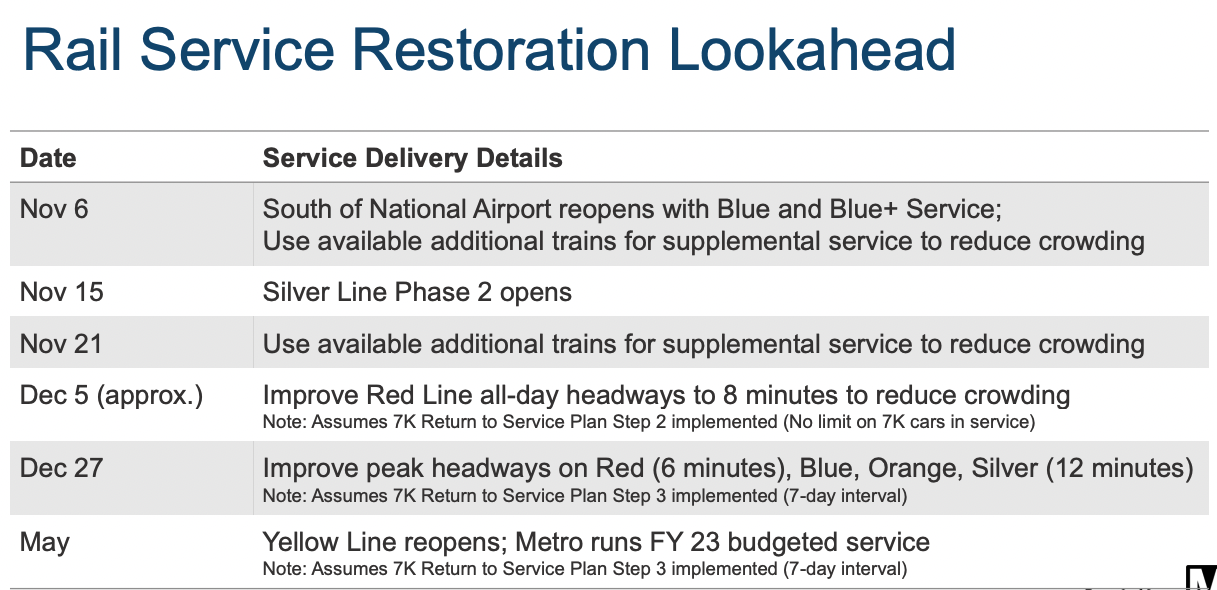
It starts this month with Blue Line trains returning to the six stations south of National Airport on Nov. 6. The Blue Line will run to both Franconia-Springfield and Huntington on the Virginia side and New Carrollton and Downtown Largo on the Maryland side. That additional Blue Line service functionally adds more service to replace the Yellow Line while Metro does bridge and tunnel work on Yellow Line across the Potomac River through next May.
On Nov. 15, the Silver Line extension opens to Dulles International Airport and Loudoun County.
Then in early December, Metro will increase train arrivals on the crowded Red Line from every 10 minutes to every eight minutes.
Toward the end of 2022, Metro will implement a new operator “pick” which lets train operators select what shifts and where they want to work. That process, combined with more train availability, will allow Metro to improve train service on the Red Line during peak hours to every six minutes and on the Blue, Orange, and Silver to every 12 minutes, down from every 15 minutes.
By next May, when the Yellow Line work is complete and service is restored, Metro will be able to return to budgeted service.
Last month, the Metrorail Safety Commission approved a plan to gradually reintroduce more trains and loosen the restrictions on inspecting the wheels of 7000-series trains if things go well. Metro must follow its service plan, which calls for inspecting wheels every four days in the first 32 days and then inspecting them weekly. The Safety Commission removed the trains from service after an October 2021 derailment partially caused by wheels moving too far apart from each other. So far, Metro has run anywhere from 12-18 of the 7000-series trains a day.
Meanwhile, bus service is not returning as quickly because of a bus operator shortage, which is affecting transit agencies across the country. Metro is down 100 operators, according to a memo, with about 25 operators a month retiring or quitting. Some are being redirected to train service as well. But Metro hopes to hire 475 operators over the next year.
The 70, L2, N2, and S2 buses will see service adjustments starting Dec. 18.
- 70: Restore weekday peak frequency to 12 minutes (up from every 15 minutes)
- 70: Restore weekday off-peak frequency to 20 minutes (down from every 15 minutes).
- L2: Increase weekday peak frequency to 10 minutes
- N2, N4: Increase weekday AM peak frequency to 10 minutes in the core.
- S2: Increase weekday peak frequency to 10-minute service.
These routes were temporarily reduced in September because of operator shortages. Several pre-pandemic routes have not returned and many will be re-evaluated next spring, Metro said in the memo.