Jacob Fenston
Remember the three Rs? Not reading, writing and arithmetic — but reduce, reuse and recycle.
D.C. has a goal to start doing a lot more of these three things: the city aims to go “zero waste” by 2032, keeping 80% of waste out of landfills and incinerators.
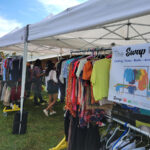
The District has just launched a new website to aid residents with R #2. It’s called Reuse DC, and includes an interactive map of places in the region where you can repair, donate, or shop for second-hand items.
“Previously-owned household items are still valuable and can service our community and create green economic opportunities in the District through the local circular economy,” said Tommy Wells, director of the District Department of Energy and Environment, in a press release.
On the map, you can filter through two dozen different categories, including appliances, baby care, books, camping equipment, musical instruments, office supplies, and tools.
Some of these are places you probably already knew about if you’re interested in shopping second-hand or donating used stuff — the Goodwill, Community Forklift, Value Village, etc. But did you know about the on-base Ft. Myer Thrift Shop? Or that there are a half-dozen shoe repair shops in the city?
The website also features information about food recovery (cutting down on food waste by donating food), and programs like Fix-It DC, which holds repair clinics around the city, and ReThread DC, an initiative to repair, reuse and recycle textiles.
The website is an initiative of the District Department of Energy and Environment’s new Reuse DC team. The team also provides grants to support donation and reuse programs. In 2022, eight businesses and nonprofits were chosen, and received $64,000, total. These were: A Wider Circle, Common Good City Farm, Community Forklift, Frontline Gig, Inc, ShopReuse LLC, The Fresh Food Factory Market, The Salvation Army National Capital Area Command, and Three Part Harmony Farm.
The 2022 grants paid for projects including solar-powered cold food storage to prevent spoilage and workshops on mending clothes and canning food.
Applications are being accepted for 2023 grants, through Dec. 8, 2022.
The three Rs come from the Environmental Protection Agency’s waste management hierarchy. “Reduce” is the first R because it’s the most environmentally friendly — cutting down on the amount of stuff we use. The second-best option is to reuse the stuff we do buy. Third-best is to recycle or compost. At the bottom of the hierarchy is the worst option: disposal.
There’s a more complicated zero-waste hierarchy, which starts with “rethink/redesign.” This calls for systemic change and prioritizes actions that “address the root causes of the current linear use of materials.” At the very bottom of the zero waste hierarchy is incineration, labeled “unacceptable.” Currently, the District sends some 325,000 tons of waste to incinerators each year, and a similar amount goes to landfills. Roughly 185,000 tons is recycled or composted.
The District has a long way to go to meet its recycling and waste reduction goals — currently just 25% of residential waste is diverted from landfills and incinerators. By comparison, neighboring Montgomery County was a waste diversion rate of 64%.
While the District has made some progress recently in upping its rate, it lags behind in many areas. For example, D.C. provides no regular yard waste pickup, unlike most surrounding jurisdictions, many of which now offer curbside compost pickup too.