Martin Austermuhle
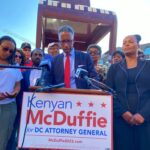
In the somewhat insular world of D.C. politics, the result of a single D.C. Council race this week has gotten plenty of people talking. That result, of course, was Councilmember Kenyan McDuffie (D-Ward 5) knocking off Councilmember Elissa Silverman (I-At Large) in the competitive eight-way race for two At-Large seats on the council. (Incumbent Democrat Anita Bonds won the other seat.)
As of Friday morning, McDuffie was ahead of Silverman by almost three percentage points, 0r 8,200 votes.
McDuffie’s victory not only represents a political resurrection of sorts for him (especially after the disastrous way his run for attorney general ended), but it was also an impressive showing of electoral strength in a divided city. Not only did McDuffie dramatically out-perform Silverman in majority-Black and working class neighborhoods in D.C., he also chipped away at her strongest bases of supports in the whiter and wealthier Wards 3 and 6. According to election data guru Corey Holman, on Tuesday Silverman lost up to 12% of her 2018 vote tallies in some parts of those wards.
McDuffie’s win impressed even Mayor Muriel Bowser, who commented on it this week. “If you’re citywide, you want to have a path [to victory] like that,” she said. “He won precincts in every ward and he had really big numbers. When you’re able to cut into an opponent’s base like he did, you’re going to win.”
But how did McDuffie manage it, especially when initial assumptions (even by some of his supporters) was that he wouldn’t be able to beat Silverman, an elected official who had seemed to carve out a strong and enduring base of supporters? McDuffie’s win can’t be attributed to any single factor, but rather a multitude that aligned somewhat perfectly leading into Election Day.
Name recognition
This wasn’t the first time that Silverman, a two-term councilmember, was challenged. But McDuffie’s bid for her seat was more significant because of who he is — and what he wasn’t.
Political consultants and campaign aides will often say the biggest challenge to winning a race is having people even know who you are. And in that, McDuffie was at a distinct advantage compared to candidates who had tried to knock off Silverman in the past, notably Dionne Bussey-Reeder, who unsuccessfully took her on in 2018.
Not only had McDuffie served as a sitting councilmember for the better part of a decade, but he had started raising his own citywide profile late last year and into this year with his run for attorney general. An internal poll conducted by his campaign during that race early this year showed almost half the respondents rating McDuffie favorably or very favorably, while 21% said they didn’t know who he was. By comparison, 35% of those same respondents said they didn’t know much about D.C. Council Chairman Phil Mendelson, who has been involved in D.C. politics for decades.
McDuffie had another advantage: he ran for himself. In 2018, Mayor Muriel Bowser fully threw herself into Bussey-Reeder’s attempt to unseat Silverman, going so far as to show up at an At-Large debate in a Capitol Hill school. (Note: Mayors don’t usually just drop by debates they’re not participating in.) Bowser’s active and personal engagement on behalf of Bussey-Reeder made the whole race something of a proxy battle; if you didn’t like Bowser, this was your chance to send a message to that effect. And many voters did just that: Silverman took in some 40,000 more votes than Bussey-Reeder, and in the process she more than doubled the number of votes she got four years prior.
Bowser seemed to have learned something from the experience: earlier this year she apologized for getting so personally involved in the 2018 race to unseat Silverman.
Money, money, money
Money is the lifeblood of any political campaign, but it alone won’t win a race. In 2018, Bussey-Reeder raised $300,000 — roughly $50,000 more than Silverman — but ended up losing the race by 12 points.
The equation can change, though, when good name recognition (which Bussey-Reeder didn’t have) is paired with solid fundraising. This year, McDuffie took in more than $600,000 in campaign contributions, compared to Silverman’s $441,000. (McDuffie fundraised traditionally, while Silverman took part in the city’s public financing program.)
But he also benefited from loads of outside independent spending that supported his campaign. Opportunity D.C., a new independent expenditure committee linked to prominent businesses and developers, spent almost $200,000 supporting McDuffie — most prominently by sending out multiple citywide mailers that sang his praises as they trashed Silverman. The D.C. Association of Realtors similarly spent money to send out mailers supporting McDuffie’s candidacy.
Independent outside spending on behalf of Silverman was comparatively less; a coalition of labor unions reported spending some $90,000 in the lead up to the election backing her.
Silverman often used McDuffie’s fundraising as a cudgel against him, accusing him of being bought by developers and special interests. She repeated that line during a speech to dejected supporters on Tuesday night. “There was a lot of money spent in this race to defeat us,” she said.
Big money, though, doesn’t always win races. Democrats for Education Reform, a pro-charter advocacy group, consistently sinks hundreds of thousands of dollars into local races. In the June Democratic primary, for one, two of its preferred candidates (in the wards 1 and 3 races) ended up losing.
Progressive splits
In many races, D.C.’s self-described progressive activists tend to coalesce around specific candidates. Ahead of the June Democratic primary, it was Robert White for mayor and Erin Palmer for D.C. Council Chair; back in the Ward 4 race in 2020, it was then-challenger Janeese Lewis George over incumbent Brandon Todd.
But the At-Large this year was different, prompting questions about what exactly “progressive” means — and who is defining the term. Some of the responses fell along racial lines, creating a rift in the city’s erstwhile progressive movement that hurt Silverman’s chances further.
Silverman has often been identified as the leader of the council’s progressive bloc, and during the campaign she touted her role in creating the city-run paid family leave program, voting for a tax increase on wealthy D.C. households (which McDuffie voted against), and gaining the endorsements from many of the city’s labor unions.
But some Black progressives say that Silverman’s most fervent supporters dismissed McDuffie’s own progressive bona fides, even more so when they tried to paint him as being beholden to developers and businesses who contributed to his campaign. (That was an accusation Silverman also made repeatedly.) That, say some Black progressives, sold McDuffie short.
“At the end of the day I felt like Kenyan has introduced more legislation that talks about the racial wealth gap, he is centering Black people through legislation, he was the only councilmember to introduce a bill around reparations. I wasn’t seeing that from Elissa,” says Chioma Iwuoha, an outgoing Advisory Neighborhood Commissioner in Ward 7 who had supported Silverman in the past but did not this election cycle.
Iwuoha also says that some of Silverman’s failings were more personal; she points to a 2020 statement when Silverman seemed to indicate that her support for the Black Lives Matter movement was conditional. “She never addressed it, she never came to us and intentionally tried to engage people,” says Iwuoha. “I think it really cost her the election.”
“Progressivism isn’t just about the ‘what,’ but also the ‘who’: who gets centered, who gets a long-denied seat at the table, and who gets to define what ‘progress’ means,” tweeted former At-Large candidate Markus Batchelor about the race; he supported McDuffie.
Silverman performed poorly in areas east of the Anacostia River in 2018, but her numbers dropped even further this year.
And in the wake of the election, some white progressives seem to be grappling with the racial dynamics in the city’s broader progressive movement. In an email on Wednesday, D.C. for Democracy, a progressive group that endorsed and organized for Silverman, said it would reflect on how to be “genuine partners in building a diverse movement that includes voices throughout D.C.”
“I don’t think we’ve seen it to this level where there was a such a divide between the [progressive] communities,” says Iwuoha.
Even as progressives split on Silverman, they did notch a significant victory: Initiative 82, which would eliminate the tipped minimum wage in D.C., was overwhelmingly approved by voters, with its biggest margins coming in the same communities east of the Anacostia River that supported McDuffie over Silverman.
The strange dynamics of the At-Large race
The contest for two At-Large seats on the council is always one of the more unusual ones, largely because of how the winners are chosen. Unlike traditional races where voters are given a single choice, all the candidates for the two At-Large seats compete against each other on the same ballot — and voters get to make two picks.
While it is true that one of the seats is almost always going to go to the winner of the Democratic primary (in this case, it was incumbent Councilmember Anita Bonds), the pick-two dynamic still gives many voters the chance to opt for candidates they really like, not merely the candidate they dislike least or think has the best chance of winning.
From a candidate’s perspective, that can be significant — even if they come across a voter who likes someone else better, they can always ask to be considered as the voter’s second choice on the ballot. That meant that for every voter considering casting a ballot for Silverman and someone other than Bonds, McDuffie could make an effective pitch to be that someone other.
And that’s exactly what influential urbanist group Greater Greater Washington urged when it endorsed both Silverman and McDuffie. As for McDuffie, some of his campaign signs encouraged people to give him their second vote.
An endorsement — and an investigation
The Washington Post’s editorial board isn’t the force it may once have been in local politics (and its record on picking winners isn’t particularly good), but its endorsements still carry some weight. And that can especially be a factor in the At-Large race, where voters make those two picks but are also drawing them from a long list of candidates they may not know very well. (This year was relatively constrained at only eight candidates; in 2020, by comparison, voters faced a list of 24.)
This time around, the Post’s editorial board endorsed both Graham McLaughlin and McDuffie, touting the latter’s “balanced approach to lawmaking in which he listens to all sides and carefully weighs issues.” Did it make a big difference? It’s impossible to tell, and there are conflicting indications. In the Ward 3 race, for example, the Post’s endorsed candidate (Republican candidate David Krucoff) lost badly to Democrat Matt Frumin.
But in the At-Large race, the Post’s nod could have been a deciding factor for voters confused by the large number of candidates they had to pick from. (The same happened in 2020, when the Post endorsed Councilmember Christina Henderson (I-At Large) on her way to a win.) And it’s generally assumed that the Post has more sway in parts of Ward 3, where McDuffie and McLaughlin ended up performing strongly. Silverman has relied on strong support in Ward 3 for her electoral wins, but as that was chipped away by McDuffie and McLaughlin, her shortcomings in other parts of the city became even more of a drag on her chances.
If the endorsement was positive news for McDuffie, some headlines in the closing weeks of the race were bad news for Silverman. In late October, the D.C. Office of Campaign Finance ruled that Silverman had misspent public campaign funds on polling ahead of a Democratic primary race in which she wasn’t a candidate. She filed a quick procedural appeal that was denied, only further giving the story life.
Silverman’s supporters protested, arguing that OCF could have waited until after the election to issue its ruling. But the damage was done: the Post’s editorial board weighed in against her, as did columnist Colbert King, who had endorsed her in the race. All of this happened while tens of thousands of mail ballots had already been filled out and returned, but also as many residents prepared to vote in person — some 75,000 all in all, most of them on Election Day.