Jacob Fenston
D.C.’s ambitious $92 million 11th Street Bridge Park has been in the works for a decade, and is finally slated to begin construction next year. But a last-minute permitting problem nearly upended the project: D.C. environmental regulators said they couldn’t issue permits because of the elevated park’s impact on the Anacostia River.
D.C. lawmakers, regulators, and the nonprofit behind the park came up with a workaround: emergency legislation that exempts the park from the environmental regulations in question. The D.C. Council passed the legislation unanimously today.
“The point of the emergency legislation is to say, look, this is unique, it shouldn’t be bound by these regulations because of its unique quality,” says Council member Mary Cheh, (D-Ward 3), who chairs council’s environment committee. “At the same time, we want to make clear that this is not an invitation to anybody else under any circumstances to put something over the water.”
Council member Trayon White (D-Ward 8) co-introduced the bill with Cheh. “I look forward to seeing this to the finish line and also ensuring that residents feel like this is a part of our community,” White said ahead of the vote. “The residents of Ward 8 deserve innovation, exemplary outdoor space, and the literal and symbolic significance of this pedestrian bridge.”
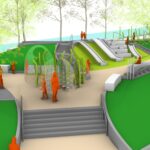
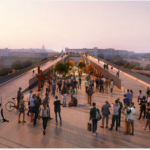
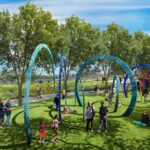
The bridge park has been described as D.C.’s version of the High Line, New York City’s extremely popular park built on old elevated railway. D.C.’s park will be built atop old bridge piers, left in place after the construction of three new spans in 2011 that carry I-295 over the Anacostia River. The park will link some of the District’s poorest neighborhoods east of the river, including Historic Anacostia and Fairlawn, with some of its wealthiest, including Navy Yard and Capitol Hill. The elevated park — the size of three football fields aligned end-to-end — will include a cafe, outdoor performance venues, playgrounds, an outdoor education center, and kayak and canoe launches.
“The bridge park, which is a very compelling idea for a lot of people, we still had to look at it in terms of ‘what’s the impact on the natural resource and is it warranted?'” said Tommy Wells, director of the District Department of Energy and Environment.
DOEE must issue a clean water certification for the project to proceed, after which the project can receive a federal Clean Water Act permit from the Army Corps of Engineers.
Wells says the new park will have several impacts on the Anacostia. First, construction will require rebuilding the old bridge piers, which would disturb the contaminated sediment at the bottom of the river and re-releasing pollution into the water. Second, the new span will permanently shade a section of the river, altering the ecosystem and slowing the growth of underwater vegetation. Submerged vegetation is important habitat for aquatic creatures, which have been making a gradual recovery in the Anacostia River in recent years.
Under D.C. regulations, Wells explains, DOEE can issue permits for such a structure impacting the river only if there is no “practicable alternative.” So, for example, the neighboring I-295 bridge: while it also shades the river and its construction disturbed the river bottom, there is nowhere else it could be built and still accomplish its purpose of carrying traffic across the river. On the other hand, the amenities planned for the bridge park — playgrounds, outdoor education, etc. — could certainly happen on land, for example on the sprawling open space in Anacostia Park, right next to the planned bridge park.
“It’s hard to say that we must have this new park,” Wells says. “You can’t say ‘because there’s not another park nearby.’ There’s 1,300 acres right at the terminus.”
Wells says he didn’t want to torpedo the popular park project, but he also didn’t want to bend the rules, which would open the door for doing the same for future projects.
“People would love to have new free real estate by putting barges or floating decks or new structures in the river to put in restaurants and other things, because there’s a high economic value to do that.”
Scott Kratz, the senior vice president of Building Bridges Across the River, the nonprofit behind the project, has been working on the park since the very beginning. He says the DOEE permit problem came as a surprise snag, after most other hurdles had been overcome.
“I’ve learned so many things about so many things working on this project,” Kratz says. “Transforming an old freeway into a park over a navigable river in the nation’s capital is a complicated process.”
The project has already won approval from the National Capital Planning Commission and U.S. Commission on Fine Arts, and has secured $81.5 million of the $92 million total project cost. “We’re checking off all these boxes and this is one of the last ones we need to move forward,” Kratz says.
Kratz says on the whole, the bridge park will be a boon for the environment. In fact, one of the main goals is to reconnect D.C. residents with the river, which has long been one of the most polluted in the nation. The project will include planting 175 native trees; the two buildings in the park will be certified highly-efficient LEED Gold; stormwater on the park will be captured in giant cisterns so it doesn’t pollute the river; and the environmental education center and boat launches will “inspire the next generation of river stewards,” Kratz says.
With the emergency legislation now in place, the park is on track to begin construction midyear in 2023 and open to the public in 2025.