Callan Tansill-Suddath
Democrats dominating elections in Maryland as they did last week is not surprising; registered Democrats outnumber Republicans in the state two to one.
The outcome is even less surprising in Montgomery County, where that margin grows to one Republican voter for every four Democrats. As expected, Democrats secured all four at-large county council seats as well as every district seat.
But not all districts in Montgomery County are built the same.
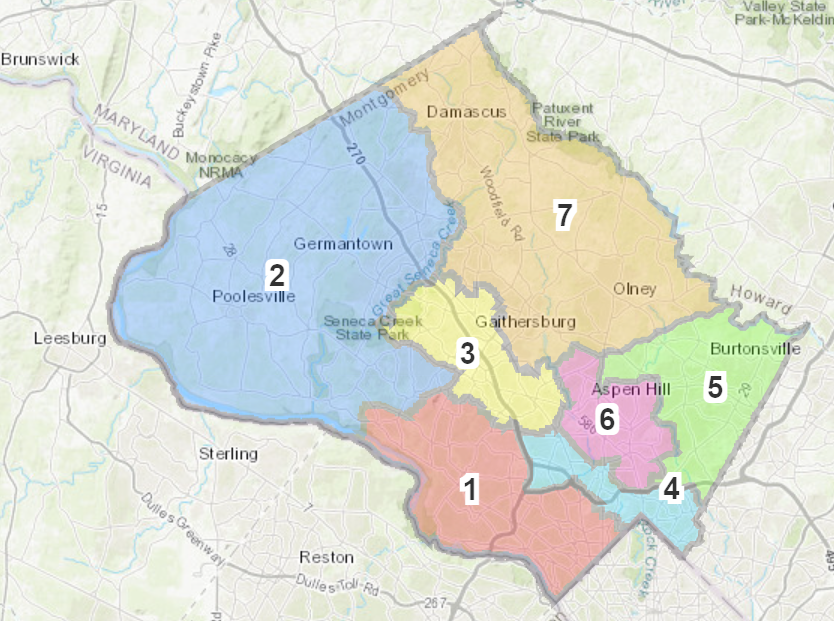
District 2 occupies the northeastern corner of the county, and is home to Clarksburg, Dickerson, Germantown, and Poolesville. Newly created District 7 is in northeastern Montgomery County and includes Ashton, Brookeville, Damascus, Laytonsville, and Mt. Airy.
In these areas, Democrats hold a slimmer majority than they do elsewhere in the county. Democrats still dominate elections, but there are sizeable Republican and independent populations in both districts.
Representing ‘upcounty’ residents
Marilyn Balcombe and Dawn Luedtke won their races to represent Districts 2 and 7, respectively, and both take seriously the responsibility to represent all their constituents.
For one thing, both hail from upcounty, the area Balcombe describes as “anything north of Gaithersburg.” The region is more rural, less populated, and more conservative than other parts of the county.
District 7 in northeastern Montgomery County is one of two new districts added to the council. It includes large swathes of the former Districts 2 and 4 and a little bit of the old District 3.
Balcombe handily won the Democratic primary for District 2, and took the general election with a sizable 68% of the 32,320 votes cast. Dan Cuda, her Republican challenger, received roughly 31.4% of the votes, a relatively strong showing for Montgomery County.
Luedtke, an attorney and the first-ever District 7 councilmember, won with roughly 62% of the nearly 37,000 votes cast. Harold Maldonado, her Republican opponent, collected more than 38% of the vote.
For context, farther south in the redrawn District 4, which includes Kensington, Takoma Park, and Silver Spring, councilmember-elect Kate Stewart of the redrawn District 4 received roughly 87% of the vote, while her Republican challenger Cheryl Riley brought in just over 15%. Of the roughly 89,000 registered voters in District 4, fewer than 9,000 are registered as Republicans.
In no council district in Montgomery County do Republicans make up enough of the voting population to win a seat; a Republican has not served on the Montgomery County Council since 2006 when Howard Denis of District 1 lost his seat.
But like many areas across the U.S., the less suburban, less populated portions of the county – those that border Howard and Frederick Counties – lean more conservative. And representation matters, says Balcombe.
“Up until this election, there’s only been ever been one other council member that’s been in Gaithersburg let alone upcounty,” Balcombe explains. Councilmember Sidney Katz, a lifelong resident of the city, was elected to a third term representing Gaithersburg’s district last week.
Upcounty residents’ interests, Balcombe says, aren’t necessarily different than those in the rest of the county. But the heavy progressive lean of the council and the lack of members from upcounty can make some feel they’re not being heard.
“It’s not as if they don’t pay attention to the county, but they’re not familiar,” Balcombe says.“I’m always asking other people to be cognizant of the geographic differences up here.” Balcombe notes not just the distance from areas like Bethesda, Rockville, and Silver Spring, but the lack of accessible public transportation in her community.
She served as the President of the Gaithersburg-Germantown Chamber of Commerce for more than 17 years. It is a role that has afforded her the opportunity to get to know the members of her community, and it’s influenced her priorities for the council.
“My number one issue is the economy and jobs, and making sure that we continue to expand our employment base, that we bring in more jobs to the I-270 corridor,” Balcombe says.
This in itself reflects common ground with some of Balcombe’s Republican constituents, of which there are 16,400 – or one for every three or so registered Democratic voters – in District 2. (In addition, some 27,000 residents are unaffiliated independents.)
Nationwide and in Maryland, both Republicans and Democrats cited economic factors as a primary concern heading into the 2022 elections. Republicans and independents put the issue first, while Democrats cited “preserving democracy” as their top issue.
Finding commonalities with colleagues and constituents
Though the county council will be controlled by Democrats, not everyone will be in lockstep, given the shades of liberal and progressive ideologies across its members. But Balcombe, who describes herself as “moderate,” does not see the point in looking for what separates her from her new colleagues before they even begin the work.
“I don’t want to line up and, you know, say who’s to the left and who’s to the right, because I think that we have so much divisiveness in our country that my interest is in let’s find the commonality.”
In District 7, Luedtke will serve 21,632 registered Republican constituents, roughly a fifth of the voting population. (Around 24,000 are unaffiliated.)
Luedtke is cognizant of this ideological diversity, and she wants her constituents to know it is one of the things she appreciates about her district. And there’s also the fact that her district includes more rural areas, including farmland.
“You can’t talk about Montgomery County and its diversity of residents without also talking about the diversity of its landscape,” Luedtke says.
“And, you know, there is a desire to not have everything be cookie cutter, and that’s okay to not have everything be exactly the same. It shouldn’t be.”
Luedtke has heard similar sentiments to those Balcombe has from members of her community about feeling cut off from the rest of the county. But she thinks her constituents have more in common with downcounty residents than they realize.
Public safety is an issue that embodies what Luedtke calls “perception issues.” While she believes public safety is a concern countywide, “folks upcounty tend to believe that people downtown are not as concerned or have very vastly different views on that,” Luedtke explains.
Public safety is also an issue that Luedtke knows well. She previously worked in the Baltimore Attorney General’s office and has professional experience training law enforcement officers. “I think you can care about racial justice, and care about crime, and care about holding people accountable for criminal conduct, right? It’s how you go about it that may be different.”
“You have to be able to have your voice heard”
This perspective – understanding residents may share more concerns than they realize – will play significantly into how she approaches her role as the first councilmember of District 7. “It’s… a willingness to say, you know, look, we’re going to work on this collectively.”
“I think they want to make sure that, you know, folks are not losing sight of the forest for the trees,” Luedtke says. “If you’re spending all your time focusing on one issue, and for folks that maybe, you know, what they perceive as ‘Oh, my goodness, the folks who are interested in racial justice only care about that and just don’t care about rising crime.’”
But she also knows that moderates and Republicans may not feel comfortable speaking up when they have concerns because of the county’s solidly liberal reputation and the county council’s one ruling party. She wants to address that as a councilmember.
“You have to be able to have your voice heard. You may fall somewhere on the spectrum that’s not in the same place as the listener and that’s okay, but you have to be able to feel like someone will listen to you,” Luedtke says.
“That’s what an elected official’s job is, you know?”
Neither Balcombe nor Luedtke has a formal legislative agenda heading into their freshman terms as councilmembers, but they do have priorities.
Chief among Balcombe’s priorities is revitalizing the I-270 corridor. Adding more jobs to the workforce in that area, she says, will resolve other issues in her district. “For every job in Germantown, it’s one less car at the [I-270] spur.”
But she acknowledges there are a variety of factors that play into this, including affordable housing, arguably the most widespread and unifying of all the issues facing Montgomery County. “We’ve got a lot of people who cannot afford to live in Montgomery County, so they live in Frederick or Urbana Newmarket [in Frederick County].”
A supporter of the Vision Zero effort, Luedtke cites pedestrian and cyclist safety in rural areas of the district and expanding public transit – particularly Bus Rapid Transit – as areas of specific focus.
Luedtke also cites the Germantown/Milestone/Upcounty Transit Centers Expansion project currently in progress, which will identify potential new bus routes for Germantown, Clarksburg, and Damascus. She says the project will have a tremendous impact on her community, much of which has limited or no access to public transit.
But her top priority is in unifying her constituents to work toward shared goals and more broadly addressing issues that may have been overlooked in previous council sessions.
“This is the first for this district, and I want to make sure that I do a great job. And doing a great job means a positive, healthy community and things moving forward, and things that hadn’t been getting attention, finally getting attention.”