 Sarah Y. Kim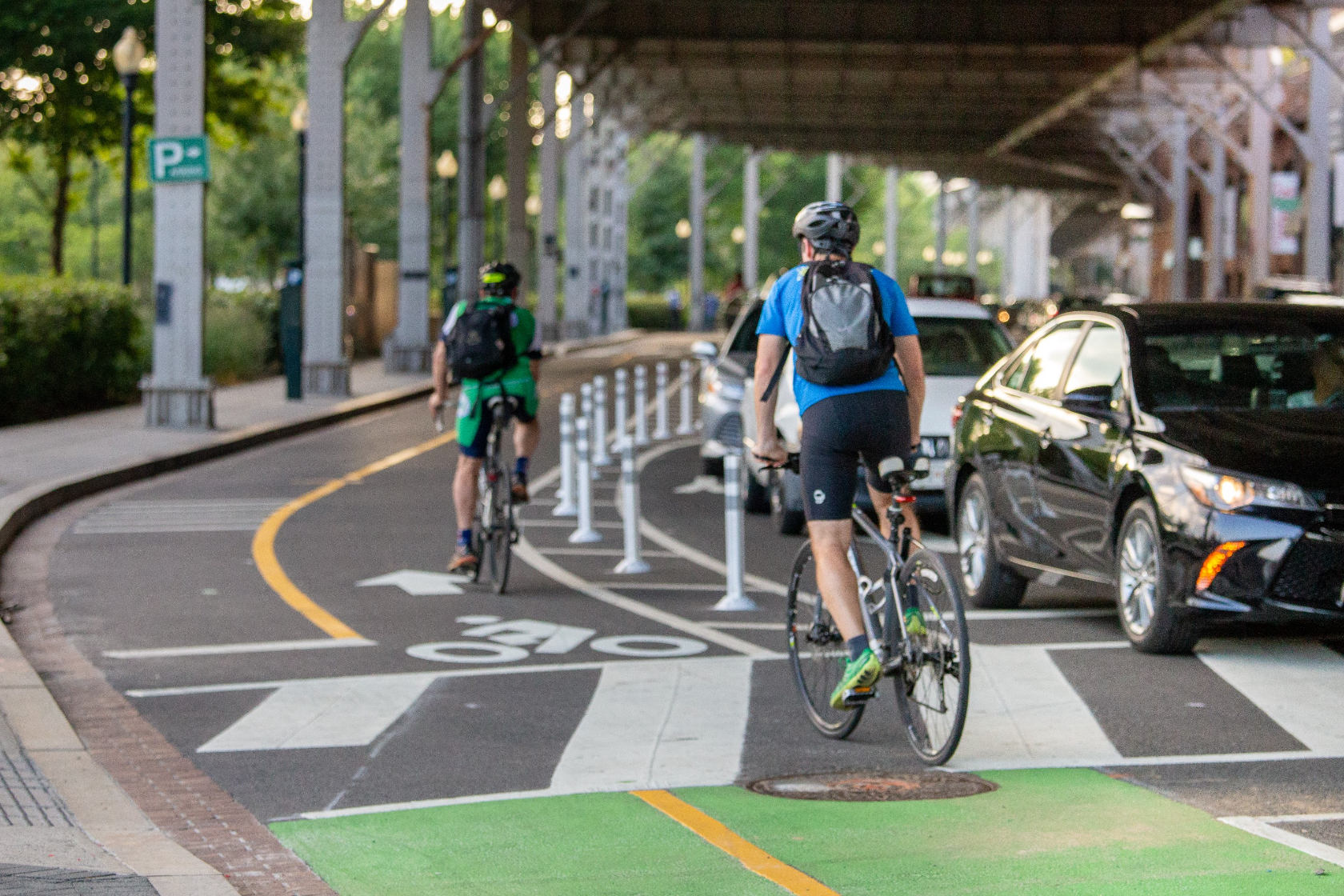
Disability organizations in D.C., including the DC Center for Independent Living (DCCIL) and several individuals with disabilities filed a federal lawsuit against the District over street redesign projects they say violate the Americans with Disabilities Act. The lawsuit, filed Monday, highlights concerns about the addition of protected bike lanes.
The District announced earlier this year its plan to create 10 miles of protected bike lanes each year for the next three years. Cycling advocates have long pushed for more protected bike lanes, which they argue would improve traffic safety.
The suit argues the city designs protected bike lanes that block people with wheelchairs from accessing curbs safely as they exit vehicles, putting them at risk of getting hit by cyclists and injured. The suit points to the recently redesigned 17th Street NW as being particularly problematic, lacking accessible and curbside parking, as well as mid-block curb cuts.
The lawsuit calls for the District to adjust its bike lane plans to be in compliance with accessibility laws, and to provide more accessible on-street parking throughout the city.
Richard Simms, executive director of DCCIL, says his organization has been hearing complaints from numerous residents with disabilities. Earlier this week, he says he got a call about two people who were hit in a bike lane.
“Just get in compliance with [the law], come on. This is 2022,” Simms says. “People with disabilities shouldn’t have to be groveling or genuflecting to get their rights.”
He noted that the city has a “significant population” of people with disabilities. According to the Centers for Disease Control and Prevention, tens of thousands of residents — making up about 12 percent of D.C.’s population — have mobile disabilities. The vast majority of them are Black, and a third are seniors, the press release announcing the lawsuit notes.
Simms says disability advocates have brought these concerns to the mayor’s office and the D.C. Department of Transportation before. “It’s been crickets so far,” he says.
The mayor’s office did not immediately respond to a request for comment. German Vigil, public information officer for DDOT, told DCist/WAMU that the department cannot comment on ongoing litigation.
Ed Hanlon, an attorney with the Dupont East Civic Action Association — one of the organizational plaintiffs in the suit — told DCist/WAMU that more accessible streets and bike lanes are not mutually exclusive.
That means being strategic about where bike lanes are being built, which he says are “not necessarily appropriate on every street.” Hanlon says the District should also redesign streets so that they have wider accessibility aisles, as well as create more curb cuts.
“A four-inch-curb might as well be a ten foot wall for somebody in a wheelchair,” he says.
Hanlon criticized the mayor and DDOT for “totally ignoring the rights of the disabled” in the bike lane designs and for limiting accessible parking to the city’s central business district.
“Disabled individuals have the right to equally participate in all aspects of our neighborhood life, in all aspects of our community life,” he says. “They cannot do that if they cannot reach the sidewalk.”