Jacob Fenston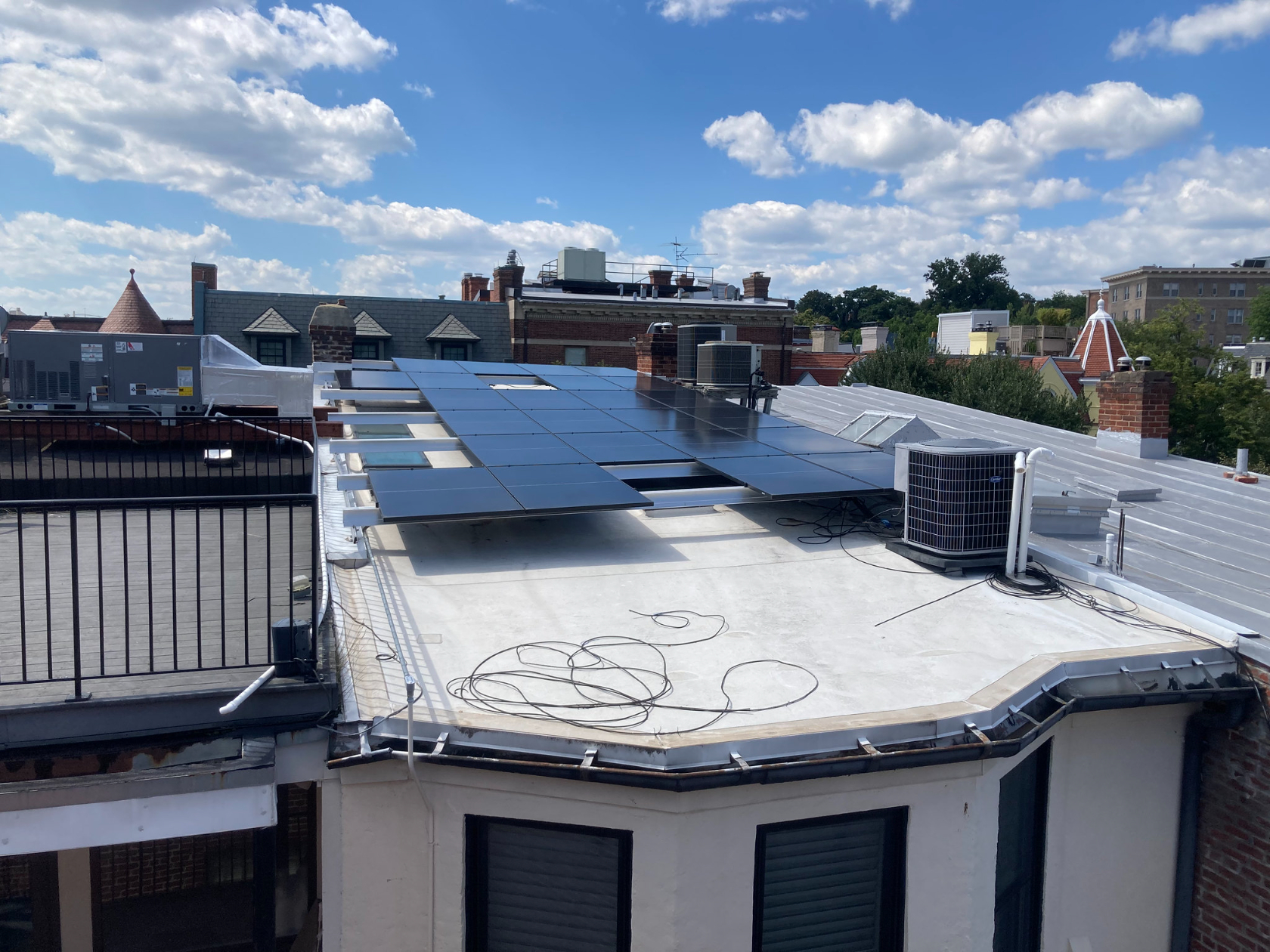
Everyone seems to agree: more solar energy is a good thing. But a bill to require more solar in the District is dividing environmental advocates. Some say it’s needed to keep the local solar industry from crashing, while others say it would be unnecessarily expensive and be a burden on low-income residents.
The District has some of the best solar incentives in the nation, and there has been rapid growth in rooftop solar – more than doubling in capacity in the past three years. But sponsors of the bill say that if they don’t take action now, that growth in clean energy will come to a halt.
“Given the increasing urgency of climate issues, now is not the time to turn our back on the system that we’ve created, especially where doing so could cause untold damage – the industry losing hundreds of jobs in the process,” said Council member Mary Cheh (D-Ward 3), who introduced the bill.
The problem, in a nutshell, is that solar has become too popular – so much has been installed in the District that it’s thrown off the supply and demand system that supports the industry.
The legislation would increase the amount of local solar required under the District’s renewable portfolio standard, or RPS. Under current law, 10% of electricity in the city must come from solar panels in the District by 2041; the bill would boost that to 15%. Additionally, the legislation would increase and extend the penalty levied on electricity providers that don’t meet the requirement.
This local solar requirement is a complicated, but elegant way of subsidizing the solar industry. That’s because to comply with the law, Pepco and other providers have to buy local solar renewable energy certificates – known as SRECs – or pay the penalty. Anyone in the city with solar panels on their roof generates one certificate for every megawatt-hour of solar energy produced. Currently these credits are selling for about $370, but the price fluctuates based on supply and demand. At this price, a typical small rooftop system could produce five credits a year, bringing in $1850 of income.
Earlier this year, the price of SRECs plummeted, as the supply surged, prompting lawmakers to draft the bill.
The legislation would basically boost prices for these certificates by increasing demand – requiring Pepco to buy more certificates. This would make installing solar a more attractive investment for homeowners and for solar companies, many of which offer low-cost rooftop solar in exchange for ownership of the SRECs produced.
But Pepco could also pass on the cost of buying more SRECs and paying higher penalties to ratepayers in the city, increasing residents’ electric bills.
“What’s concerning to me about this bill is that we’re doing this in a way that feels regressive to taxpayers – it’s going to fall on the back of working class people” said Council member Janeese Lewis George (D-Ward 4) during a committee meeting this week. “Even small monthly increases can be a big problem for residents on a fixed income.”
The Council advanced the bill out of committee this week, on a 4-1 vote. Lewis George was the lone “no” vote, though she previously supported it, as one of the original introducers of the legislation. Still, the bill appears to have broad support on the Council, introduced by eight out of the 13 members.
At a hearing in October, numerous solar companies, advocacy groups, and residents testified in favor of the legislation, arguing that without it the market for SRECs will collapse, making going solar much more expensive for residents.
However, numerous environmental groups testified against the bill.
“Amid high inflation and displacement due to the high cost of living in the District, we cannot add to ratepayers’ energy burden,” said Lara Levison, with the D.C. Chapter of the Sierra Club. “D.C. already has a strong solar energy presence, and to the extent funds are raised from ratepayers, there are more cost-effective ways to promote our larger clean energy and climate goals than further subsidizing local solar generation.”
For example, Levison said, solar power could be purchased from large-scale projects in neighboring states at “a fraction of the cost,” compared to subsidizing local rooftop installations.
Exactly how much the legislation would increase electric bills is up for debate. According to Cheh, it would be an average of $3.75 per month for residential customers. However, Cheh says more local solar would save Pepco money on long-distance electricity transmission. Factoring that in, Cheh says, the monthly cost would be $1.40 a month.
The Sierra Club came up with very different numbers – according to that group, the added cost per month in 2030 would be more than $8 each month.
Lawmakers did make some changes to the bill to address concerns – phasing out the compliance penalty over the next two decades, and directing some of the proceeds of those penalties to help low-income residents pay energy bills.