Elliot C. Williams
On the east side of Rock Creek Park, nestled between Beach Drive and 16th Street NW, lies a swath of recreational heaven with outdoor jungle gyms and picnic areas. There’s a hardcourt tennis stadium, which draws thousands of fans each summer for the Citi Open. And just a few hundred yards away lies a deteriorating, 4,200-seat music venue hidden beneath a tree canopy.
It’s the Carter Barron Amphitheatre, where the likes of Bruce Springsteen and Diana Ross have graced the stage — but which has more recently fallen into disrepair. Now, the National Park Service is finally teeing up a big renovation — to the tune of more than $20 million — and enlisting the help of a new nonprofit alliance to restore Carter Barron to its 20th-century glory.
The Carter Barron Alliance comes from the Rock Creek Conservancy, an organization tasked with protecting and fundraising for the larger park. The nonprofit launched the alliance in June to recruit local and national partners, raise funds through online donations and public events, and galvanize the public in the effort to reopen the amphitheater by 2026.
So far, more than 60 individual members have joined and nearly a dozen groups have joined as organizational members, including Blues Alley, CapitalBop, and the 16th Street Neighborhood Association, according to the group’s leaders.
The vision: to attract big-name artists — and music fans — to Carter Barron once again.
Longtime amphitheater still has potential
At the moment, the amphitheater has seen better days. The historic space has been closed since 2017, when an engineering study revealed that the stage could not support the required 150 pounds per square foot — a major problem since the dressing rooms are directly below it. The Park Service decided to shut it down.
Now, a passerby will see much of the theater’s concrete covered in graffiti tags, and peeling paint on the wood beams and surface of the stage.
But D.C. native and National Park Service Deputy Superintendent Brian Joyner sees so much more. He’s long thought of Carter Barron as an urban oasis.
“You just kind of disappear into the woods,” Joyner told DCist/WAMU on a recent walk around the amphitheater grounds. “It is a relaxing place to come and spend an evening listening to music. And the idea that this sits tucked right in the middle of the city is an amazing thing.”
And so the Park Service is in the middle of drafting up a schematic design that includes a stage rehabilitation and major infrastructure upgrades. Rehabbing the stage alone could cost up to $2 million, and the larger project is expected to top $20 million, according to NPS’ estimates.

Due to its designation with the National Register of Historic Places, it’s unlikely the overall look and feel of the venue will change significantly, or that NPS will completely do away with its defining Mission 66-style architecture that includes native limestones and a space for an orchestra beneath the stage.
Plus, the Park Service also has to consider the input of the National Capital Planning Commission and the U.S. Commission of Fine Arts.
“Things that will be upgraded are things that are often invisible to us,” says Jeanne Braha, the Rock Creek Conservancy’s executive director.
That list includes making sure the venue adheres to Americans with Disabilities Act requirements; fixing the electrical systems; modernizing the backstage area; rigging the place for WiFi; and, the least-sexy part of restoration, Braha says: plumbing.
“Codes have changed since 1950,” says Braha. “The number of toilets that are expected per visitor have grown.”
It’s possible the plans will include weatherproofing the space with a cover over some of the seating to make it usable beyond just the summer, Joyner says. This could also include some sort of structure that could shield the nearby animals from the venue’s lights and noise. (Bats have been known to fly around in the background during shows.)
NPS hopes to have a preliminary design and renderings ready by mid-2023.
Carter Barron’s history of inclusion
The amphitheater has a special place in the heart of D.C. culture, known for its inclusivity and accessibility — despite its rocky start.
It opened in the summer of 1950 as the Sesquicentennial Amphitheater, to honor the 150th anniversary of D.C. being named the nation’s capital. It was an integrated federal facility and a unique fixture in pre Civil Rights-era Washington. President Harry Truman dedicated it in 1951, naming it after motion picture executive Carter T. Barron, who served as vice chairman of the theater’s planning commission.
The public admired the new outdoor theater’s grandeur and natural setting.
“Set amid the imposing trees of a lovely park, the open-air theatre is one of the finest, if not the finest, in the country, and may be set down as one of Washington’s permanent assets,” raved New York Times drama critic Brooks Atkinson. He was less impressed by the opening production, Faith of Our Fathers, Paul Green’s symphonic drama about George Washington and the early days of the nation. (Based on Atkinson’s review, it sounded like a boring version of Hamilton).
After poor revenue and reviews, the commission abandoned the production and disbanded, leaving the amphitheater under the care of the NPS, which brought in an outside production company to book the acts for the summer.
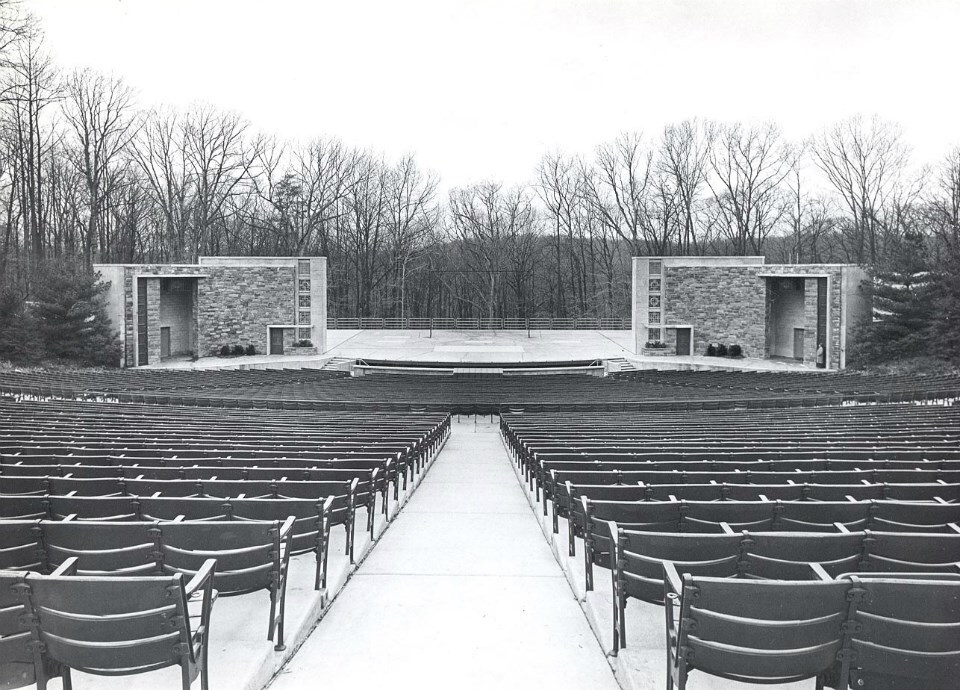
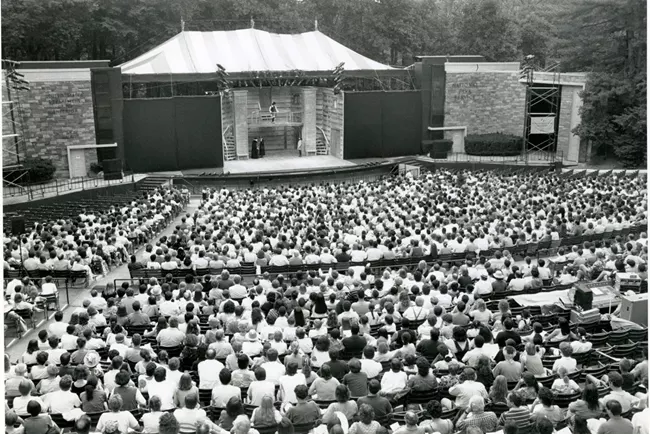
By 1954, the managers began booking acts like Ella Fitzgerald, Louis Armstrong, Harry Belafonte, and Ray Charles. Though its popularity waned over time — due to multiple ownership changes, “white flight” after the 1968 D.C. riots, and the construction of nearby competing venues — many locals considered it a hidden gem.
Carter Barron offered plenty of free shows and other offerings for as low as $3, says Tony Richardson, who began working for the Rock Creek Conservancy last summer and is now working with the alliance. He grew up a bus ride away from the amphitheater in the nearby Shepherd Park neighborhood.
“I really grew up taking the Carter Barron Amphitheatre for granted,” says Richardson. “It was sort of one of those things where I always thought it would be there.”

Like many D.C. natives, Richardson was sad to learn the venue had become dilapidated. He remembers going with his parents to see Shakespeare Theatre Free for All on a perfect summer night at Carter Barron. (The free program from Shakespeare Theatre Company brought top-tier productions to new audiences for nearly two decades. The actors made the most of the elements, one time even sliding across the stage in the rain mid-performance; actor Franchelle Stewart Dorn called the Carter Barron audiences “fantastic.”)
Richardson’s parents also had fond memories of seeing legendary musicians like B.B. King, Earth, Wind & Fire, and D.C.’s own Chuck Brown perform at the venue in the 1980s and ’90s, he says.
Richardson now manages the organization’s J.E.D.I. (justice, equity, diversity, and inclusion) initiatives, which includes the Carter Barron Alliance. He hopes that when the theater reopens, it can serve as a place for community gathering and summer programs for D.C. youth.
Braha says there’s a romantic quality she hopes the renovation will bring back.
“I have a lot of friends who went on first dates at the Carter Barron,” she says, “because they could afford it, if they were interns in D.C.”
Another Washingtonian with fond memories of the venue? That would be Gregory “Sugar Bear” Elliott, bass player and lead man for the go-go band Experience Unlimited (EU). Carter Barron played an integral part in his music career, he says.
Elliott frequented the amphitheater in the 1980s to see his favorite groups perform — and eventually, took the stage himself when EU took off. He remembers being 16 and meeting fellow bassist Verdine White, of Earth, Wind & Fire, after a show at Carter Barron. For no more than $10 a ticket, the experience each summer in the park was unmatched, he says.
“It was sold out every weekend,” Elliott says. “People really enjoyed it because it was a friendly, safe atmosphere. It was just the place to be.”
First up: Build the alliance. Then rebuild the theater
So where do things go from here? While NPS proceeds on the design concepts, the Carter Barron Alliance will look to grow its ranks as it solicits the community’s input, Richardson says.
“We are building a network of arts, parks, historical preservation, philanthropic and community groups, working together to support the revitalization of the Carter Barron Amphitheater,” he says. “This group is really going to be the community voice.”
Meanwhile, NPS will pick a third-party operator to oversee the venue’s ticketing, booking, and performances. This operator is also a key piece of the renovation project’s funding: Braha expects that on top of the philanthropic and NPS-provided funds, the third-party operator will cover some of the initial capital costs of the project.
The alliance is also working on a documentary about the history of the amphitheater and wants to interview members of the community. Those interested in that opportunity or getting more involved in the project can sign up for the alliance’s newsletter.
The alliance recently hosted a virtual panel discussion about the history and future of the amphitheater as part of the Rock Creek Conservancy’s series on race and history. During the event, Rock Creek Park Superintendent Julia Washburn paired a discussion of the values the Carter Barron Amphitheatre represents with a plea for the local community’s engagement in its revitalization.
“We value all of these things: access, diversity, inclusion, affordability, and making art available to everyone. So we want those values to continue into the future,” she said. “Your participation and your influence are going to make sure that we get this project done.”
Alan Spears, of the National Parks Conservation Association, described the forthcoming renovation as “both a rehabilitation project and a political campaign.” Parks are underfunded nationwide, and it’s up to the public to tell their elected officials how valuable they are, Spears said.
“[Government officials] will respond when they hear from this group of people, so committed to this process, that Carter Barron is too big and too significant and too storied a resource to let go,” he added. “It can’t just simply be rehabilitated and then left to flounder in the wind. It’s got to be rehabilitated and reopened in such a way that will lead to long term benefits and a long lifespan.”