 Jordan Pascale
Metro General Manager Randy Clarke’s first budget proposal takes care of the agency’s $184 million deficit while delivering more service and other long-hoped-for items like simplifying fares.
Clarke described the budget as a good bang for the buck. He said the transit agency is trying to maximize Metrorail efficiency by concentrating more service in the core and making transfer times shorter.
“This service stuff is really good,” Clarke told reporters Monday. “If we actually care about equity, and getting more people back in the system, and truly driving access to opportunity these are awesome changes, for very little dollars.”
Clarke noted that most people look at changes just at their station, but that’s the wrong way of looking at it, he said.
“You’re part of the network and the network has changed. So I just want to kind of double down on how much we think the value is on that.”
Meanwhile, Metro closed its budget gap with several ideas: eliminating vacancies, improving ridership, increasing development on Metro land, cutting costs, raising fares, and using $146 million of the infrastructure law money toward maintenance.
And while the transit agency navigated budget shortfalls this year, they will return often in coming years as wages, which account for about 70% of the agency’s budget, grow faster than ridership revenue.
Clarke’s proposal will get reviewed and potentially tweaked by Metro’s board of directors this year before the budget goes out for public comment in February. The board will take a final vote in April and then the budget will go into effect next July.
Here are the highlights:
Eliminating peak fares, keeping peak service
Clarke has called Metrorail’s fare system the most complicated in the world – with both peak and off-peak fares, and different prices for different distances.
He’s proposing to end peak fares, which riders decried during the pandemic as they paid top dollar for subpar service – trains arrived every 15 minutes or so.
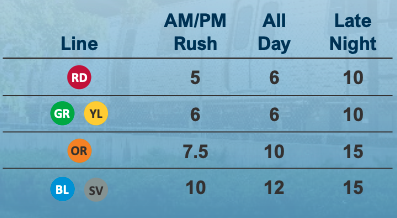
And while riders wouldn’t pay peak fares under this proposal, peak-level service would remain. Here are the train frequencies Metro is aiming for in the budget year starting next July.
Rising fares for mid-to-long trips
Short-distance trips would be the same or cheaper, but mid to long-distance trips would bear the brunt of the increase. The base rail fare would remain $2 but the farthest distance fare level would increase to $6.50, up from $6.
For instance, a mid-day rider from Shady Grove to downtown D.C. would usually pay $3.85, but now will pay $6.50 no matter the time of day, a nearly 70% increase for that time frame.
Metro says the average fare would see a 5% increase.
Late nights after 9:30 p.m. and weekends would remain a $2 flat fare.
Metro explored moving to a zone-based fare instead of specific station-to-station prices but decided it would be too complicated to start next year.
Low-Income Fare Program
About 400,000 residents in the region who qualify for Supplemental Nutrition Assistance Program benefits would be eligible for half off Metro fares, making the bus $1 and Metrorail rides anywhere from $1 to $3.25.
This program is separate from D.C.’s recently announced proposal to make bus trips free for any rider who boards in the District. Clarke calls the ideas “connected without being dependent.”
It would be Metro’s first system-wide low-income program, but it would be similar to the discount programs for seniors and people with disabilities.
Metro used the SNAP threshold as a straightforward and quick bar to qualify for the program. Officials say they realize not every low-income resident in the region is eligible for SNAP, but it’s a start without creating their own means-testing program.
The program would cost the system about $4 million but would generate an anticipated 1.6 million additional rides.
It could launch as soon as next fall. Metro would join 15 other transit agencies in the country that offer a low-income fare.
Turnbacks on Yellow, but not Red Line
Metro won’t pursue turnbacks on the Red Line at Grovesnor-Strathmore and Silver Spring, as previously considered. And it’s not because of political pressure and a recent letter written by delegates and senators from Montgomery County.
Clarke said he thinks there will be growth and more returning ridership on the Red Line this year.
“Our goal was to show options and be transparent on those options,” Clarke said. “This is what we think is the right thing (for the next fiscal year).”
He said Red Line turnbacks could be on the table in future years.
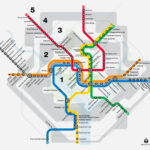
Meanwhile, he’s pitching the Yellow Line ending at Mt. Vernon Square, instead of Greenbelt.
That would double service levels south of Mt. Vernon. The Green Line north of Mt. Vernon would see trains every six minutes. It would no longer be a one-seat ride from Greenbelt to Huntington.
These changes would negatively affect 8% of trips but positively impact 49%.
Better transfers
Transit planners say riders perceive the time waiting for a train as twice as long compared to the time while on a train. And about 1 in 3 passengers transfer on their trips.
With Metro’s service changes making trains more frequent in the core, some of those transfer times would be reduced.
For instance, a trip from Braddock Road in Virginia’s Blue and Yellow Line to Navy Yard on the Green Line for a baseball game takes about 31 minutes now. The average wait to catch a train at Braddock takes about six minutes, followed by a 15-minute ride on the Yellow Line, then a six-minute wait at L’Enfant Plaza followed by a four-minute ride.
More frequent trains in the core mean shorter transfer times with a six-minute wait instead of a 12-minute wait, making an overall trip 25 minutes.
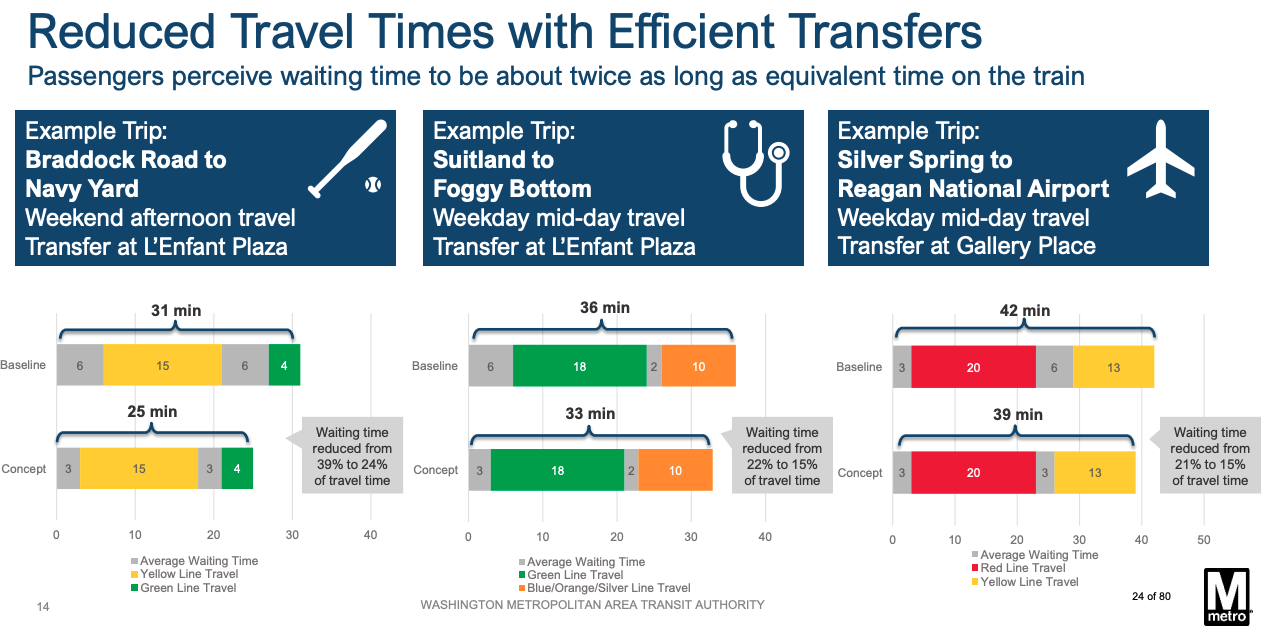
Clarke says cutting wait times creates more job access opportunities since it takes less time to go farther and more stations are within a 30-minute commute.
More Orange Line service
In one of the biggest quality-of-life improvements, Metro would aim to halve current wait times on Orange Line trains, with trains arriving every 7.5 minutes instead of every 15 minutes.
Metro says it improves connections to MARC and Amtrak at New Carrollton. The Orange Line was chosen for more service because it traditionally sees 10-25% more customers than the Blue and Silver spurs to Downtown Largo.
No Silver Line express service this year
A proposed idea to skip some Silver Line stops on some trips won’t be tried out this year. The goal was to cut down on the long travel time from Dulles Airport to downtown.
Planners are hoping to get a better sense of how ridership on the new 11.5-mile Silver Line extension pans out before changing things around.
Bus changes
Clarke gave three examples of route changes that would either add more frequency, create more access or make more equitable service.
The B2 from Anacostia to Mt. Rainier would see a bus arrive every 12 minutes all day, compared to every 10 minutes during peak and 16 minutes in non-peak times now.
The A12 in Maryland would be split into two routes. Both serve Downtown Largo and the hospital there every 20 minutes, but one route would go to Landover station on the Orange Line and end near a Walmart at Capital Plaza. The other would go to Addison Road station and then end at New Carrolton on the Orange Line.
The 16M in Virginia down Columbia Pike would be restructured, adding stops in the Skyline area and extending from its current end in Pentagon City to Crystal City to help serve that neighborhood and its growing Amazon presence.
Those changes are a preview of the Better Bus Network Redesign project that will “rethink, redesign, and revitalize bus service to better serve the needs of customers.” Metro hopes to complete it by the end of next year.
Capital Budget
Metro’s capital budget includes plenty of long-term construction and other improvement projects.
The 10-year plan has $25 billion in wants and needs but capital funds will run out in 2029 and Metro would need to finance any projects after that. Metro is now a 55-year-old system with growing maintenance needs that won’t go away.
The 8000-series trains are included in the long-range plan with delivery in the second half of 2024.
Planners say they should have a selection for the Blue/Orange/Silver line tunnel study by June 2024. The study is investigating how to relieve congestion in the Rosslyn tunnel. Most plans call for building a second tunnel and adding new lines. Some possibilities for new stations include Georgetown, National Harbor, Ivy City, and more. Building any preferred selection will be a generational investment that could take three or more decades.
One line item that didn’t have a timeline or much of an explanation: “Rehabbing customer and employee restrooms.” Clarke has made it a point on Twitter that WMATA bathrooms should be for public use (they’re often closed or station managers won’t allow you access them). He’s said they should be more accessible with signage.