 Jordan Pascale
If you’ve ever cursed your jerky Metro train as it comes into a station, take comfort in the fact that those days may soon be over.
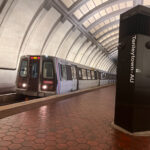
Metro is seeking to return its Red Line trains to automatic operation — instead of manual human operation — by next spring, the transit agency noted in a presentation Monday. The rest of the system could return to automation by the end of 2023.
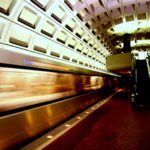
WMATA officials say Automatic Train Operation (ATO) would make the ride smoother, and safer and help save power and money because all acceleration and braking are pre-programmed instead of run by people. Metro says most of the red signal and station overruns (when a train goes beyond the platform on accident) are caused by human error.
System shut down after 2009 crash
Metro was originally designed to be an automated system. And it operated that way until 2009 when a sensor in the track malfunctioned, which led to a train crashing into the back of another train near Fort Totten. The crash killed nine people and injured 80 others. (The malfunctioning circuit meant one of the trains involved in the collision was, in essence, invisible on the system.)
Even though Automatic Train Operation wasn’t cited as a cause of the crash, Metro nonetheless took the system offline — and it remained that way for the past 13 years. At certain points, Metro decided not to bring it back because the infrastructure wasn’t in place. Other times, it wasn’t a priority as more pressing issues faced the system.
But now WMATA General Manager Randy Clarke says it’s critical to restart the automated operation.
“We are the only transit rail property in the world that has regressed from the technology we started with,” he said at a November Metro board meeting. “We ran on an ATO system, which is the way every major safe rail system in the world operates — and we don’t operate on that now.
“It is much safer to run an ATO than it is the way we do manual today,” he added.
Now, Metro leadership points out that 34 of 42 comparable transit systems around the world are automated and they should return to their automated roots to provide an optimal rider experience.
Track signal officials say they have the infrastructure and preventative maintenance processes in place to bring it back. And they think they can get approval for the plan from Metro’s safety oversight body, the Washington Metrorail Safety Commission.
That body has in the past two years issued two reports critical of Metro’s upkeep of systems related to ATO.
The WMSC issued an audit of Metro’s Automatic Train Control system in 2021 noting that Metro had been working to restore ATO without “following its safety certification procedures … not scheduling or completing all preventive maintenance as required by its own or manufacturer manuals, and … allows managers to bypass preventive maintenance work … .”
Earlier this year, it noted that Metro was not properly cleaning or maintaining rooms that hold Automatic Train Control equipment. In response, Metro said it’s re-evaluating its cleaning standards, but also noted the equipment is encased in plastic and the parts are delicate so they don’t want to remove them to clean them too often.
Tiffani Jenkins, vice president of signaling systems at WMATA, says she respects and appreciates the WMSC’s role.
“They’re skeptical because that is their role … They’re the oversight team. They should question the things that we do,” Jenkins said. “The onus is on us to make sure that we give them what they need so that they feel comfortable and we can move forward.”
Updates since 2009, and a plan for restarting
Metro says has made a number of changes since 2009 including replacing all the track circuits, creating a new process to identify faulty circuits, and developing a more robust preventative maintenance and inspection program.
Metro would undertake checks of the circuits, live-test the system after service hours, and re-train operators before it introduced the automated system back to trains with passengers. It would also get engineering help and peer review from other transit systems, in addition to the WMSC approval.
“We did not maintain the system as it should have been maintained,” Jenkins said of the 2009 crash. “We have made significant improvements since.”
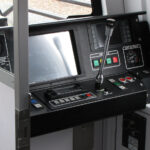
Currently, Metro operates in “Grade of Automation 1” which means train operators are responsible for starting, accelerating, braking, opening, and closing doors, and more. It wants to return to Grade of Automation 2” which would still include an in-cab operator but starting, accelerating, braking, stopping, and door opening would be done by the Automatic Train Operation system. Operators would be in charge of manually closing the doors so passengers don’t get caught.
Metro has also had false starts trying to restart some or all of Automatic Train Operation. The transit agency attempted to bring back ATO in 2018, but never completed the task. Then, in 2019, Metro turned the “Auto Doors” feature back on which automatically selects which doors to open based on which station the train is at. That feature was turned off after numerous glitches, like doors automatically closing, that Metro couldn’t isolate.
Currently, at each station operators are mandated to stick their heads out the window and double-check which side of the train to open the doors. The process takes several seconds that add up.
Looking ahead to newer automation tech
Decades down the road, Metro hopes to install higher levels of automation, which would have the system act more like an autonomous airport rail system. The train would operate on its own and train attendants could walk through the train, help customers and take over in an emergency.
“An attendant could come and provide more in-person assistance, so it does allow us to really reimagine what customer service looks like,” Jenkins said.
That would require installing platform doors at all of the nearly 100 stations and a new type of ATO system known as Communications Based Train Control.
CBTC ditches the track circuits and has the trains themselves talk to each other via radio, which allows trains to run closer together. The MTA in New York has a good explanation of how it works:
Jenkins says Metro will need this more modern technology both out of practicality and need.
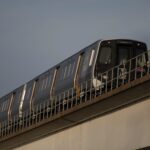
The 1960s-era technology the Metro’s current ATO system uses is becoming obsolete and the ability to operate trains closer together is a benefit. Jenkins said Metro’s current trains would need to be retrofitted for the CBTC system to work, but the upcoming 8000-series would be prepped with CBTC in mind.
Metro is one of the last major transit agencies in the world to wade into the CBTC technology.