Matt Blitz
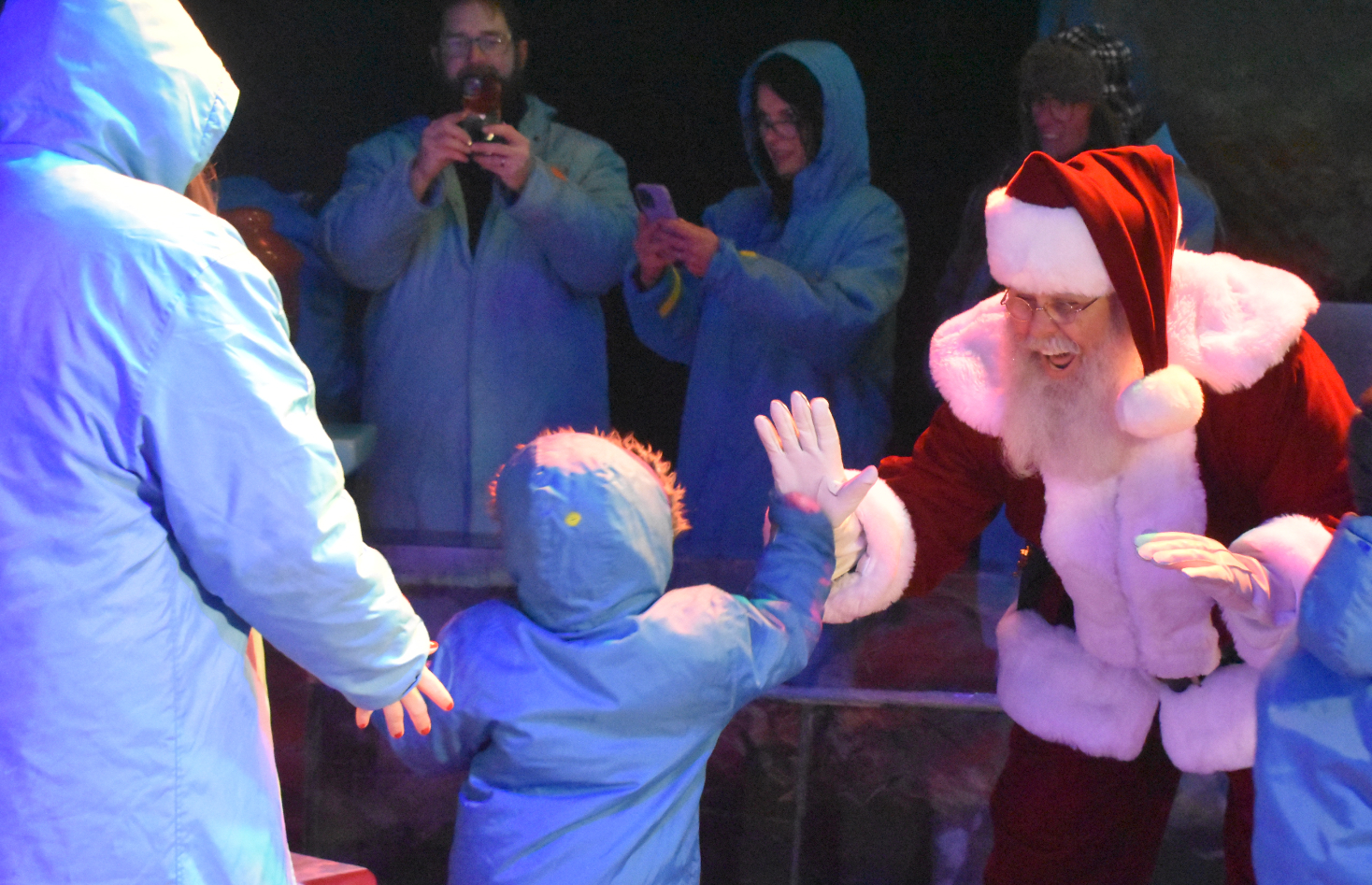
A familiar holiday scene is playing out inside Santa’s workshop at the Gaylord Hotel. Four-year-old Cleo Boudreault nervously approaches Santa Claus. As her parents encourage her, the man in red smiles gently at the little girl.
Then, with a twinkle in his eye, Santa greets Cleo in American Sign Language. For a brief moment, she pauses and is unsure what to do.
But then Cleo signs back.
They share a conversation, completely in ASL, for a few more minutes. While mostly silent, Cleo and Santa have made a clear connection— she even smiles for her photo.
On Monday evening, the Gaylord Hotel at National Harbor welcomed Santa Charles, one of the country’s few deaf Santa Clauses. Throughout the night, local kids line up to tell the man in red what they want for Christmas.
“[I told him] I want some new Vans shoes,” eight-year-old Ramon Torres Morán told DCist/WAMU through a translator. “I want a couple of Goosebumps books. And… a Rubik’s Cube. And I want a really hard one, not just one of the regular squares. A really complicated one.”
Another kid told Santa he wanted a skateboard; another, a Nintendo Switch. At the end of every conversation, Santa gives the kid a warm hug and signs “Merry Christmas.”
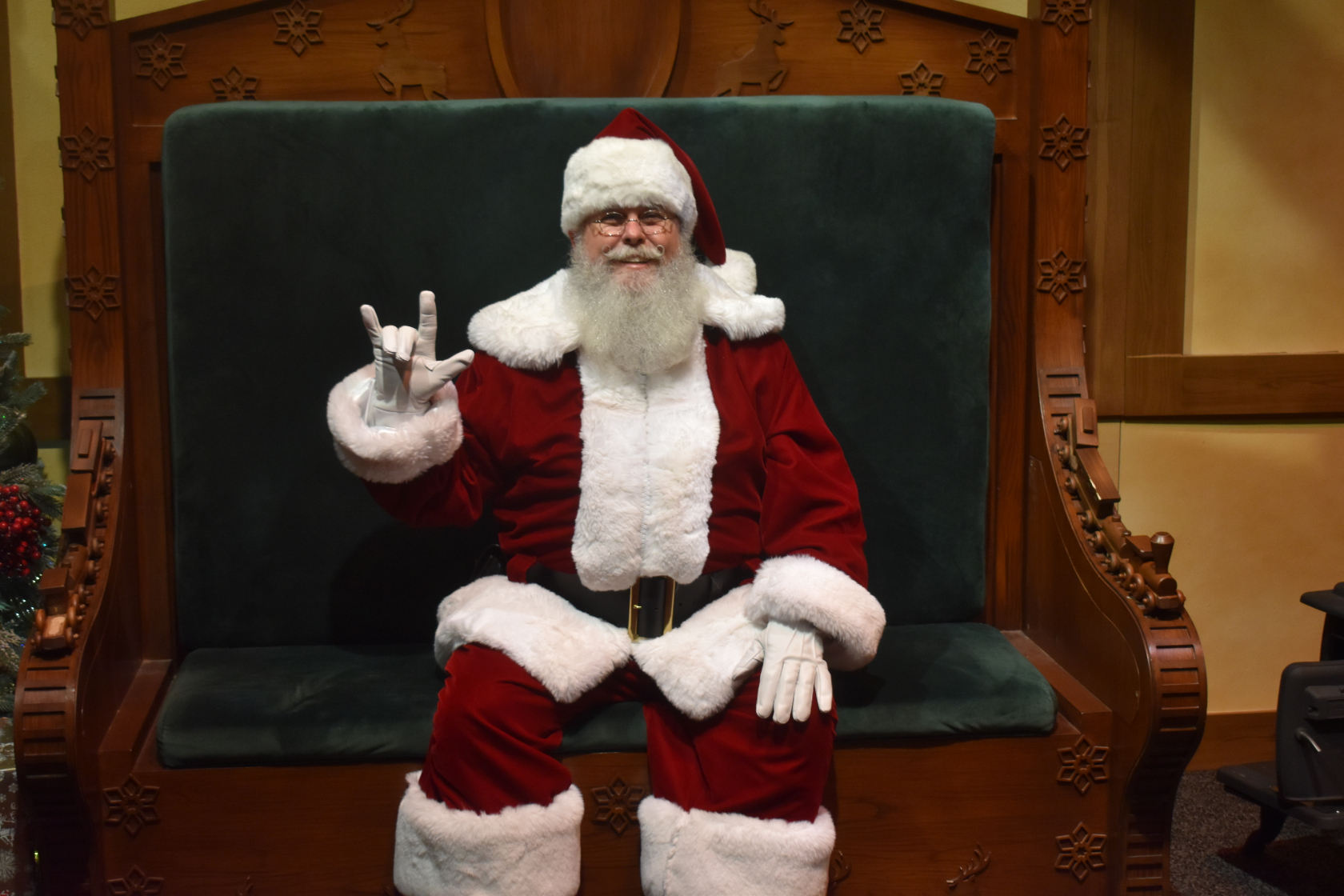
Santa’s real name is Charles Graves. He’s deaf, so even when he’s not the man in red, he communicates in ASL. Graves is a residential counselor at the Texas School for the Deaf where he’s helped kids like him for more than two decades.
About four years ago, Graves realized that his physique suited a seasonal transformation into Santa Claus — and he knew that he could offer something more than other Santas.
“There are a lot of hearing Santas out there,” Graves told DCist/WAMU through ASL translator Anthony Mowl. “And for that child to be able to look up to somebody who’s like them … that’s why I do this.”
This is the first year Santa Charles left Texas for the holiday season. Both he and Mowl, who works with Graves to book gigs and spread their message, knew that the D.C.-area had to be one of their stops.
This region has one of the largest deaf and hard-of-hearing communities in the country. There are more than 20,000 such residents in the District alone, per the city government.
One of the biggest reasons is Gallaudet University in Northeast D.C. It’s the only liberal arts college in the world specifically designed to be barrier-free for students who are deaf and hard of hearing. Santa Charles paid a visit to the school over the weekend.
Mowl himself is a Gallaudet graduate and now lives in Austin, Texas. As Mowl describes it, he is “the fourth generation of my family to be born deaf.” He first met Graves several years ago, when he took his own daughter to meet the deaf Santa.
“He just took my heart away,” he says. “Every child should be able to see a Santa that they can relate to, that they can understand, and is a reflection of themselves.”
Mowl realized, with Santa Charles’ help, there was a real opportunity to show that “even the most magical man in the world, he can be deaf.”
The mission goes beyond just providing a chance for kids to meet a deaf Santa. Mowl notes how people who are deaf and hard of hearing are “drastically underemployed.”
Data backs this up. Only 55% of those in the deaf community were employed as of 2019, compared to 71% of those in the hearing community, according to statistics from the National Deaf Center. Graves hopes that by familiarizing people with a deaf Santa, perhaps it will open up opportunities elsewhere for those in the Deaf community.
“We’re hoping they get more attention on this, to create more jobs, more opportunities for deaf Santa Clauses,” he says. “We just want equal access, equal opportunities.”
It’s also about representation and inclusivity. Just last month, the documentary Santa Camp premiered on HBO Max. It tells the story of three Santas that have historically been underrepresented — a Black Santa, a transgender Santa, and a Santa with a disability — and their experiences at a weekend-long camp that teaches the ins and outs of being Santa.
Mowl says the movie had “the right idea” with the message of inclusivity and helping every kid to see themselves in Santa. But what he felt was missing was the discussion of how those Santas can get jobs; it didn’t really deal with “finding people who want to create a space” to employ underrepresented Santas.
Santa Charles’ visit to the Gaylord is a step in that direction. Cleo was “in awe” meeting a Santa Claus that communicates the same way she does, her parents told DCist/WAMU.
“To see Santa as a person, as a real life character, and he can be here and be an example, that is just so fantastic,” said Cleo’s mom, Genie Gertz, in ASL through an interpreter.

Patrick Boudreault, Cleo’s dad, added through an interpreter, “This is a great example of representation. Representation matters.”
Franklin Torres, 8-year-old Ramon’s dad, says that there was always something missing from their previous visits to “the man with the bag.”
“At the mall, they’d have huge lines to see Santa and we’d always wait patiently to go see him. But no word of communication. Just a wave, a thumbs up, and a pat on the back. And that was it,” Torres said.
Having a deaf Santa changes that, says Ramon’s mom, Norma Morán.
“It’s the magic of Christmas for our kids,” she says.
Ramon says it “felt really good” to meet a deaf Santa because it was “easy to communicate with him.” That hasn’t been the case for the other Santas he’s met.
“I thought other Santas [I’ve met] were all really fake. They had fake beards and the hat and the suit … sometimes the beard would fall off,” Ramon said through an ASL translator.
So, was this Santa real then?
“Yes,” Ramon says, beaming. “He’s real.”
Correction: This story has been updated to correct the spelling of Ramon and Norma’s surname. It is Morán.