Martin Austermuhle
The D.C. Court of Appeals on Thursday revived the long-running fight over whether a condo building can be built on a small, privately owned concrete plaza in the heart of Adams Morgan. A lower court must now hold a trial to consider arguments from two community groups that a promise was made decades ago to keep the plaza as public space in perpetuity.
In its ruling, a three-judge panel of the city’s highest court found that the two community groups — the Kalorama Citizens Association and Adams Morgan For Reasonable Development — have standing to wage the legal fight over the plaza’s fate. The panel also determined that the groups’ argument that an easement exists on the land have enough merit to justify a full jury trial to consider the issue.
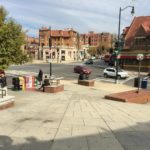
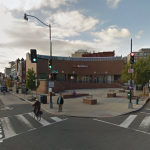
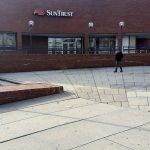
The case dates back to 2017, when the groups sued to stop SunTrust Bank — now known as Truist — from selling the 4,000-square-foot plaza at the intersection of 18th Street and Columbia Road NW to a group of D.C. developers who wanted to construct a 54-unit condo building there.
The two groups argued in the lawsuit that in 1976 the plaza’s then-owner — another bank — had dedicated the space to public use (known as a public easement) as part of a negotiation over ending a lawsuit in which the bank was accused of not offering mortgages to minority homebuyers. Since then, they said, the plaza had become a central gathering point for Adams Morgan, hosting a weekly farmers’ market and other occasional public gatherings.
The banks that have owned the site argued that while they allowed the plaza to be used for the market and other public uses, it was always under the knowledge that the site was privately owned and could eventually be used for other purposes, like the construction of a residential building.
The case jumped between local and federal court until a D.C. judge ruled against the two groups in 2021, saying there was little evidence that such a public easement existed. But on Thursday the appeals court ruled that “a genuine dispute of material fact exists as to whether the bank intended to offer the public an easement… and if so, whether it continues.” The court also ruled that public easements don’t formally have to be accepted by the government to be legal; rather, acceptance by the public at large suffices.
“The Court of Appeals has ruled that ordinary citizens can stand up to big banks who break their promise to preserve public space. This is a huge win for the public’s right to enforce community agreements, and to assure that space dedicated to public use is not later sold to private interests,” said Paul Zukerberg, an attorney for the two groups and an Adams Morgan resident.
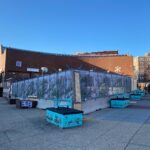
Earlier this year the plaza was fenced off by Truist Bank, which said it was blocking off public access because of health and safety concerns related to a small homeless encampment there. Some community groups said those residents experiencing homelessness were forcefully evicted, though city officials contest this. One of the residents, Miguel Gonzalez, died nearby shortly thereafter, and advocates say the closure of the plaza encampment was partly to blame.
“We hope they’re going to take down their military barriers,” said Zukerberg. “It’s a fortress.”
In an email, a spokeswoman for Truist said the bank “is evaluating the ruling and next steps.” (Truist was created by a merger between Suntrust and BB&T. Truist now operates the old BB&T location across the street from the plaza.)