
 Aja Drain
Christmas weekend is almost here, but rain and record-low temperatures may cause sudden freezes and create headaches for drivers and flyers alike. Nearly 2.5 million D.C. area residents will be traveling between Dec. 23 to Jan. 2, with the majority of them –around 2.3 million — opting to drive. Another 141,000 will be flying, and around 95,000 will be using other modes of transportation.
“This year, travel time will be extended due to Christmas Day and New Year’s Day falling on Sundays,” Ragina C. Ali, Public and Government Affairs Manager for AAA Mid-Atlantic in Maryland and Washington, D.C. said in a press release. “With hybrid work schedules, we are seeing more people take long weekends to travel because they can work remotely at their destination and be more flexible with the days they depart and return.”
The holiday travel craziness is only going to be exacerbated this weekend by an incoming storm. But we know you’ve got places to go and people to see. So here’s what you need to know to prepare:
Arctic air and freezing temperatures are coming our way today with about 1-2 inches of heavy rain through this afternoon into the evening.
“The good news, though, is it should let up by around nine or 10 p.m. this evening,” Meteorologist for Capital Weather Gang Dan Stillman says. “So that will give us most of tonight for pavement to dry. Temperatures in the 40s this afternoon should actually rise to near past 50 this evening ahead of the Arctic Front.”
But when that Arctic Front comes on Friday, travelers should be on the lookout. Another band of showers is predicted for tomorrow morning, possibly turning into snow around 6 a.m.-10 a.m.
“[The showers] could leave enough wet spots on the ground for that flash freeze risk as temperatures rapidly fall from near 40 mid-morning, Friday morning into the 20s before noon in the teens by late afternoon,” Stillman says. He emphasizes that the freeze is possible, not necessarily probable. But for drivers traveling tomorrow, he says the best thing to do is to avoid the hours of the frontal passage from mid-morning into early afternoon.
“Between the rain and potentially snow showers, strong, gusty winds, and yes, that uncertain flash freeze risk, I would just lay low those few hours while the front comes through until things calm down just a bit,” Stillman says.
By Christmas Eve and Christmas Day, there shouldn’t be any more precipitation, but temperatures may be the lowest we’ve seen in decades, with Christmas Eve temps predicted to be 15-22 degrees and Christmas Day at 16-27 degrees, according to the National Weather Service.
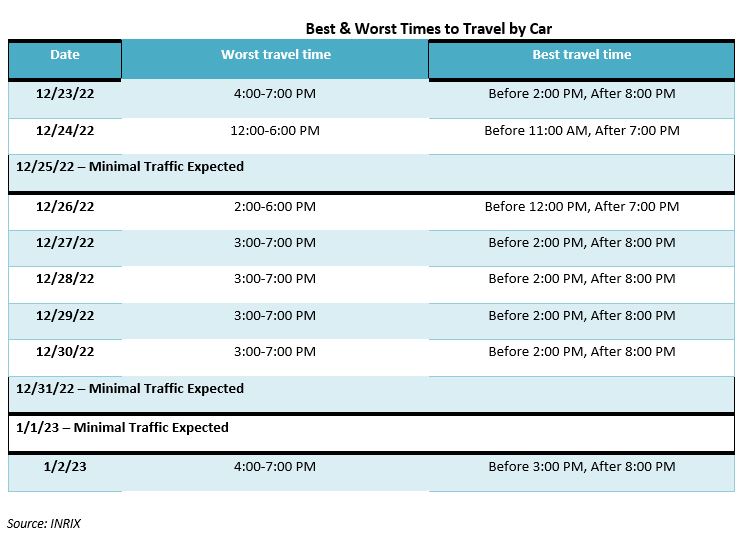
In addition to the weather, the worst traffic on the road is expected to be on Dec. 23, 27, 28, and on Monday, Jan. 2, according to AAA. The most congested times are expected to be this Friday between 4 p.m.-7 p.m. and on Saturday from 12 p.m.-6 p.m. And what’s holiday car travel without our beloved backups on I-95? AAA anticipates peak congestion after Christmas on Dec. 27 between 9:30 a.m.-11:30 a.m. on I-95 South, MD-212 to Central Ave.
If you’re driving in rain, snow or in icy conditions, AAA recommends first checking your car battery and tires, and packing a winter emergency kit as preventative measures ahead of the storm. Stillman also says to watch real-time weather conditions on the day you’re traveling and make sure to fill your gas tank to keep it from freezing.
And flights will be impacted by the weather as well. Stillman says those gusty 40 to 50 mph winds from the Arctic Front could cause flight delays. Across the U.S., over 47,000 flights are scheduled for this Thursday, according to the Federal Aviation Administration, but the Midwest is supposed to be hit with a massive winter storm that could impact flights across the system.
“When there is a big weather event somewhere in the country it can affect the availability of flights elsewhere in the country,” a spokesperson for the Metropolitan Washington Airports Rob Yingling says. “That’s why it’s important to check the status of your flight. Even if you’re not flying to or from the city where weather could be a factor. Because at some point during the day, your plane could be passing through that location and a disruption could affect the timeliness of your flight.“
Flight cancellations have already begun, with airlines offering vouchers to some passengers, according to the Washington Post.
In addition to the weather, Yingling says there are other things to keep in mind for air travel. Similar to Thanksgiving, flyers should be aware of high demand for parking at airports and heavy road traffic near airports over the next week. But he says that Metro accessibility for Reagan National and Dulles International can help people beat the traffic.
If you’re bringing gifts through TSA, he advises not wrapping them, since there my be issues with screening on their X-ray machines. And of course, make sure to budget extra time for when you get to the airport.
“People shouldn’t expect to just breeze through the airport at the last minute,” Yingling says. “It’s prudent to budget at least 2 hours after you arrive at the terminal for a domestic flight and 3 hours for an international flight.“
For more information and help planning your trip to the airport you can check FlyReagan, FlyDulles, and BWI’s website.