Jacob Fenston
The health of the Chesapeake Bay has plateaued in recent years, despite billions of dollars spent on a decades-long regional cleanup effort. That’s the conclusion of the latest report card from the Chesapeake Bay Foundation.
Among the top challenges identified in the report: climate change, increasing suburban sprawl, and tough-to-tackle pollution from farms. It’s not all bad news though: an infusion of federal cash and beefed-up enforcement could make a big dent in pollution.
The State of the Bay 2022 report gives the nation’s largest estuary an overall grade of a D+, the same as the last report, in 2020. That’s only five points higher (on a scale of 100) than the first report card, issued nearly 25 years ago.
The two major pollutants damaging the bay are excess phosphorus and nitrogen. These nutrients feed algae, using up oxygen in the water and creating dead zones. They come from many sources, including waste water treatment plants, urban stormwater runoff, and fertilizer used in agriculture. According to the report, phosphorus pollution improved slightly, gaining two points, while nitrogen pollution remained steady.
Other health indicators were also mixed. Blue crabs are on the decline, though still relatively healthy – dropping five points, but still receiving a B grade. Oysters, on the other hand, are showing signs of rebound and gained five points, but still earned an F.
In 2021, the blue crab winter survey showed the lowest number of crabs on record – the third consecutive year of lower-than-average numbers.
Oysters had record high reproduction in 2020 and 2021.
“Every species has a niche that it likes to to be successful in,” explained Chris Moore, a scientist with the Chesapeake Bay Foundation, during a press conference Thursday morning. In any given year, conditions in the watershed, “from dead zones, to atmospheric conditions, to other habitats, all affect different species differently,” Moore said.
Climate change has a negative effect on the bay in numerous ways, according to Beth McGee, director of science and agricultural policy with the foundation. “More severe storms, more precipitation, means more pollution coming into the bay,” McGee says.
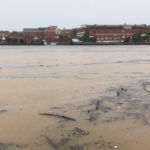
In recent years, heavy summer and fall storms have dumped heavy loads of pollution into the bay and its tributaries, including the Potomac and Anacostia, slowing down cleanup progress. Such weather is becoming more common in the mid-Atlantic because of global warming.
Warmer water in the Chesapeake also has a cascading impact on the bay ecosystem, pushing out some native species, and allowing invasives to thrive. At the same time, warmer water holds less oxygen, making it harder to fight the Chesapeake’s dead zone. Rising sea levels threaten some 250,000 acres of wetland in the bay watershed.
At the same time, forests and farmland continue to be cut down and paved over, causing more pollution to wash into the watershed. In just four years, some 95,000 acres of farms and forests were developed in the region.
Officials in the region recently acknowledged that they’re unlikely to meet the 2025 deadline to clean up the Chesapeake Bay. Advocates blame a lack of enforcement from federal regulators, especially during the Trump years, as well as a lack of sufficient funding.
While progress has been made toward pollution reduction goals, much of the remaining work is more difficult. The largest reductions so far have come from upgrading wastewater treatment plants. Now, some 90% of the remaining reductions are expected to come from the agricultural sector, where pollution is much more diffuse and harder to tackle.
On the bright side, hundreds of millions of federal dollars – potentially billions – are now set to be invested in the Chesapeake Bay cleanup in the next few years. This includes $238 million from the bipartisan infrastructure law passed in 2021.