 Sarah Y. Kim
Rosalynn Talley arrived at the Martin Luther King Jr. Memorial Library at 9 a.m. on Friday with a mission in mind: to get off of the waiting list for public housing she’d been on since 2009. By noon, and much to her surprise, it had happened.
“I don’t live good where I’m at. I live in a bad neighborhood and I got mold in my house,” Talley said. “And I’m living really crowded, I’m smashed up like sardines. I’m glad I’m getting a bigger place.”
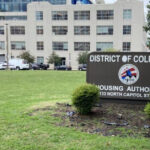
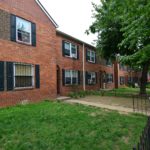
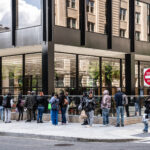
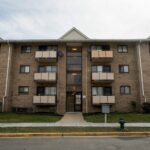
Talley was one of hundreds of people who lined up outside the library on Friday for an event held by the D.C. Housing Authority aimed at quickly moving people off of the agency’s waitlist for public housing and into one of the city’s many vacant housing units. As of last year, more than 24,000 people were on the waitlist, which has been closed to new applicants since 2013 but hasn’t seen much movement in recent years.
Housing Authority Director Brenda Donald said Friday’s event will be the first of several in-person events where the authority will invite people on the waitlist, confirm their eligibility, and match them up with available housing to move in. They could be housed within 30 days or even a couple weeks, much faster than the usual pace, Donald said.
The Housing Authority has been under scrutiny since a damning federal audit last year that found that the agency is failing at basic tasks and that a quarter of the District’s public housing units are unoccupied. Shortly after that audit, Mayor Muriel Bowser introduced an emergency bill that would replace the authority’s 13-person board with a smaller one, which the D.C. Council passed in December.
Donald, who became director in August 2021 and has pledged to reform the agency, said the previous administration “really didn’t do outreach” to the public housing waitlist, focusing instead on getting public housing for people already in units that they may needed to have moved out of. “We still do that. But that doesn’t increase your occupancy rate. That just moves people around,” she said.
Speaking on WAMU 88.5’s “The Politics Hour” on Friday, Bowser said she is “really gratified” that the authority held event, which she says will be the first of several “mass lease-up fairs” and suggested will be more efficient than previous methods of outreach.
The event, which began at 8 a.m. Friday morning, is set to wrap up in the evening. Donald said turnout has been “fantastic” and they’ve been making progress recently in reaching out to people in need. Over the last year, she said, they did outreach to about 7,000 people on the waitlist. For the event Friday, letters and robocalls were made to 5,000 people on the waitlist; roughly 1,000 said they would attend.
Talley, who currently lives on Alabama Avenue SE, said she’d long given up on getting matched with public housing. So when she learned of Friday’s event about two weeks ago, she was surprised. Coincidentally, the event was scheduled on her birthday. “I thought it was a joke or a scam,” she said. “It’s a blessing.”
Talley made it inside the building at around 10 and was matched with housing shortly before noon. Talley hasn’t confirmed where exactly her new home will be, but said she listed her preference as somewhere in Northeast or Southeast D.C. Talley said it’s “been really sad” waiting about 14 years, and that the Housing Authority needs to get through the list faster. But she feels the agency has been “a little bit better” at outreach than they were years ago.
Michael Browne, who lives in Congress Heights in Southeast, got to the library at around 9:45. About two hours later, he made it indoors. Like Talley, Browne has been on the waitlist since 2009. A lot has changed since then — he’s now 45, and “much more responsible” than he was in his early thirties.
“Truthfully, I forgot about it,” he said of the public housing list.
Browne’s still not sure what to expect from Friday’s event. He said he doesn’t have any expectations, and he’s not sure if he can get public housing where he needs to be. He needs to take care of his mother, who recently had a heart attack and had bypass surgery. Right now, they live near other family members who can step in and help him take care of her.
If he does get public housing at a convenient location, it would mean he wouldn’t have to work as much, and that would give him more time to be with his mother.
“I don’t know how long my mother will be here,” Browne said. “I do have a lot of regret because as I tell my mom, either I can work so that way I can help you pay your bills and take care of your home. Or I could be here.”
Browne said there needs to be better communication from the authority and that some people have waited even longer than him. He said the person in front of him had been on the list for 20 years.
“Especially because the bulk, as you look out here, is minorities,” he said. “There’s people that’s not going to even make it because they don’t even know. Because they’re probably homeless, dead, or have moved on successfully. And maybe they haven’t made it successfully, but they’re finding a way to make it.”
His own mother was one of those who “found a way to make it,” as he put it. When he was a kid, she was on a public housing waiting list. When a similar event was held back then to match people with housing, she didn’t go. By then she was at the top of the list.
Rhondelle Lincoln, who also lives in Southeast, hopes to make her current apartment a part of D.C.’s public housing. That way, she won’t have to pay about $2,300 a month for her duplex on a $50,000 yearly salary.
“I am gainfully employed but I’m literally almost living from paycheck to paycheck,” Lincoln said. She’s working with her landlord to make the transition happen and said it would be a “win-win situation’ for both of them.
Lincoln says it’s “not right” that there D.C. has so many vacant, habitable buildings and can develop while leaving so many unhoused.
“You have all these million-dollar businesses, buildings going up, half of them are vacant. But our people are still down here on the ground. That’s not fair,” Lincoln said. “This is Washington, D.C. None of us should be homeless in Washington, D.C. Hopefully a lot of us will be living somewhere nice by the end of the year.”
As for Donald and Housing Authority officials, the scrutiny is likely to continue: the agency has to show progress by the end of March in addressing the deficiencies identified by last year’s scathing federal audit.
Martin Austermuhle contributed reporting.