 Aja Drain
The Montgomery County Office of Animal Services has reported an increase in patients with the dog flu in the past couple of weeks. It’s hitting pets during a veterinarian shortage, long waits for appointments, a limited supply of flu vaccines, and increased travel. But animal healthcare workers are advising pet owners not to panic.
Canine influenza is typically spread through respiratory droplets and contaminated surfaces. Symptoms include a “goose-honking” cough — as Dr. Marianne Bailey, a veterinarian in Queenstown Veterinary Hospital on the Eastern Shore, puts it — runny nose, eye discharge, fever, lethargy, and poor appetite. Some dogs can also have the flu, but remain asymptomatic; others will experience severe symptoms. But most dogs recover within two to three weeks
“But if there is a decrease in appetite, they’re sluggish, they’re coughing to the point that it’s causing them to spit up or vomit, then I definitely would get them seen by a veterinarian,” Bailey says. “At least get them something to make that cough kind of a little bit more mild.”
Canine influenza is not transmissible to humans, but people can spread the virus to dogs from clothing, equipment, or hands. Dogs diagnosed with influenza should be separated from other animals for at least 28 days.
“If you have an infected dog that travels to another place, the influenza virus can stay on a contaminated surface for 48 hours,” says Maria Anselmo, community relations manager for the Montgomery County Office of Animal Services. She adds that it can also stay on your hands for 12 hours and clothing for 24 hours.
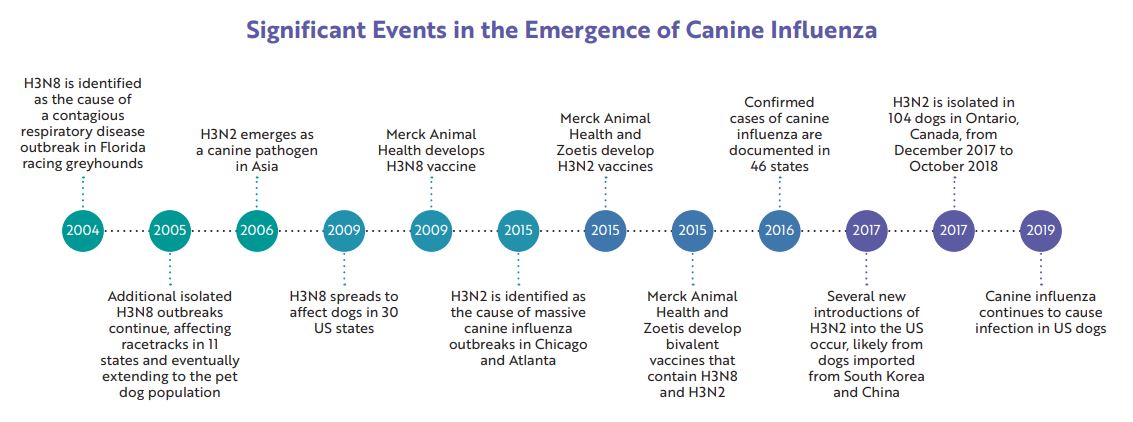
Canine influenza is a relatively new disease. The H3N8 strain of the virus originated in horses, but in 2004 the illness started appearing in the dog population of the U.S., according to the Centers for Disease Control and Prevention. H3N2 – another strain of the virus that originated in birds – caused an outbreak in Chicago in 2015.
Canine influenza is not a required reportable disease in Maryland, so numbers are most likely an undercount. Anselmo says they confirmed 57 cases and five deaths last week in Montgomery County, with the likelihood of more cases appearing since then.
Veterinary emergency units in Maryland have seen a spike in the flu for the past month and a half, Danielle Klein, Practice Manager at CARE Veterinary Center in Frederick, MD, said via email. Klein said their team saw 10 cases of influenza in one day.
The biggest risk right now is holiday travel as we approach Martin Luther King Jr. weekend. Bailey says dogs can spread canine influenza pretty easily when they’re boarded up in high-density settings. Doggy daycare, socializing events, animal shelters, and other spaces where dogs are exposed to each other are also risky settings, Bailey says.
“Despite the facility’s best [intentions], most dogs are not showing any signs when they start spreading it,” Bailey says. “So there’s no screening really to know if the pet could have it before they get there.”
As cases of canine influenza are rising, so too is the demand for the vaccine to treat it. The flu vaccine is not considered a core vaccine for dogs, according to Anselmo – it’s known as a “lifestyle vaccine,” meaning it’s usually only used for pet owners who leave their dogs in boarding or daycare often. But now, with more cases due to the outbreak, demand has increased with the same limited supply at veterinarians’ offices as before. Bailey says that at her Eastern Shore hospital, influenza vaccines are on “rolling backorder.”
“So we’re allocated how many we can get right now. And when those are gone, we can’t get more until the next batch,” Bailey says.
Meanwhile, shortages of veterinarians and vet support staff members are straining pet care capacity around the country. Pet owners may struggle to schedule appointments with their vets. Even for a regular annual exam with her own dog, Anselmo had to book a month and a half in advance.
DC hivemind- I have a sweet cat who is in need of medical attention (she has developed a limp and is more irritable than usual.) Every vet I call has a 3 week waiting period for new appointments and no mobile vets are taking new clients. Does anyone have any leads?
— Bridget Todd 💁🏿 (@BridgetMarie) September 30, 2022
Oof, yea. I had to book my pup’s yearly exam months in advance, and they never have anything available if you need something within the same week. For reference, I go to VCA MacArthur.
— Carly Cloud (@CarlyC26) January 13, 2023
With the increased demand, Anselmo says more people are calling their vets for vaccine appointments, so you may see some backlog. She also adds that it’s important for pet owners not to rush to the vet out of panic, especially if symptoms aren’t severe, to avoid overtaxing vet offices.
If patients need immediate care, 24-hour pet emergency rooms are available. At CARE Veterinary Center in Frederick, MD, wait times vary, but historically, the busiest times are nights, weekends, and holidays, according to Klein.
“On busy days, the average wait time can be two to four hours,” Klein said via email. “However, similar to human ER, we will triage and prioritize patients based on the severity of their cases.”
With the flu vaccine in high demand, Bailey encourages pet owners to consider other forms of preventative care if their dog isn’t in urgent need.
“So we just really encourage people only to get the vaccine if they actually need it, if they’re going to be boarding their dogs that can be exposed to other dogs,” Bailey says. “If they’re not going anywhere for six months, maybe let’s wait and save it for someone that’s got plans to travel next month.”
Additional precautions include: limiting direct contact with other dogs on walks (sorry, no sniffing!); avoiding shared toys/dishes; avoiding high-density dog spaces; and contacting the dog’s daycare and facility to ask about their recent cases and cleaning protocols.