Margaret Barthel
The Arlington County Board may take an important step on Saturday towards approving a significant — and controversial — zoning change.
The Board will consider moving forward into the final phase of crafting zoning policy following its Missing Middle Housing Study. The plan would edit the county’s zoning standards to allow “missing middle” units — duplexes, triplexes, and small multi-family buildings — in neighborhoods that currently only allow single-family detached homes. Those neighborhoods account for about three-quarters of the county’s residential area.
Most members of the Board have expressed some degree of support for the concept, but there are plenty of details still to be hammered out. They include how many units could be built in a building (up to 8-plexes, though an alternative would cap the number at six), a wide variety of design requirements like parking and tree cover, and a potential limit on the number of lots per year that could be developed into missing middle-style homes.
On Saturday — following what will likely be a very long public comment period — the Board could vote to “advertise” the policy, which would identify the range of options for final consideration and start a 60-day countdown for a final vote.
The goal of the change, according to the county, is to increase and diversify Arlington’s housing supply and ultimately provide more housing options for residents to choose from, either as rentals or homes to purchase. Long-term, county leaders hope that the policy could give a wider cross-section of homebuyers a handhold on the homeownership ladder, which is out of reach for many. (In 2022, a single-family home in Arlington went for $990,000 on average; a townhouse was $720,000, on average, and a condo or co-op unit was $355,000, all according to an analysis from the real estate firm Redfin.)
It is a nationwide and regional issue, but the problem of rising housing costs has been accelerating in recent years: average home sales, of any type of unit, have skyrocketed in Arlington in the past decade, from $575,125 in 2012 to $791,000 in 2022, according to data from the Northern Virginia Association of Realtors.
The Missing Middle plan, advocates say, would also reverse Arlington’s decades-long history of exclusionary zoning, which prohibited construction of townhomes and other denser, less expensive forms of housing. This served to keep neighborhoods unattainable for prospective homeowners of color.

The controversy over expanding housing options in Arlington is as loud as the county’s leafy single-family-detached neighborhoods are quiet. Opponents and supporters have starkly different visions about how allowing missing middle construction would play out in the county.
Opponents see an overcrowded, uncomfortable future where Arlington’s suburban neighborhoods suddenly have too many people, not enough parking, fewer trees, and more impervious surfaces that could cause flooding and other infrastructure problems.
“I’d say the worst case scenario is that we envision urbanization in what is now currently a community, a village,” says Julie Lee, the president of the Glencarlyn Citizens’ Association and the leader of a coalition of 16 civic association presidents who do not support the missing middle policy. “We consider this a village-type atmosphere, and we want everyone to be able to live in our community. However, we don’t have the space to incorporate a city or urbanized living within this small village of a community that we have.”
Lee’s family has owned homes in Glencarlyn for generations (she bought in when she retired to Arlington). She is also a founding member of Arlingtonians For Upzoning Transparency, one of the main advocacy groups fighting the missing middle plans.
Supporters, meanwhile, see a long-term future where Arlington is a denser, more diverse, multigenerational community — and one where the divide between the people who live in the quieter, more suburban neighborhoods and the people who live in high-rise rental apartment buildings in transit-oriented growth corridors is not quite so great. They see current “teardowns” — when developers replace the county’s historical housing stock of small brick homes with far more expensive, large “McMansions” — as a threat to the county’s social cohesion.
“I worry enormously about a community that is exclusively very large houses,” says County Board member Katie Cristol, a proponent of the plan. “I think very large houses have their place in the community, but diverse housing forms create diverse communities.”
Opponents argue that the County Board could take steps to limit the size of homes built on single-family lots, which would make teardowns less lucrative.
Arlington Board Chair Christian Dorsey is philosophical about the public furor.
“If we were able to go through and do things that didn’t engender a great deal of community interest and even in some cases community upset, then it probably wouldn’t be all that consequential,” he says.
Similar debates are happening nearby, too. Pushed by housing supply shortages and high prices, leaders around the D.C. region are toying with the idea of expanding zoning options. Montgomery County recently approved similar changes to its general plan, after a similarly fierce battle. Nearby Alexandria is about to begin exploring a new “Zoning For Housing” initiative. Housing advocates in Arlington feel all eyes are on the missing middle vote and the fierce debate around it.
At the center of much of the Missing Middle debate are questions of affordability — who will be able to afford the potential new units, when might the community and housing market begin to see the effects of the policy, and how the proposed zoning change fits into the county’s larger project of keeping housing in its 26 square miles (at least sort of) affordable.
Will missing middle housing units be affordable?
It depends on what you mean by “affordable.” When housing policy experts refer to “affordable housing” or “committed affordable housing,” they usually mean housing units that have received some kind of government subsidy in the development process to keep prices down. (More on those later.)
Missing middle units, in contrast, would be market-rate. And for many people, they would still not be affordable to buy or rent, at least not immediately. Households making at or above area median income — $128,100 in 2022 — are the group the county believes could stand to benefit most from missing middle construction.
For example, a newly-developed missing middle unit with 2-3 bedrooms in a triplex or 4-plex could run between $700,000 – $900,000, according to county estimates from May 2022. At the time, the county suggested those units would be affordable to households bringing in $124,000 – $160,000 per year. (Some note that the county’s assessment of affordability assumes a fairly large down payment and were calculated before interest rates jumped up in response to inflation.)
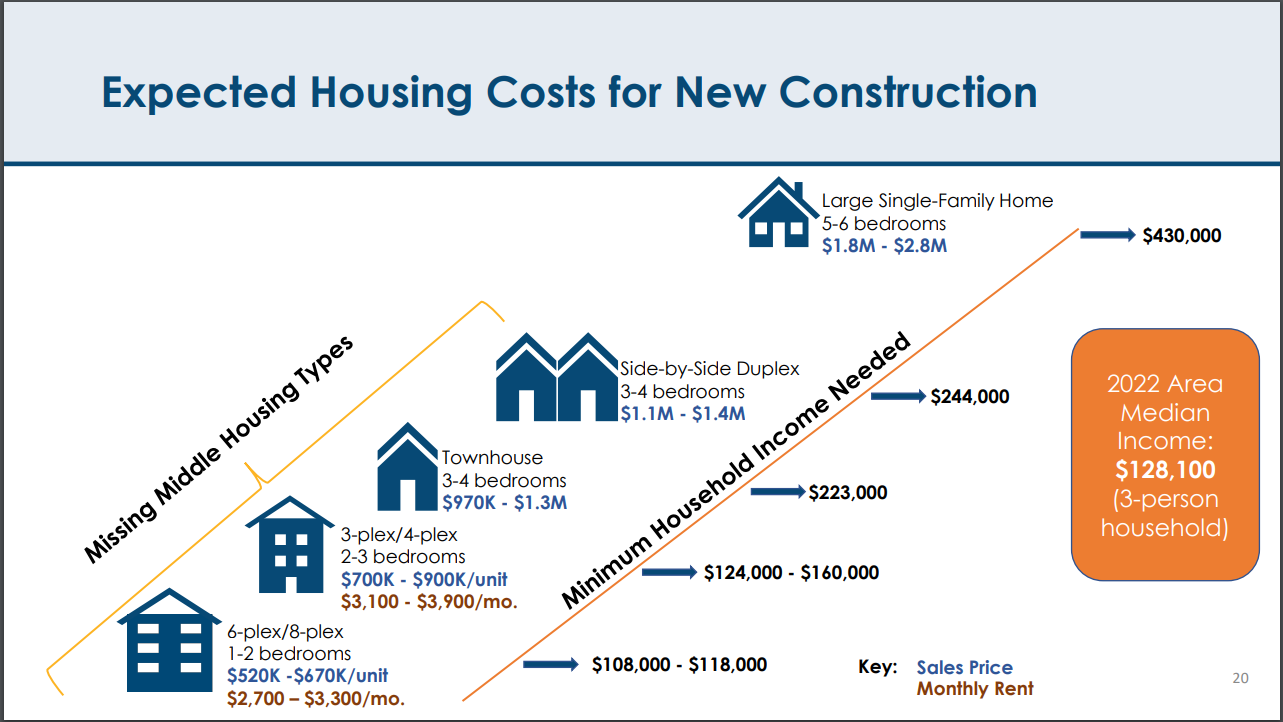
Newly developed side-by-side duplexes would run above $1.1 million, according to estimates, above the price of some older, smaller single-family homes in the county and just above the 2022 average price for single-detached homes in Arlington ($990,000, according to Redfin).
Critics of the policy, like Lee, point to these numbers as a sign that it’s doomed to fail. She feels the county and supporters of the missing middle plan have done an about-face in talking about “affordability” as one of the plan’s primary goals.
“They have completely abandoned any talk of affordable or reasonably priced housing,” Lee says. “They have acknowledged that what is being offered now is not going to be of help to low or moderate income households. They acknowledged that fact, but the message is not getting out.”
But Cristol and other supporters say the initial sticker shock is only part of the missing middle affordability equation. As these units age — and as the supply gradually increases — prices could moderate, a phenomenon that Cristol is personally familiar with.
“Over 30 years, you start to see a supply of midlife missing middle-type housing. And that’s what serves to deliver on the affordability,” she says. “That’s what creates the small condo that was 30 years old that let me buy into Arlington. That’s what created the 12-year-old townhouse that I could then buy next.”
Others point out that the pace of building will likely be slow, making it difficult to affect housing affordability in a noticeable way, even over the long term. In Portland, Oregon and Minneapolis, two cities that recently enacted similar zoning reforms, the change has been slow to take hold in the market, producing a small number of new multifamily units in the first few years.
Advocates also argue that allowing Missing Middle redevelopment could help curb the trend of “teardowns” in the county, where builders buy lots and raze smaller, older single-family homes — the county’s supply of somewhat-less-expensive detached houses — and put up much larger, newer homes that can sell for significantly more money, thus maximizing profits. Between 2012 and 2021, county data show, upwards of 1,700 single-family homes were completely redeveloped.
Allowing missing middle housing wouldn’t necessarily stop teardowns entirely, supporters say, but it would give builders the option to choose to put up a multifamily building instead. Even a $1.1 million duplex, they think, is better than a new single-family home that costs around $2 million.
“Developers seeking to maximize the value of redevelopment lots are likely to build significantly larger single family units of 4,200 to 7,000 square feet or larger with prices in excess of $1.8 million,” says a consultant analysis of construction and home prices in the county. “With opportunities for Missing Middle Housing, the mix of new housing would shift to include a wider range of housing types and prices.”

Lee and opponents of the missing middle plan feel that supporters have overemphasized the problem of teardowns.
“They’re using the biggest, most expensive, most egregious type of single-family home to compare to what they would like to be able to build. So I feel that it’s not a fair comparison,” she says.
Lee points out that her neighborhood and others nearby in South Arlington have had relatively few teardowns, and county data does indicate that teardowns have so far been concentrated in North Arlington neighborhoods. She worries that Missing Middle plans could incentivize tearing down smaller, relatively modestly-priced homes in her neighborhood in favor of multifamily units which could be almost as expensive. Instead, Lee and others are calling for the county to limit lot coverage, or how big builders can build new homes relative to the size of the land the home sits on, as a way to take away the profit margins for a teardown.
“Then we can deal with some of the homes that we have now which can be retained to be starter homes,” she argues. (Though, advocates for missing middle contend, such limits wouldn’t fix the fundamental problem of rising costs of housing due to limited housing supply.)
Could the Missing Middle plan cause displacement?
Maybe — but it also could create or preserve socioeconomic and racial diversity, depending on who you talk to.
Displacement has long been a fact of life in Arlington. Put simply, land in Arlington is extremely valuable, and extremely expensive. As its value rises, the cost of renting or buying a home increases, as do property values and property taxes — and that can price people, including people of color, out. In Arlington’s historically-Black Halls Hill neighborhood, for example, the population went from 70% Black in 1991 to just 22% in recent years. (Further into the county’s past, there have been more direct forms of displacement, like the government’s forcible removal of Black communities to construct the Pentagon.)
Opponents of the Missing Middle plan worry that it could accelerate the county’s long-running displacement trend. As noted earlier, the new zoning could incentivize developers to buy up single-family home lots and turn them into multifamily units.
That trend could leave seniors on fixed incomes and renters vulnerable, Lee says.
“We have many long term renters in my community here, and I’m very concerned that the lots that they rent on will be sold and they will be displaced,” she says.
One economist who opposes the plan called it “little more than micro-targeted poor-people removal,” in an op-ed in The Washington Post.
County analysis notes that those are real concerns on an individual basis — but also says that just 15% of housing in the zoning areas that could be opened up to missing middle development are rental properties, compared to the 62% of properties countywide which are rentals. (A majority of Arlington’s residents are renters.)
And that displacement risk, the county contends, would not be different than it is now, “where lower cost rental housing can be redeveloped as large single-detached family homes.”
Supporters of missing middle housing policy point to the displacement that has already happened across the county. In the long term, they see an opportunity to create some degree of socioeconomic and racial diversity in a county that has been losing it.
“Unfortunately, no, we’re not going to be able to get those communities of color who were displaced from Green Valley or Halls Hill or Arlington Mills back,” says Bryan Coleman, the second vice president of the Arlington NAACP (he rents an apartment with his partner in Courthouse). “But we should be asking ourselves, what are we going to do about that in the future rather than bemoaning what happened in the past. Because we can’t change the past. We can make things, though, not only symbolically, but tangibly better for future generations.”
There’s some data to support the idea that a wider variety of types of housing can lead to a more diverse community. Currently, the single-family zoned residential areas in the county have notably lower percentages of people of color (28%, on average) than areas that allow multifamily buildings (48%), according to the county.
Cristol points out that in a small number of cases, expanding zoning options could allow a new path to help struggling homeowners or people who have inherited homes hold onto them by creating the possibility of subdividing them into multiple units and perhaps renting one out.
Why is missing middle housing “missing” in the first place?
Starting in the 1930s when the county first began setting zoning policy and running through the 20th century, exclusionary zoning — limiting housing types to more expensive single-family homes — replaced explicit racial discrimination in housing policy, walling off neighborhoods from people of color by making home prices unattainable.
While Arlington has some missing middle-type units — they make up about a third of the housing stock — there have been decades where builders couldn’t choose to build them in large swaths of the county.
Coleman, with the NAACP, notes that the impacts of racist housing policies are still felt today. His own great-grandfather was denied the ability to buy a home in East Chicago in the 1920s — and with it the opportunity to build generational wealth — because of a racial covenant that forbade Black people from owning homes.
For Jane Green, one of the founders of YIMBYs of NoVA, a pro-housing group, getting rid of the exclusionary zoning rules that limited the building of different types of housing and perpetuated racist segregation in Arlington is reason alone to move forward with a missing middle policy.
“Single-detached-only zoning was a tool to keep neighborhoods segregated. So we must, we must end that period,” she says. (Green rents an apartment with her family in the Courthouse neighborhood.)
Lee and other opponents, meanwhile, argue that “symbolic” policy isn’t useful — particularly when, they believe, people of color do not stand to benefit from the new housing built under it.
“We need real value and we need things that will provide real improvements and real answers to diversity and exclusion,” she says. “And I just don’t see the missing middle providing that.”
County data suggests that 39% of Black households, 39% of Hispanic households, and 60% of Asian households in the D.C. region could potentially afford missing middle units as they are built, to say nothing of the longer-term effects of having a more diverse housing supply.
Coleman wants to see communities of color in Arlington included in the conversation over missing middle in a fuller way, and for the discussions to recognize the history of trauma and fears of displacement housing conversations carry with them in communities of color.
“I think we all shoulder responsibility, both nonprofit organizations and advocacy groups, as well as the County Board, to be sensitive to these these traumas and be particularly keen on addressing them before we try to engage in a systemic policy [change],” he says.
What are other ways Arlington can make housing more affordable, and how would the Missing Middle plan fit into them?
The county’s consideration of zoning changes dates back to 2015, with the adoption of the Affordable Housing Master Plan, which analyzed the county’s current and future housing needs and elaborated on the policy levers the county could pull in order to fulfill them. The master plan looked at strategies to build or preserve subsidized affordable housing units, as well as possible zoning changes to expand the housing supply more generally.
Arlington County does not own or operate affordable housing. Instead, Arlington and other jurisdictions in Northern Virginia help subsidize the production and preservation of so-called “committed affordable” units by helping to finance those projects with favorable loans (along with federal and state money). Localities typically do that through a dedicated housing trust fund, which they fund in a variety of ways: line items in their budgets, returned payments from previous projects, and contributions from residential or commercial developers. The county also has leverage to make exceptions for high-density development projects that help advance the county’s affordable housing goals.
Those “committed affordable” rental units are geared toward households who make a percentage of area median income — in Arlington’s case, often around 60-80% of the area median income (it’s harder and more expensive to subsidize housing for especially low-income households). Arlington’s goal, based on county projections of future need, is to have nearly 18% of its housing stock be affordable to households at or below 60% of area median income by 2040.
The effort is big: in the five years between 2015 and 2020, the county increased its total number of committed affordable housing units by 1,433, or about 287 per year.
If as planned that pace is sustained, it “will dwarf” the expected rate of new missing middle units, according to Cristol. County estimates suggest around 20 lots could be redeveloped each year under the Missing Middle plan, equating to around 100 new units (opponents, including Lee, have suggested there’s no good data to back that rate up; the county insists the numbers are based off of an analysis of the projected rate of return for constructing Missing Middle types versus single-family detached homes, plus early data from Portland, Oregon and Minneapolis, two localities that enacted similar zoning reforms).
But the two are still related, says Michelle Winters, a housing consultant who previously led the Alliance for Housing Solutions. She uses the metaphor of boats bobbing on a body of water. As the water rises — as market housing costs increase — you need more and more public subsidy to keep affordable housing boats floating at the water line. But if zoning policies can ultimately bring down the water line — or even just stop it from rising quite so fast — that eases the burden.
“It’s a really, really inefficient and ineffective way to think about creating housing affordability through only that one type of subsidy tool, rather than thinking about it in a two-phased process where the entire market works as well,” she says.
A lower water line in the housing market also makes it easier for the county to provide direct help to homeowners, Board Chair Christian Dorsey says.
“When you increase the number of units that are available on a particular parcel, it makes the ability to have homeowner assistance programs or subsidies for public employees — it makes those dollars stretch a lot farther,” he says.
There are other ways to ease housing costs, too. Arlington is in the middle of a study on homeownership, seeking to review its current programs and better understand community homeownership needs and goals. The county has an existing first-time homebuyers’ program which offers no-interest loans, and offers some support for struggling homeowners, too.
Coleman, with the NAACP, wants to see the county create a community land trust — an idea the county is considering — and is also eager to see rent stabilization policies, though those would need to be allowed by the state legislature.
Lee says she supports efforts to make housing more affordable, particularly in Arlington’s already-dense transit-oriented corridors. She also wants to see the county double down on providing mortgage assistance for lower-income and first-time homebuyers, tax help, and also suggests exploring designated housing for community employees. She also suggested Arlington consider trying to convert empty commercial office buildings into residential buildings, an idea that has garnered some interest in D.C., but which housing experts say is complicated and expensive.
Cristol welcomes the broader discussion about affordable housing that missing middle has sparked, and said she hopes community members will stay engaged in the issue.
“This has certainly brought a lot of people out to talk about affordable housing who maybe weren’t involved before,” she says. “And I hope that it is an opportunity for us to say, we’d really love your voices on this issue.”
Green sees signs in the political fight over Missing Middle for the larger question of affordable housing in Arlington, too.
“If we can’t get neighborhoods to accept small multifamily buildings, how can we get them to accept committed affordable housing, which we do sorely need in Arlington?” she asks.
Whew. So what’s happening on Saturday again?
Think of the Board’s meeting on Saturday as the step that could push the Missing Middle plan into its final phase of consideration. If the Board votes to “advertise” the policy, it will be putting a final set of options for the policy forward for 60 days of community scrutiny (along with more public hearings), followed by a final vote on the final structure of the policy.
So, the Board won’t be crafting the final policy on Saturday, but — again, assuming they vote to advertise — they will be setting the terms of the last leg of the debate.
Here are some of the major policy details that are still up for debate (see the county staff’s report for the full list):
- Total number of units permitted in a missing middle building. One option would cap the number at six, while another would allow for eight.
- How many units can be allowed on lots of certain sizes. There are several options for determining this in the staff report. One would allow any missing middle construction on any of the residential lots under consideration, and rely on design requirements like parking to dictate to builders how many units could fit on a given lot. Others specifically prohibit higher-unit buildings on smaller lots and add exceptions to try to incentivize more units near transit. (The complication here is that many of the county’s larger lot sizes, which would more readily accommodate larger buildings, are located further away from transit corridors, which tend to be surrounded by small or medium-sized lots.)
- A possible cap on the number of missing middle-type developments per year. One option here would limit the number of missing middle redevelopments — whether entirely new construction or a renovation — to 42 per year, double the projected number of new missing middle construction projects predicted by a consultant study. A second option would not add a cap.
- Parking requirements. Two options presented by county staff would designate certain lots as “transit proximate” and allow builders to build fewer parking spaces for those buildings, either half a parking space per unit or no required parking spaces per unit. In both cases, buildings in areas that are not near transit would need to have at least one parking space per unit. Other options require one space per unit across the board or would get rid of parking requirements altogether.
All those details matter, in part because design requirements and a possible cap all play a key role in dictating what is financially feasible for builders to build — a higher-unit missing middle building, a townhome or duplex, or a large single-family detached home. Cristol said she worries even with the expansion, developers will still default to large single-family homes, which already sell well, or better-known forms like townhomes and duplexes, not small apartment buildings, which the market knows less about and are therefore seen as riskier investments.
“I wish I knew what policy levers we could pull to ensure that we get more modestly-sized missing middle forms and not very large missing middle forms,” she said. “What I’m nervous about are the ‘duplansions,” she said, referring to extra large, more expensive duplexes.
Advocates like Green and Coleman hope the Board will choose to include the most expansive missing middle options in their advertised policy.
“If this doesn’t move forward, it will be a huge loss and the county will continue to be dominated by this idea that single-family homeowners are the leaders of this county, and they are the voices that we should listen to rather than the majority of the population, which is renters,” says Green.
Lee, for her part, hopes the county holds off. She wants to see more neighborhood-by-neighborhood studies done to figure out what possible impacts could be coming, and how they would affect specific communities. (County estimates suggest the Missing Middle plan could increase Arlington’s population by around 150 people per year across the county, which is why, Cristol says, they have not moved forward with the broader impact studies usually done for increases of 1000 people or more.)
“They want to provide more housing for people in Arlington, and I understand that. I respect that,” she says. “I believe that there are places in Arlington where missing middle-type housing should be put, where Missing Middle housing can be absorbed within the community.”
This story has been updated with information about Bryan Coleman’s neighborhood and family context.