Martin Austermuhle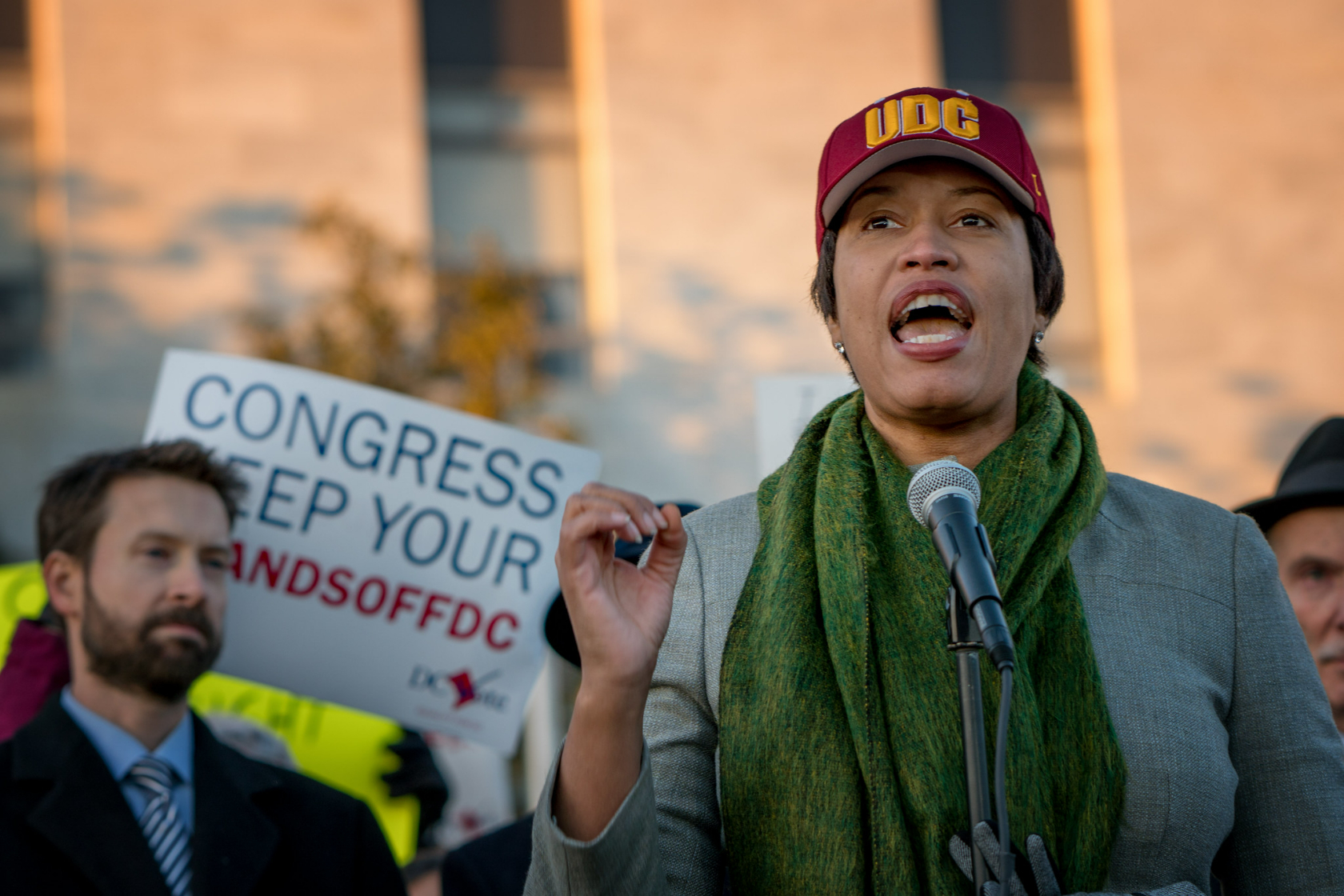
D.C. Mayor Muriel Bowser on Monday unveiled a package of changes she’d like to see made to the recently passed overhaul of the city’s century-old criminal code, just as House Republicans are pushing to repeal the overhaul in its entirety.
The dueling debates — one in the Wilson Building, the other in Congress — center on issues of crime and justice, and are happening as the city has seen a spike in gun-related offenses and carjackings. But they also touch on issues of local governance, with D.C. officials insisting they can responsibly manage the city’s affairs while Republicans in Congress counter that it’s their legal right to dictate how the nation’s capital is run.
And they’ve put Bowser in a difficult position, with Republicans citing her veto of the overhaul as proof that it should be repealed outright while she and other city leaders say that any changes to local laws are best handled by local officials.
Speaking at a press conference on Monday, Bowser said her proposed changes would address one of the biggest points of contention in the 450-page bill passed by the D.C. Council late last year that revises and modernizes the criminal code — that the number of maximum penalties for some violent offenses was reduced.
Proponents argue that the changes were made to more closely align sentences on paper and the sentences judges are actually handing down, and that the new penalties won’t make a difference in the current public safety context since they don’t go into effect until Oct. 2025. But critics like Bowser say that they send the wrong message to criminals.
“While no one believes that penalties alone will solve crime and violence, right now we must be very intentional about the messages we are sending to our community, including prosecutors and judges. If you bring harm to our city, you must be held accountable. People are tired of violence, and right now our focus must be on victims and preventing more people from becoming victims,” she said.
Bowser’s bill would largely keep current penalties for gun possession, robbery, burglary, and carjacking in effect in the revised criminal code. But it would remove two broader provisions in the revised code the council approved: one that expands the right to a jury trial to anyone charged with a misdemeanor, and another that expands the ability of people serving prison sentences to request early release.
Proponents of expanding jury demandability say that D.C. is one of only a handful of jurisdictions that limits who can request a jury trial, a policy that was implemented in the mid-1990s during a budget and staffing crisis in the city’s court system. As for allowing more people serving time in prison to ask for early release, supporters say it serves as a means to address people who have rehabilitated themselves.
Bowser said both those policy changes should be stand-alone bills that are subject to public hearings, instead of being included in the broader revision of the criminal code. Her bill would also further delay the full implementation of the revised code to 2027, two years later than currently planned.
But on Monday Bowser’s proposed changes took something of a backseat to the larger drama playing out on Capitol Hill, where House Republicans are expected to move forward with a pair of resolutions to repeal both the overhaul of the criminal code and another bill passed by the council that will allow non-citizens to vote in local elections starting in 2024.
“The D.C. Council’s radical rewrite of the criminal code threatens the well-being of both Washingtonians and visitors — making our nation’s capital city a safe haven for violent criminals. In response to this dangerous and severely misguided measure, it’s now up to Congress to save our nation’s capital from itself,” said Rep. Andrew Clyde (R-Georgia), who authored the resolution that would repeal the revised criminal code.
In 2021 Clyde compared the Jan. 6 insurrection to a “normal tourist visit,” and last year he said that D.C.’s locally-run government should be abolished. More recently, he attracted attention by handing out assault-rifle lapel pins to fellow Republican members of Congress. The revised criminal code increases penalties for the possession of assault rifles.
Over the weekend, all 13 members of the council sent a letter to House congressional leaders urging them not to move forward with the disapproval resolutions.
“The District of Columbia has the right to self-govern as granted to us under the Home Rule Act. Any changes or amendments to the District’s local laws should be done by the elected representatives of the District of Columbia. As those representatives, we alone are accountable to the voters of the District of Columbia. Just as Congress does not interfere in the local matters of other states, we compel you not to interfere in our matters,” they wrote.
And on Monday, Councilmember Brooke Pinto (D-Ward 2), who chairs the council’s judiciary committee, said that she will hold public hearings on Bowser’s proposed changes, but said that the immediate focus would be on stopping Congress from “unjustly and undemocratically overturning the duly enacted legislation of the District of Columbia.” Bowser made a similar point, arguing that for whatever disagreements exist over the revised criminal code, “We’ll fix it locally.”
Speaking on Monday, Council Chairman Phil Mendelson said that any move to overturn the revised criminal code would leave the city with nothing more than the existing criminal code, which was written in 1901 and everyone from prosecutors to public defenders has said is outdated, unclear, and ineffective.
“What we passed was a well-thought-out, deliberate, debated piece of legislation. It doesn’t mean people can’t disagree with it, but simply overturning it leaves us with nothing,” he said. “I’m certain that no member of the House has read the bill, and they don’t know what’s in that bill. So all we’re getting is political rhetoric in the runup to the 2024 election.”
In his own statement, Councilmember Charles Allen (D-Ward 6), who shepherded the revised criminal code through the legislative process, argued that some of the new penalties it includes would be stiffer than comparable sentences in some of the states represented by Republicans would are likely to support the disapproval resolution.
“Arizona, Kentucky, Kansas, North Dakota, Ohio, Georgia, and Tennessee have lower maximum penalties for armed carjacking than the D.C. law the GOP members pretend to care about. Further, Alabama, Texas, Kentucky, Montana, Arkansas, Illinois, Utah, and Virginia have lower mandatory minimums for first-degree murder than D.C.’s duly-approved measure. When did Congress tell those state governments they were wrong?” he said. “A whopping 35 states have the same right to a jury when facing jail time that D.C.’s measure would provide D.C. residents. Where was Congress’ concern when Alabama, West Virginia, Arizona, or Texas (among many other) state governments passed their laws?”
Congressional efforts to overturn D.C.-passed laws are few and far between, largely because it requires both the House and the Senate to pass resolutions and for the president to sign off on them. A 2015 effort to overturn a D.C. bill banning discrimination based on reproductive decisions succeeded in the House but stalled in the Senate, while in 2017 a House committee approved a disapproval resolution of a bill legalizing physician-assisted suicide in D.C., but it again gained no traction in the Senate.
Still, there remain concerns that some Senate Democrats could support repealing the revised criminal code, largely because the issue of public safety could be used against them during their next election cycle.