 Jordan Pascale
MetroHero, one of the most praised real-time arrival apps for Metrorail and bus service, is ending its eight-year run in July.
The app distinguished itself by showing exactly where trains were on the line, highlighting Metrorail and bus performance statistics, and allowing users to mark trains that had hot cars or crowding or disruptive passengers.
It also maintained an archive of historical data on rail trips, which has been valuable to journalists and other Metro watchers after crashes, derailments, and other incidents. You could see the exact times when trains passed through a station, and the train number, which was vital to deciphering radio communications during emergencies.
Its dashboard also shows average wait times, how closely trains were adhering to schedules on each line, and the number of eight-car trains in service, among other items. Advocates and regular people have used the data to hold Metro accountable. It’s data that they otherwise wouldn’t have access to.
But now, Metro is promising to deliver a similar customer-facing web-based dashboard in the coming months.
In a blog post, MetroHero developers James and Jen Pizzurro said the technology landscape was different back in 2015. The app used Metro’s publicly available data but made it easy to digest.
“There were no apps or websites that could show you where your train was,” he wrote. “This was especially a problem because WMATA at the time was also struggling to effectively communicate with its riders during a time when the system was beginning to literally fall apart due to poor management of deferred maintenance issues.

“Back then, we saw a clear gap in the market that we could fill given our backgrounds as software engineers and daily Metrorail commuters, and thus MetroHero was born.”
Recently, the Pizzurros moved from Arlington to the Baltimore area. The project takes a lot of time and money to keep going, so they decided to end the app.
“It’s definitely not an easy decision, but it’s been humbling but also sobering to hear from folks who are, as they put it, distraught over the decision,” Pizzurro said.
He said Metro has made strides in being “more communicative with its riders, offering its own first-party apps and services to make the riding experience easier, especially when unexpected service problems arise.” Several other apps like Transit, Citymapper, Google Maps, WMATA’s SmarTrip app, and more have provided more data in recent years, too.
But MetroHero’s developers are keeping its ARIES (Adherence + Reliability + Integrity Evaluation System) for Transit project to monitor the performance of transit systems in the Baltimore-Washington region. It grades bus lines on how well they operate.
On July 1, Pizzurro will make MetroHero’s source code available to anyone who wants to iterate on it. He hopes someone else, or Metro itself will pick up the mantle.
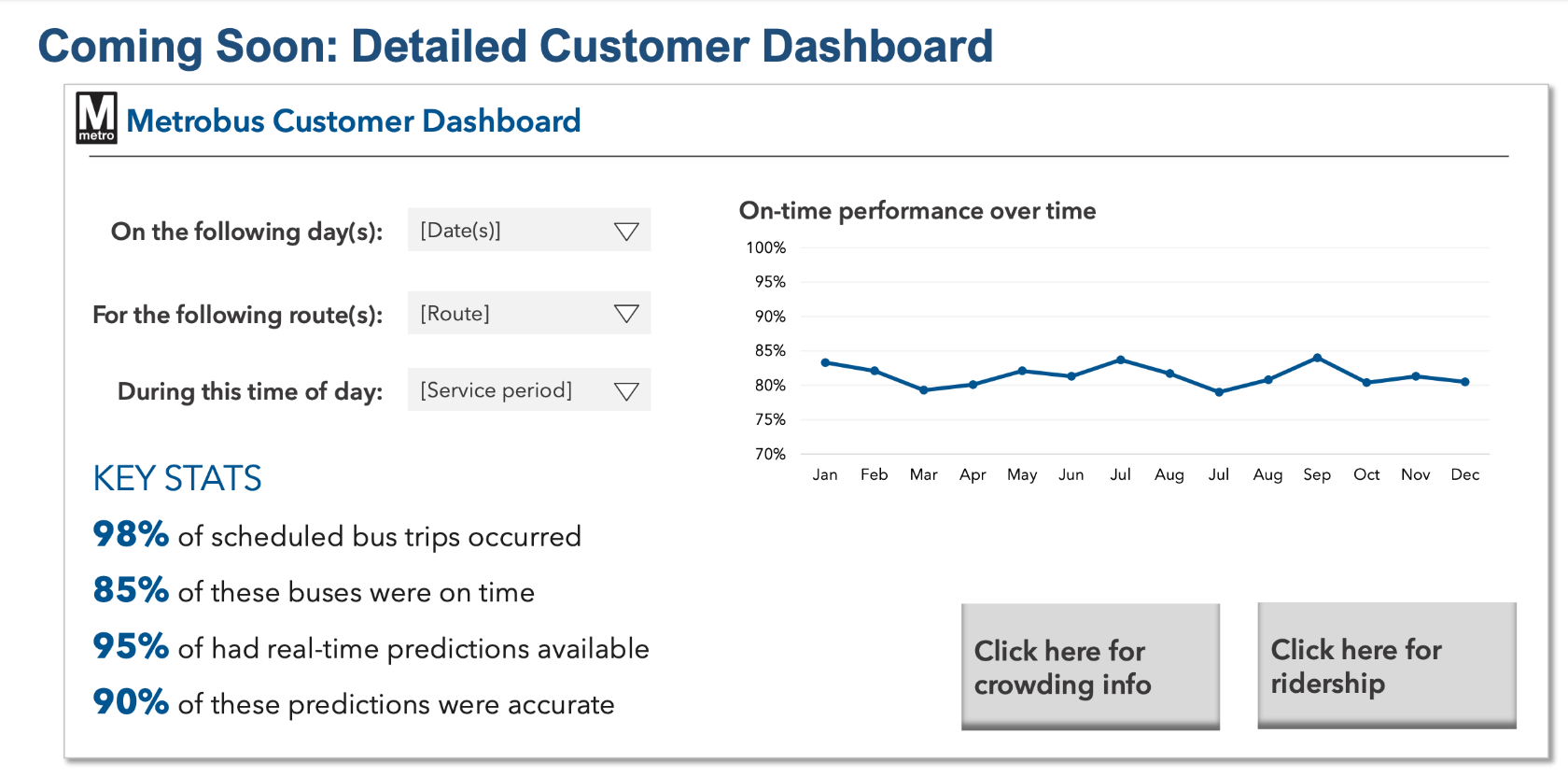
Metro’s new dashboard
Metro board member Tracy Hadden Loh said she used MetroHero over the years to figure out what was going on with bus lines and “explore really detailed analytics about how hyper-specific performance issues play out in the system.”
Thursday, Metro’s director of performance Jordan Holt presented a mockup of its new customer-facing dashboard with similar performance features as MetroHero. Holt said the dashboard would be good for oversight and accountability and tracking progress towards goals.
“From a customer’s perspective, I know personally I always want to know what’s happening, what happened on the Green Line… what happened in my trip?” Holt said. ” How’s the H4, how’s the H8 doing? And so what we’re working on is building a dashboard that will allow customers and members of the public to drill down to that level.”
It will focus on what service was provided, where service was missed, how often the service was on time, etc.
“It is such a huge piece of progress for WMATA that we are now going to be able to offer these kinds of analytics to the public to understand what’s happening inside the system, but also just internally for ourselves to inform how we manage and prioritize the system,” Hadden Loh said.
Metro General Manager Randy Clarke has focused on more transparency and communication since he took over six months ago. The dashboard is the next step in that quest.
“We’re all transit geeks,” Clarke said of himself and the planning staff. “They love the data and they want to get it out. And they’re all customers. They use the system every day.”
Clarke launched a similar dashboard in Austin where he was CEO of CapMetro. It highlights ridership data, safety reports, reliability, route performance, and more.
Metro does publish several statistics in its quarterly reports and has a ridership database, but it lacks many features that MetroHero provided. Clarke hopes WMATA’s new dashboard will allow riders to dig into any rail or bus line.
He also hopes someday to highlight what he calls Metro’s “value proposition” showing
all of your trips, how they all performed, the emissions and time savings over driving, and more. (You can find some of that info buried on WMATA’s SmarTrip website under “MyTripTime dashboard” if you have a registered SmarTrip card. This reporter’s trips were on time 82% of the time over the past three months).
“I want us to try to look more like that – open, transparent, and show how you’re getting value out of this community system,” he said.
In 2021, Metro issued a $2.8 million contract for a complete rebuild of its website, WMATA.com. The design phase is almost done, but it’s unclear when it will launch. The redesign does not include a new app for iPhone and Android, though the new website will be mobile-friendly.
Metro officials say the website modernization includes a complete rearchitecting of the SmarTrip web application, updates to key trip planning tool, and re-doing the underlying technical architecture of the website.