Margaret Barthel
Virginia officials held a press conference Wednesday morning to make the case for relocating the FBI headquarters from downtown D.C. to Fairfax County. The federal General Services Administration, which will make the final decision, is considering a site in Springfield and two options in Prince George’s County, Maryland.
Officials said they anticipate a March meeting with the GSA to press Virginia’s case to win the new headquarters.
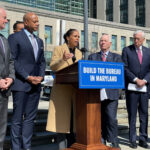
In the meantime, their public pitch was not subtle. “VIRGINIA: BEST HOME FOR FBI,” read a sign attached to the podium at the event. A who’s who of Virginia elected officials — including Gov. Glenn Youngkin, Senators Mark Warner and Tim Kaine, U.S. Representatives Gerry Connolly, Don Beyer, and Abigail Spanberger, Fairfax Board of Supervisors Chairman Jeff McKay, Loudoun Board of Supervisors Chair Phyllis Randall, and more — crowded behind the podium to tout the site’s fit for the FBI.
Specifically, they noted the proximity to the FBI’s training division in Quantico, and Langley, home to the CIA, as well as other national security offices already located in Northern Virginia. Other benefits include easy access to rail and bus transit, nearby universities, and Fairfax’s good public schools. And they cited Northern Virginia’s track record of shepherding big corporate headquarters projects.
“Over the course of the past few years, extraordinary organizations have made the same decision,” said Youngkin. “Amazon, Boeing, Raytheon Technologies, they have all undertaken this exact same selection process, and they have made the decision to move their headquarters to Virginia.”
“We as a jurisdiction absolutely know how to accommodate federal agencies,” said Fairfax County Board of Supervisors Jeff McKay. “We are proud here in Fairfax County to have every single infrastructure asset and human asset necessary to make this enormously successful for the FBI and their employees.”
Youngkin also spoke about Virginia’s “business-friendly ecosystem” and quality of life measures. He also noted the commonwealth’s investments in law enforcement as an indicator that FBI agents would feel welcome. He took a break from his usual arguments about declining school performance, calling Virginia public schools “world class.”
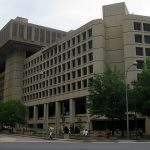
Virginia is competing for the headquarters with locations in Landover and Greenbelt in Maryland. The FBI is currently housed in the Hoover Building in downtown D.C., a much-maligned concrete Brutalist building built in the 1960s and since fallen into disrepair. The FBI and GSA have been in talks about a new headquarters since 2004. They identified the three options currently on the table during the Obama administration, but the Trump administration tabled the project, which was recently revived by a united push from the Maryland and Virginia congressional delegations.
The new headquarters is expected to house at least 7,500 workers, according to the Biden administration’s 2023 budget request. That request also references the intention to include a budget line item for the new facility in the 2024 budget, which is reportedly expected to come out next month.
The FBI and GSA are also seeking a federally-owned site in D.C. that could house a smaller cohort of 750-1,000 FBI staff responsible for working directly with the DOJ, the White House, and Congress.
To guide the decision about the move to the suburbs, the FBI and GSA have outlined five criteria for the site selection process: proximity to other FBI offices and the agency’s training facility in Quantico, and the U.S. Department of Justice in D.C.; transportation access; “site development flexibility,” or the dimensions and characteristics of the site, particularly as they impact how quickly it would take to begin construction; sustainability and equity considerations; and cost of acquiring and preparing the land.
Several speakers pointed out that the 58-acre Springfield site is the only one of the three under consideration already owned by the federal government — it’s adjacent to the new TSA headquarters — which they argued would shorten the timeline between the decision and when construction could ultimately begin.
The same group of Virginia leaders sent a letter to the FBI and GSA this week, outlining why Virginia best matches the agencies’ stated criteria.
At the event, speakers emphasized the region’s transportation investments: $15 billion in recent transportation infrastructure spending they say will directly benefit employees in Springfield. The site is within walking distance of the Franconia-Springfield Metro station, at the end of the Blue Line. The station also includes access to VRE trains and is the main hub of the Fairfax Connector, the county’s bus service. The commonwealth’s much-anticipated $4 billion Transforming Rail program is slated to significantly expand passenger service across the state by 2030.
Highways got their due, too. Loudoun Board of Supervisors Chair Phyllis Randall, who also chairs the Northern Virginia Transportation Authority, highlighted the addition of express lanes on I-95, 395, 495, and 66. She also noted that commuter bus lines can use the lanes.
Workforce issues were a top line of argument. Virginia Sen. Mark Warner, who chairs the Senate Intelligence Committee, said he believed the Springfield site — close as it is to universities, across the street from a Northern Virginia Community College location, and surrounded by a highly diverse community — would provide the FBI with a much-needed talent pipeline.
“We know in prior times…you could generally spot an FBI guy right away because it would generally be a white guy in a white shirt,” he said. “But as the changing nature of challenges emerge, we need to make sure that we have a diverse workforce.”
Sen. Tim Kaine, who joked that Warner’s attendance at an event before 9 a.m. was a marker of its significance, said the diversity and academic rigor of Fairfax County Public Schools was also a key selling point.
Several speakers also addressed the FBI’s stated goal of “advancing racial equity and support for underserved communities through the federal government” through the site selection process. They made the case that Springfield and surrounding areas are home to a diverse but often economically-disadvantaged community, and argued that the FBI’s investment would be a major driver of upward mobility.
“Just east of here in Hybla Valley, one in five people are living in poverty. To the north in Annandale, nearly a fifth of the population is uninsured,” said Congressman Don Beyer. “In Alexandria City, that I represent, over half the students of public schools live in a home where a language other than English is spoken.”
The FBI headquarters is also expected to bring thousands of additional jobs to its immediate area by attracting other companies and services eager to work with the agency. Officials said that investment could uplift local communities — but did not specifically address concerns about rising housing costs and displacement that often accompany major development projects located in less-wealthy neighborhoods. McKay noted Fairfax’s investments in creating affordable housing.
The announcement was a rare moment of unity for Youngkin and Northern Virginia leaders — all of them Democrats — even as the FBI criteria required them to present a united front on two highly political topics: environmental sustainability and “equity.”
Youngkin’s attempts to remove Virginia from a regional carbon cap-and-trade program have drawn ire from Democrats in Northern Virginia, some of whom have also questioned his “all of the above” energy strategy, which includes fossil fuels and nuclear as well as renewable energy sources. Likewise, the governor’s decision to replace the word “equity” with “opportunity” in the title of the commonwealth’s cabinet-level position devoted to the subject — and his choice to remove “equity”-focused materials from state web pages — has provoked pointed criticism from Democrats.
Those disagreements stayed mostly under the surface on Wednesday, though Randall, of the Loudoun Board of Supervisors, used some of her time at the podium to draw a distinction between “opportunity” and “equity.”
“What we know at NVTA and what they know at the FBI is that equity and opportunity are not the same thing,” Randall said. “You have to have equity before you get to have the opportunity.”
Randall told WAMU/DCist after her remarks that she intended no specific pushback against Youngkin, but rather was seeking to clarify that the group understood the FBI’s stated values.
McKay, of the Fairfax Board of Supervisors, acknowledged existing “ideological disagreements,” but said it hadn’t impacted the project.
“In this particular case, we’re all in agreement. There is no division between us when it comes to relocating the FBI here,” he said in an interview.
The overall mood of the event was bipartisan — and unapologetically boosterish about the commonwealth.
“America was born on a farm in Virginia,” Beyer said. “It only makes sense that the place that gave us the father of our country and the Internet also is the best location for the FBI headquarters.”