Margaret Barthel
 Tyrone Turner
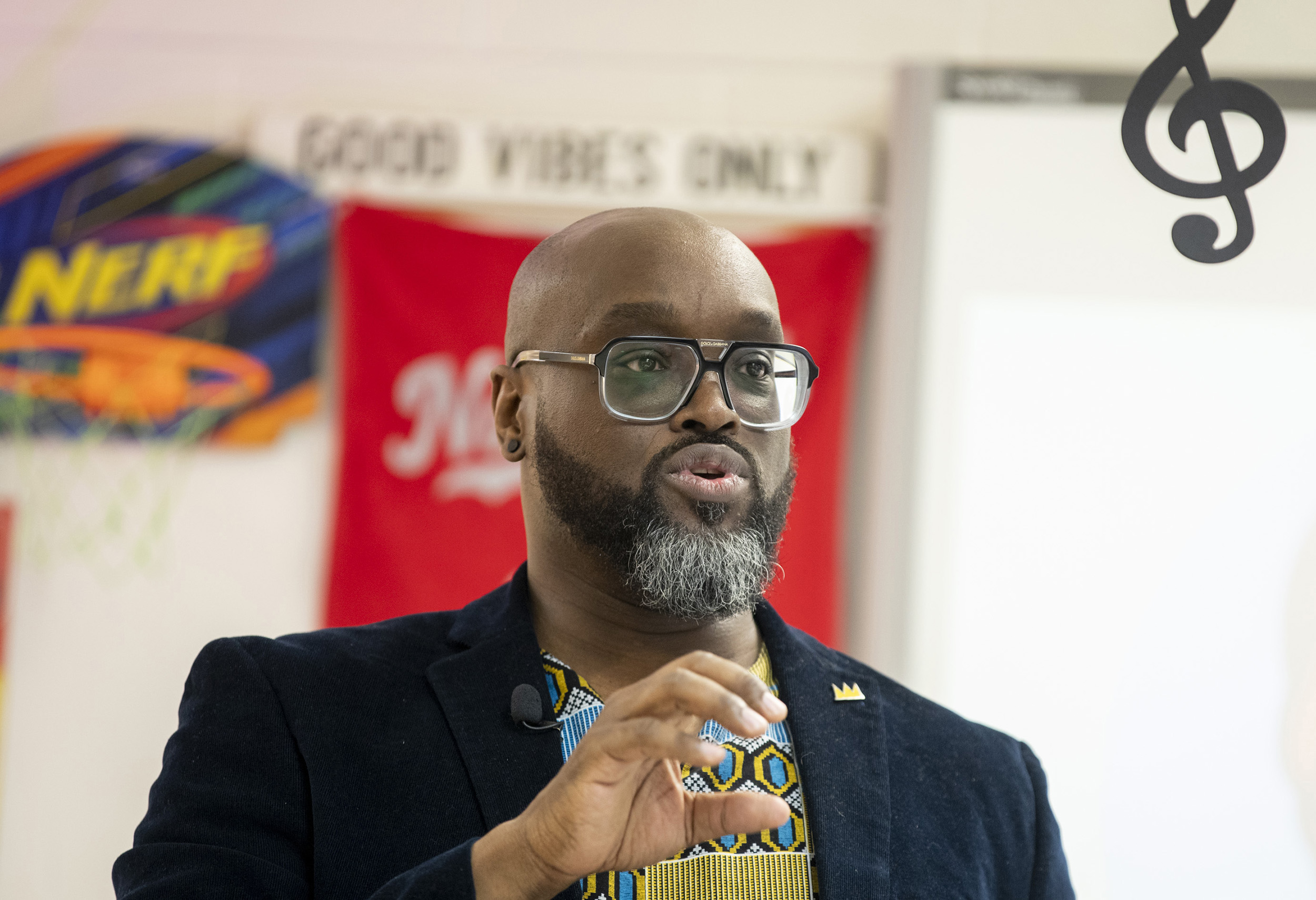
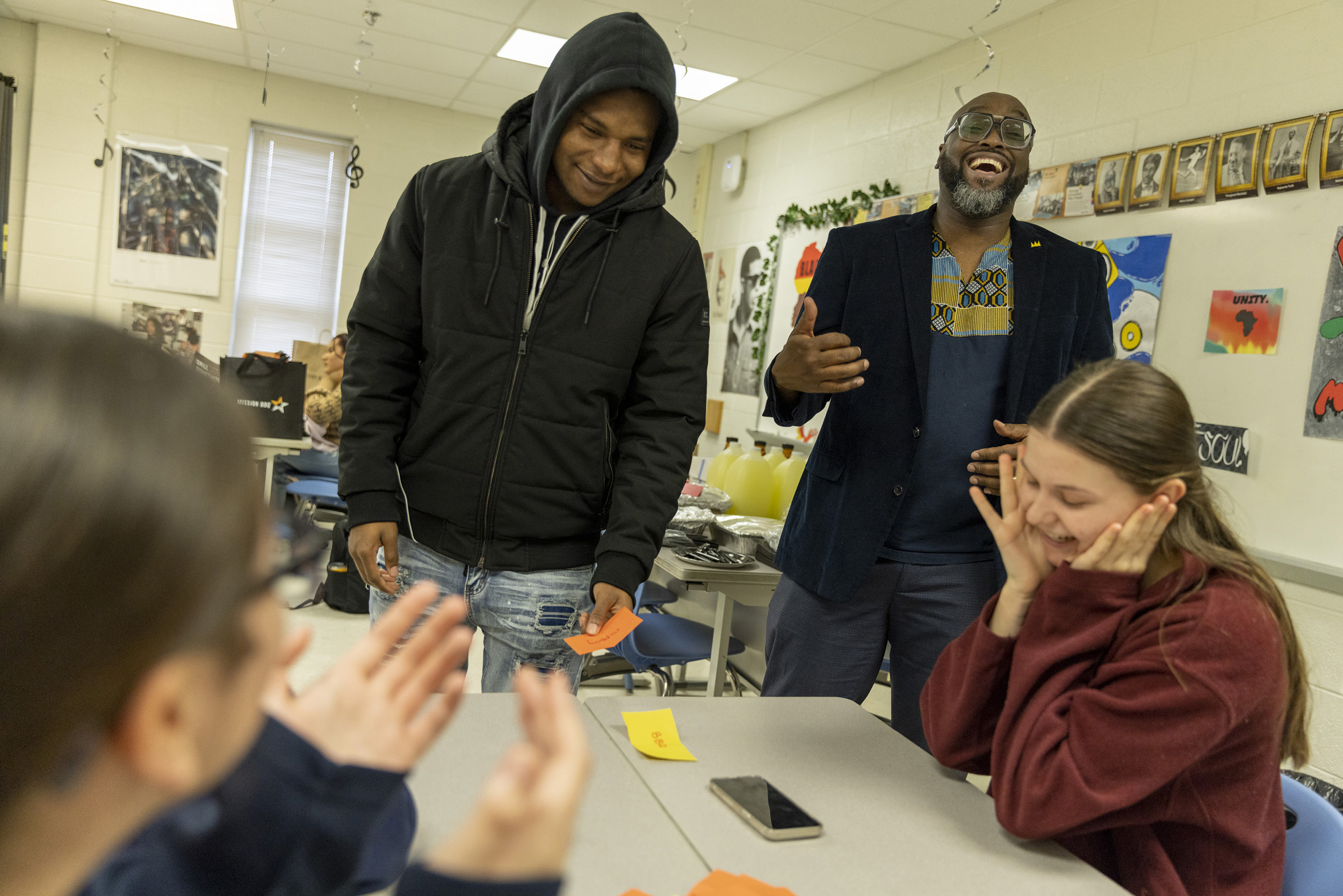
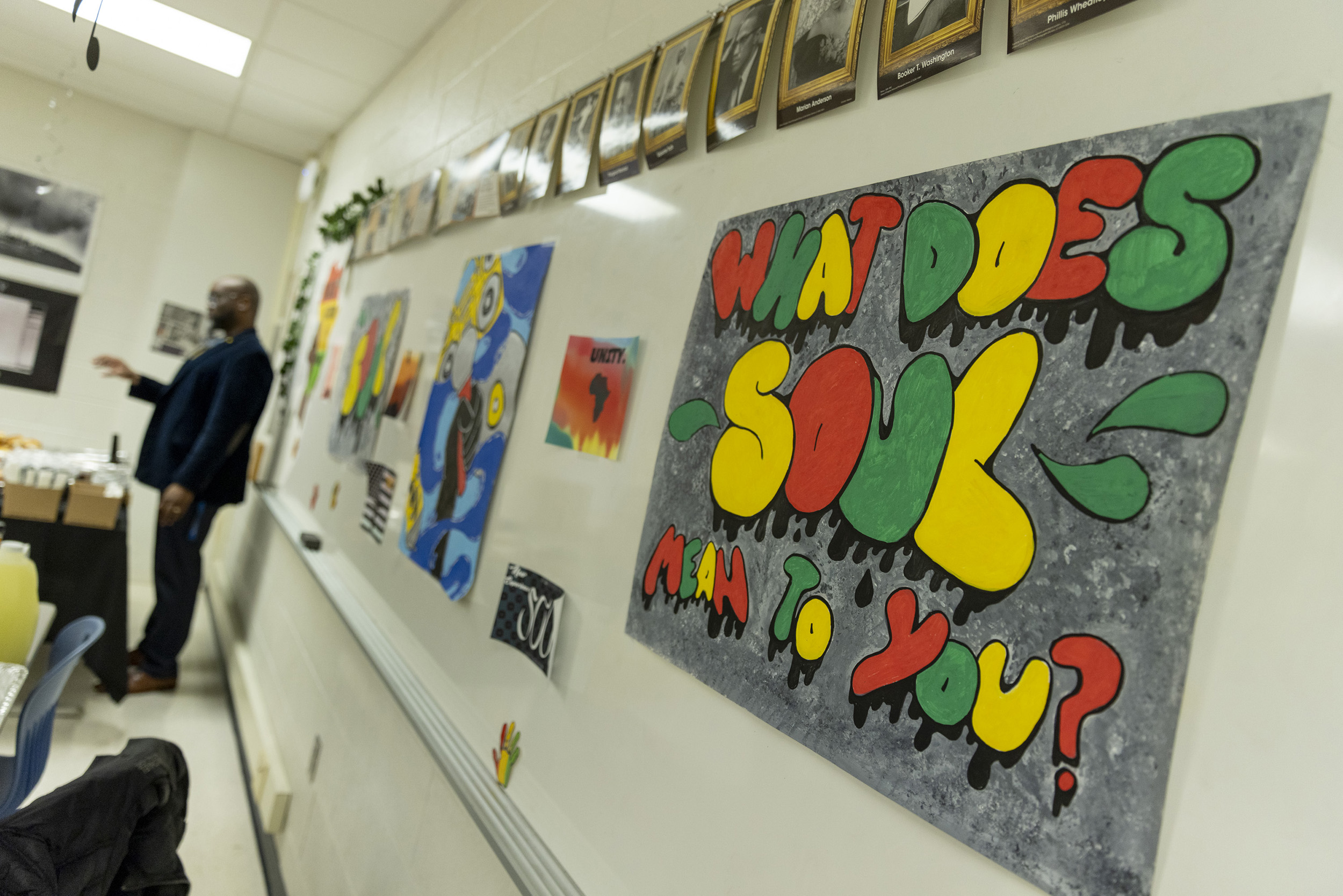
The tables are overflowing with brisket, mac and cheese, cornbread, jollof rice, cookies, lemonade, iced tea, and more in today’s class period of Sean Miller’s African American history class at South County High School.
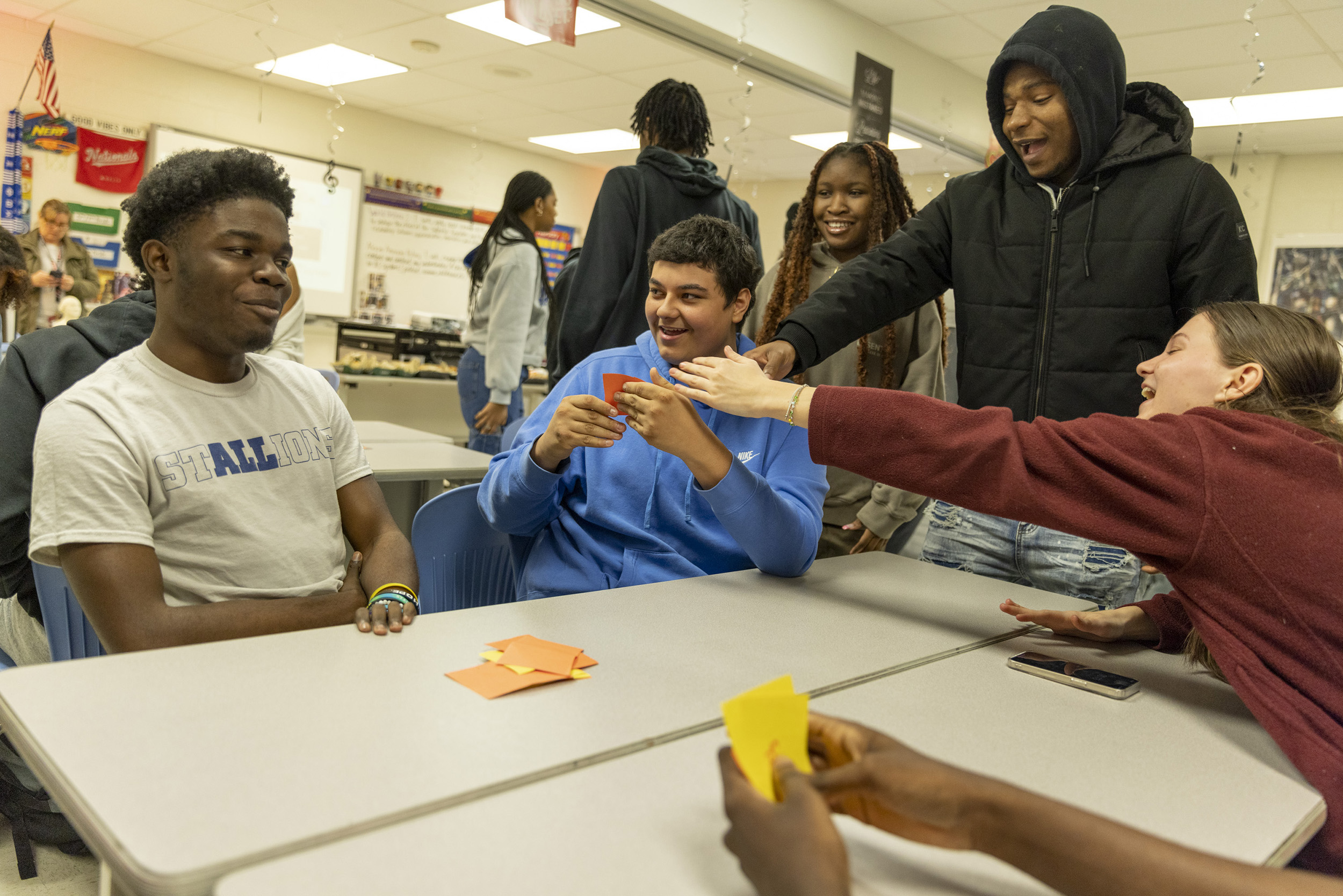
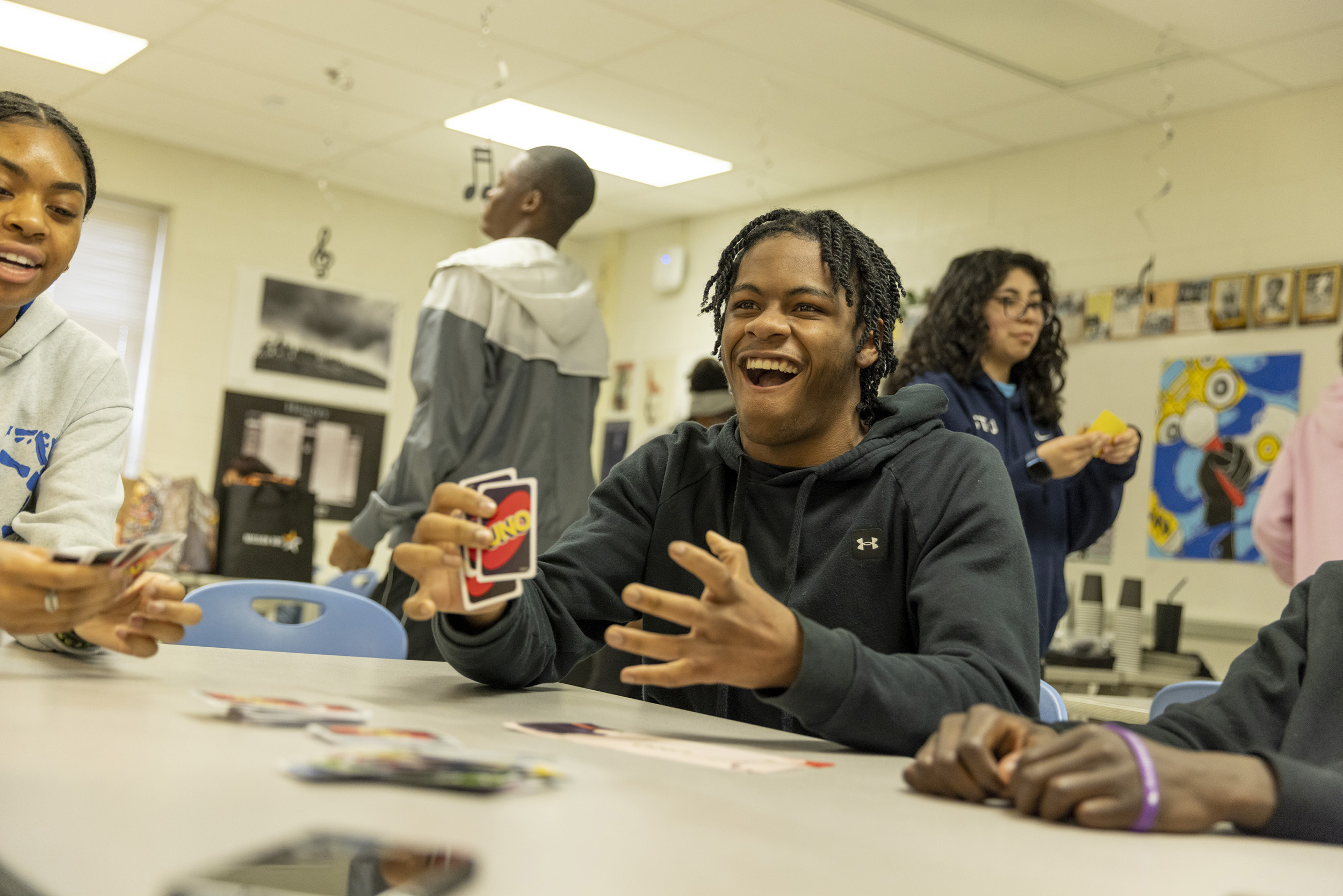
Today is what Miller calls the “Black Joy Family Reunion” — a student-created version of traditional Black family reunions. The goal is to learn about how African American families have created community through the decades, and to celebrate the joy of coming together.
“A lot of Black people are constantly represented as sad or angry, and we have to recognize that Black people are more than just our trauma,” says junior Kennedy Smith. “We are happy people, we are joyful, we are celebratory.”
Smith baked two truly enormous batches of lemon shortbread and chocolate chip cookies for the occasion, and other students have brought foods that they associate with family. Others pitched in on researching music for the playlist or are leading their classmates in games their families play.
“We’re doing something authentic. It’s not about commercialism,” Miller tells his students. “This is about how you the students at South High School and me as your teacher celebrate African American culture, and how we also celebrate your individual cultures as well.”
Miller talks a lot about how he wants students to bring their own identities — and the tangle of racial and cultural experiences that come with them — to their study of Black history in America. For him, creating a safe, positive place to talk about that history starts with being open about what everyone in the room brings to the conversation.
“It’s a vibe,” Miller says, of the kind of student-centered, safe atmosphere he tries to create in his classroom. “It’s a thing, you know, you just feel it in the air, and that comes with fostering that kind of environment from day one.”
And that’s all the more essential, he says, when they’ll be discussing some difficult subjects in class. They’re about to embark on a unit about racist ideas codified in laws, and Black resistance to them. The course delves into themes of identity, resistance, systemic discrimination — and it also covers the history of Black people in America chronologically, from ancestral Africa to the present day.
Not everyone agrees that focusing on racist oppression or racial differences in classrooms is a good idea. Across the country, conservative politicians have mounted a wave of pushback against schools’ attempts to teach about systemic racism. In Florida, Republican Gov. Ron DeSantis, a presidential hopeful, banned a pilot of the AP African American studies class, saying it was too left-leaning and lacking in “educational value.”
In response, the College Board, which creates the curriculum for AP classes, revised some of the aspects of the course, scaling back focus on more recent topics like Black Lives Matter, queer communities, and reparations. Earlier in the month, DeSantis said he may entirely end state support for all AP classes.
Similar debates are playing out closer to home. Virginia Governor Glenn Youngkin’s first executive order in office sought to prevent an over-emphasis on race in public schools, arguing that it divides children along racial lines and teaches them bias and victimhood.
Since then, the Youngkin administration has faced criticism over proposed revisions to Virginia’s history standards and a decision to strike equity-related resources from the state’s Department of Education website. The administration said last week it will review the pilot AP course for evidence of bias, following Florida’s lead.
The Virginia African American history elective is not the same as the AP course. But as the debate over the AP class rages, it offers a window into what a course focused on Black history can mean for students, many of them students of color.

‘I’m part of the historical narrative’
For one thing, it’s the first time many students have been exposed to the scope of Black history. Many students know a few historical touchpoints and names, but little else.
“What I find is that they’re like, ‘Okay, civil rights, slavery, that’s all I know,’” says Sean Miller.
That was Miller’s own experience too, attending schools down in the Chesapeake area as a kid. He still remembers one teacher who showed his class a movie that dealt with racial tensions in the South, but for the most part he had to learn about — and process — Black history outside of school.
A lot of that learning happened with his mom. The two talked about the historical roots of police brutality when Miller was in third grade and trying to understand the viral video of the beating of Rodney King by Los Angeles police.
“She really put a lot of time before me understanding, you know, how history plays out, how it’s relevant today, and how I’m a part of the historical narrative and can make some positive changes,” he says.
That’s how Miller says he now approaches his classroom: seeking to fill the big holes in students’ knowledge, with an eye to helping them see they are part of history, too. In the fall, after the class lays the framework by discussing their own racial and cultural backgrounds, they move on to a unit that covers African American history in Fairfax County. They learn about the Black families who owned farmland in what is now Tysons and the local students who led area desegregation efforts. Miller and some of his students participated in the county’s Historical Marker Project, researching and proposing prominent Black residents for inclusion in new historical markers around the county.
Miller isn’t alone in focusing on local history early in the course. Mark Witzel, who teaches the African American history elective at West Springfield High School, says his class had a visit from staff at the Laurel Grove School Museum, which interprets the history of a schoolhouse built and run by people formerly enslaved at Mount Vernon and their descendants.
“That’s the history I think resonates best with us, real-people history, not guy-on-a-pillar history,” Witzel says.
After their study of local Black history, both classes turn to a chronological study of Black history in America, beginning with the context of ancestral African civilizations and then moving forward through slavery, the Civil War, Reconstruction, segregation, the Civil Rights movement, and on to the present. Witzel says one core aspect of his class is asking students to think about how African American people throughout history created a strong new sense of identity and community after they were forcibly removed from their ancestral homelands.
“You basically have to build an identity from scratch,” Witzel says. “And so exploring how that identity is built and how it transforms over a period of 400 years is fascinating.”
Contrary to Youngkin’s concerns about teaching victimhood, Witzel says that exploration is powerful — especially when the class arrives at the point in the historical record where there are primary sources written by Black people telling their own stories.
“You realize it’s not a tale of victimhood. It’s a tale of power and of anger and of joy and of all that great stuff that makes history come alive,” he says.
Miller agrees. He jokes the class has been “harping on Black joy” from the beginning of the school year, carving out space to talk about the joy and resistance of artists, musicians, and writers in a special segment during class. Kennedy Smith says it’s been eye-opening.
“Resistance is definitely connected to joy because being happy itself in the face of trauma is resistance within itself, and resistance is one of our core concepts in the class,” she says. “And it’s just really great to see different forms of resistance that aren’t always violent or negative. Sometimes it’s nice to just laugh in the face of pain.”

‘It’s ok to identify the way I do’
Seeing Black history and Black people front and center in an academic class can do more than just expose students to new historical and cultural information. It can also give them a space to discover things about their own identities and how they move through the world.
Paula DeMegret-Murray took the African American history elective at West Springfield High School last year. It was the first time she’d heard of Frederick Douglass. It was also the first time she’d had the language to talk about her own complicated identity: Her father is white and her mother is from the Caribbean. That’s a lot to untangle in a mostly-white community.
“I feel like I always struggled with, ‘What is my race and how do I identify?’” she says. “When I was a kid, I really wanted to be white, because that’s how everyone was around me.”
DeMegret-Murray remembers feeling shame in elementary school for taking snack packs offered to lower-income students. She felt hyper aware of fitting white peers’ stereotypes about being a person of color from a less affluent background, and she felt uncomfortable when other kids made fun of English language learners — many of whom were Hispanic like her — for struggling in class. And it took a long time for her to shake the white beauty standards she saw everywhere.
“I thought I was ugly because I wasn’t white,” she recalls.
She doesn’t remember explicit discrimination or name-calling, but she still felt separate.
“I don’t know if it’s like a suburbs thing or a Northern Virginia thing, but even if you feel like someone’s being racist towards you or discriminatory, I feel like it’s never going to be straight up,” she says.
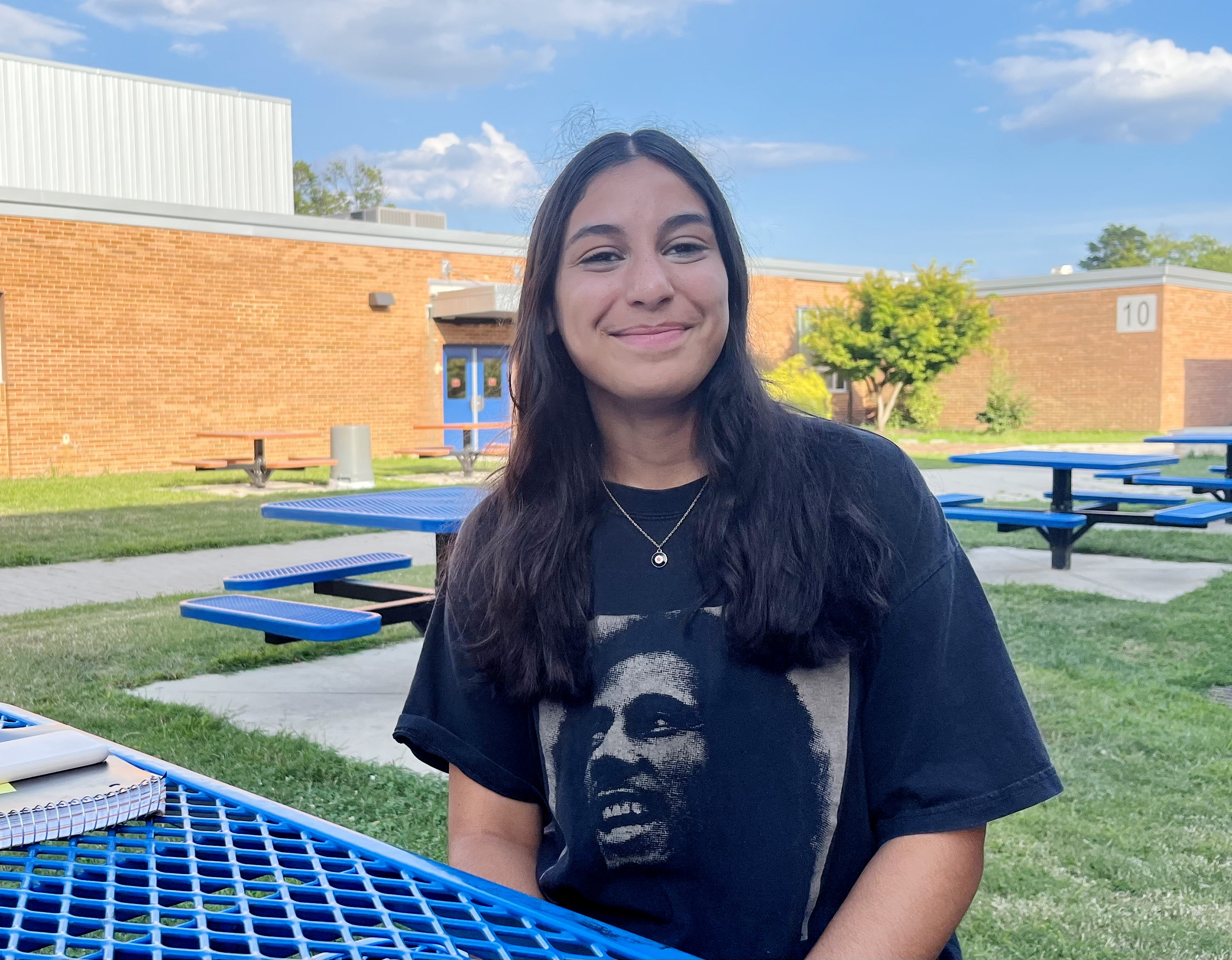
Things have improved as she’s gotten older. DeMegret-Murray, now a junior at West Springfield, has learned to navigate the school, where white students make up about 50% of the student body and most students do not qualify for free or reduced price lunch.
But when she found out that the African American history elective would be offered last year, she jumped at the chance to take the class, thinking it would be interesting and might help her think through her own identity.
“I don’t necessarily look white, but I also don’t look black, and I was also Hispanic,” she says. “So it was like, ‘Okay, maybe I just tell people I’m Hispanic.’ But it’s very confused and nuanced.”
Learning about the Middle Passage — another term she had not heard before — and slavery on Caribbean sugar plantations was hard, but it also started conversations with her mom about their family history.
“It was really interesting to be like, ‘Wow, you know, that’s kind of my history,’” she says.
With the history elective under her belt, DeMegret-Murray says she feels more confident in what she wants to call herself: Hispanic and mixed-race.
Kennedy Smith, at South County, had a similar experience.
“I definitely feel like this class has just confirmed for me that it’s okay to identify the way I do. I identify as Afro-Latina and a Black woman,” she says.
Smith is using her final capstone project in Sean Miller’s class to explore questions of intersectionality: She’s interested in the mental health struggles of Black queer youth and how to address them.
“As a young Black woman, I see teenagers facing depression and anxiety every other day,” she says. “It’s just good to figure out why and how we can resolve that issue.”
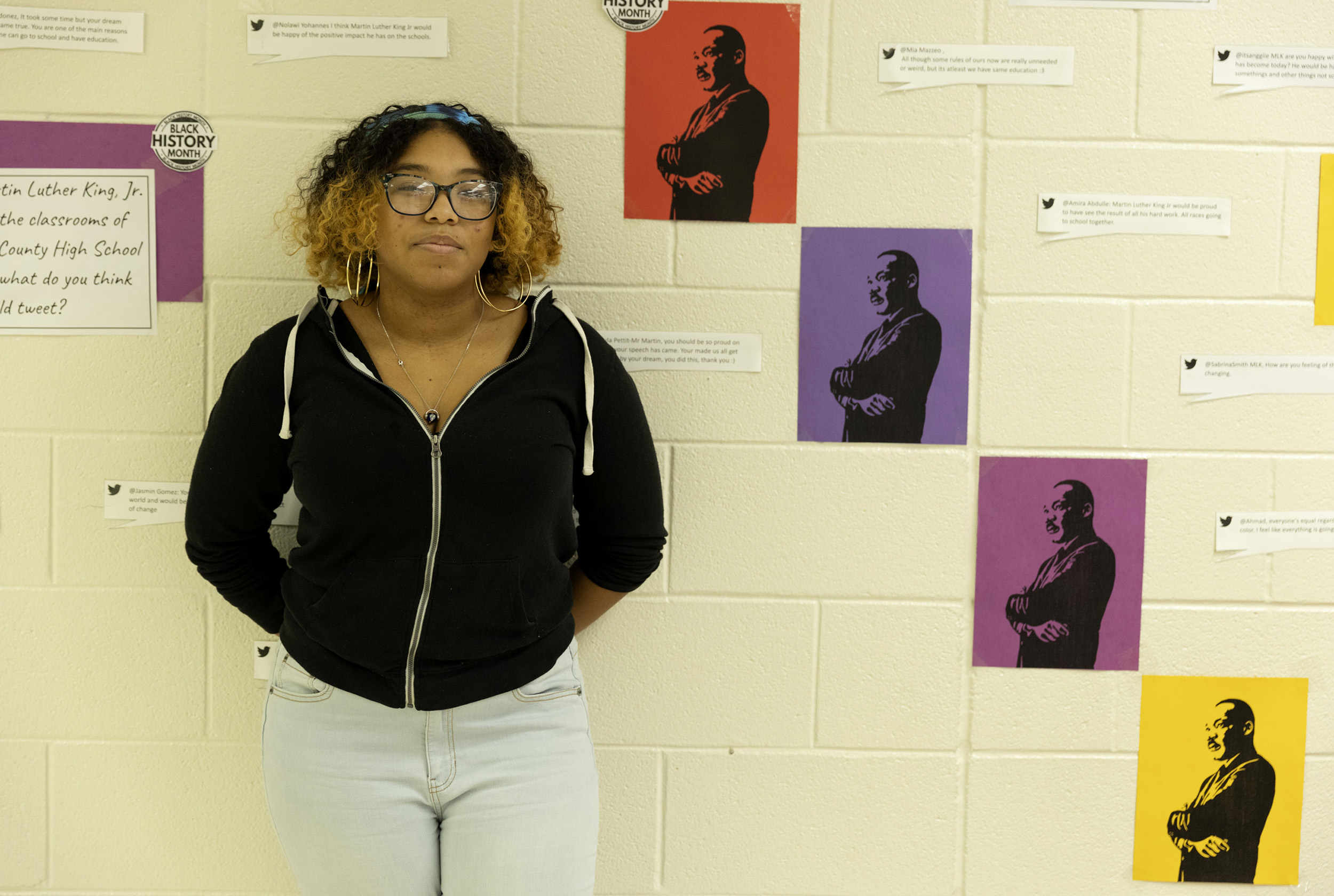
None of that is surprising to Miller, who says he talks openly about his own experiences as a Black man and his love of comic books and art. And his students respond in kind, sharing deeply personal and sometimes painful things about their lives with the class.
“What I find is that a lot of students are eager to speak about their identity,” he says. “They have a lot of thoughts inside and a lot of things they have not expressed.”
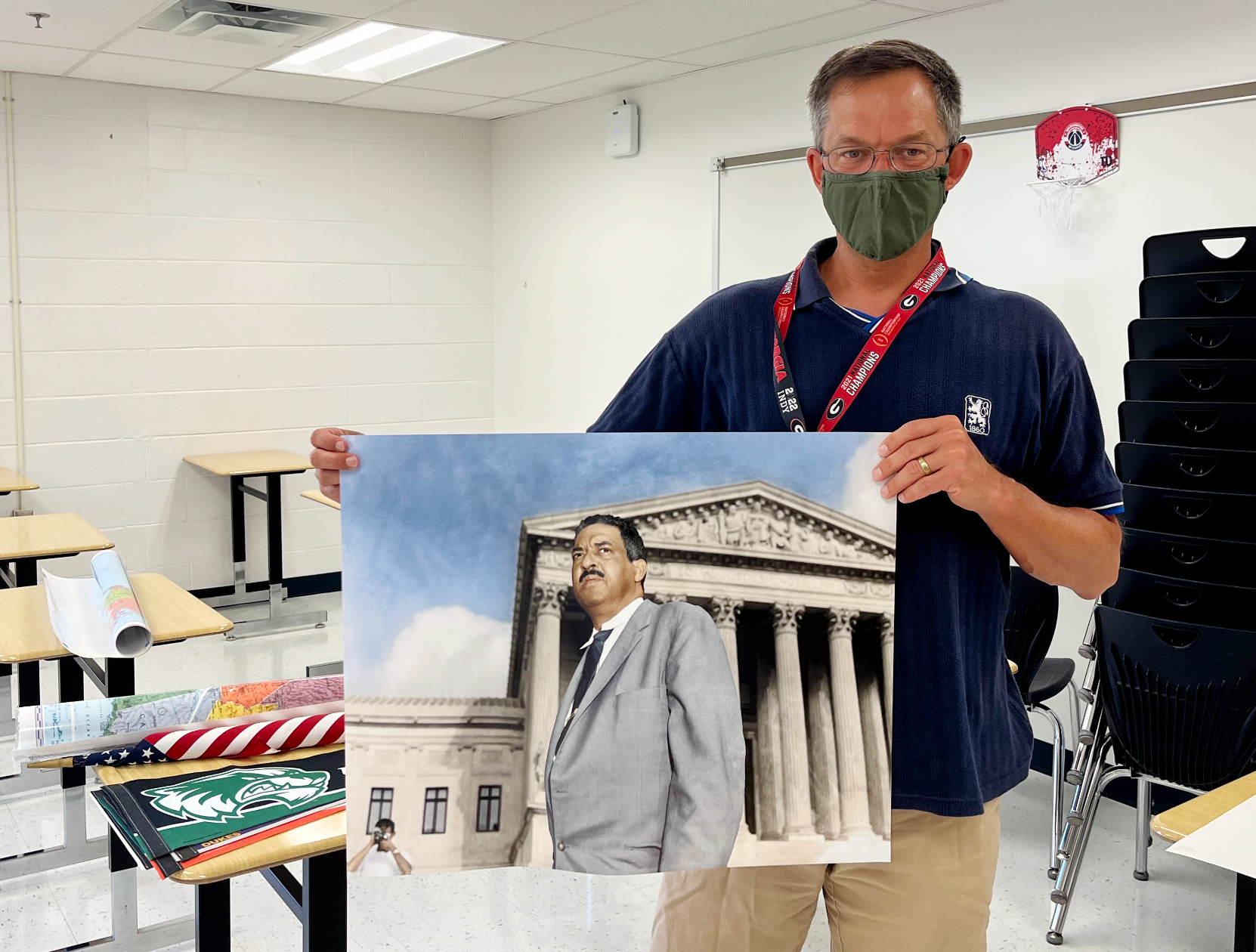
For Witzel, navigating discussions of identity as a white teacher at the head of an African American history class is complicated. But he does his best to make students feel at home, covering his classroom walls with posters of Thurgood Marshall and Tupac Shakur, a Kente cloth to represent the course’s ties to Africa, and former students’ art.
“They walked in the room, and they were like, ‘This room looks like me. There’s a shared experience here that’s worth pursuing,’” Witzel recalls of his first day teaching the course. “And then they looked up at the teacher, who’s white, and they go, ‘Oh, well, that’s not awesome. But, you know, maybe we’ll make it work.’”
Students of color have to “make it work” in most of their classes. Nationwide, the vast majority of teachers — 80% — are white. 7% are Black and 9% are Hispanic. That problem holds true in Fairfax, too: The school system has faced criticism over its lack of teachers of color, with some schools having no nonwhite instructors at all. Fixing that problem and achieving a more diverse workforce is one of the main goals of the division’s equity policy.
Witzel says his strategy in class has been to just get out of the way, offering students the space and time to lead their own discussions about personal experiences of race and racism. Historical roundtables — where students take on the perspectives of different Black figures to debate a topic — have sometimes morphed into conversations about students’ experiences in the present.
“I’ve heard students talk about, you know, ‘I have a group of white friends. They like to use the N-word. I don’t know what to do. I don’t want to make them not my friend, but at the same time, I can’t accept that this is happening. My parents say go with the flow,’” he says. “I mean, that’s a lot to have to carry around.”
‘It’s not about white people’
So what’s it like teaching African American history amid political debate in Virginia and nationally? Miller and Witzel say it doesn’t affect how they teach.
“It’s not about deifying or demonizing anybody,” Miller says. “It’s about saying, ‘Okay, here are the facts, here’s what happened. Now, process that information and then make your own opinions based on that information.’”
Witzel calls the political debate over teaching about race an “imaginary problem.”
But leadership in Richmond would beg to disagree. Youngkin, who made pushing back on public school equity policies a centerpiece of his campaign for governor, used his first executive order to ban instruction that overemphasizes race and systemic racism.
“Inherently divisive concepts, like Critical Race Theory and its progeny, instruct students to only view life through the lens of race and presumes that some students are consciously or unconsciously racist, sexist, or oppressive, and that other students are victims,” the order reads. “This denies our students the opportunity to gain important facts, core knowledge, formulate their own opinions, and to think for themselves.”
Critical race theory, an academic study of systemic racism, has become a conservative political punching bag across the country. In Florida, state lawmakers banned teaching history that makes students feel guilt or shame about their race, and now state officials are pushing back on the pilot AP African American studies class on similar grounds. Florida Gov. Ron DeSantis, a presidential hopeful, has called the course “woke” and said it lacks any academic merit.
Youngkin frequently talks about “teaching history, the good and the bad,” and his order references “the horrors of American slavery and segregation” and “the heroic efforts of Americans in the Civil Rights Movement.” But he has chosen to follow Florida’s lead, saying the Virginia Department of Education will review the AP African American studies course to see if it conflicts with his executive order banning “inherently divisive concepts.”
“The Education Secretariat will review the AP African American Studies Course — as we do with all policies, programs, training, and curricula and continue to do so — to ensure that our students are being taught how to think, and not what to think,” said Virginia Secretary of Education Aimee Guidera in a statement to WAMU/DCist.
The Youngkin administration did not respond to follow-up questions about whether the non-AP elective currently taught in Virginia would come under scrutiny, too. The elective is not the same as the AP class, though both courses include similar subject matter, and in some cases students earn college credit for taking the class.
Paula DeMegret-Murray, at West Springfield High School, was excited about the idea of the pilot AP class, seeing it as a measure of progress. She strongly disagrees with Youngkin’s concerns about over-emphasizing race and identity in class.
“A lot of this whole critical race theory is like, ‘Oh, you’re hating on white people. You’re teaching children to hate white people,’” she says. “It’s not about white people, you know?”
Instead, she argues the opposite: that learning about the ugly history of redlining and Jim Crow as well as the triumphs of Black entrepreneurs and boundary-breaking Black politicians during the Reconstruction is essential to addressing present-day inequalities. She’s frustrated that other students aren’t exposed to the information in regular courses.
“I chose to take this class and I chose to learn these things, but it should be taught to everyone,” she says.
For now, the AP African American studies class will move forward into another year of the pilot, which will include as many as eight Fairfax County high schools next year, assuming enough students enroll and provided state officials allow the course to go forward. South County High School is on the list, with Sean Miller preparing to teach the class.
Miller says he isn’t daunted by the politics swirling around it.
“I feel like we’re still getting an opportunity to teach holistic history,” he says. “I haven’t lost a step of excitement. I’m really hyped about teaching the course next year.”
Kennedy Smith is going to be one of his students.
“I was deciding, like, do I want to take another AP my senior year? And I decided [to take it] not only because of the teacher, just because of the environment,” she says. “I like to consider myself an activist. So taking this class I feel like would really benefit my education and life.”