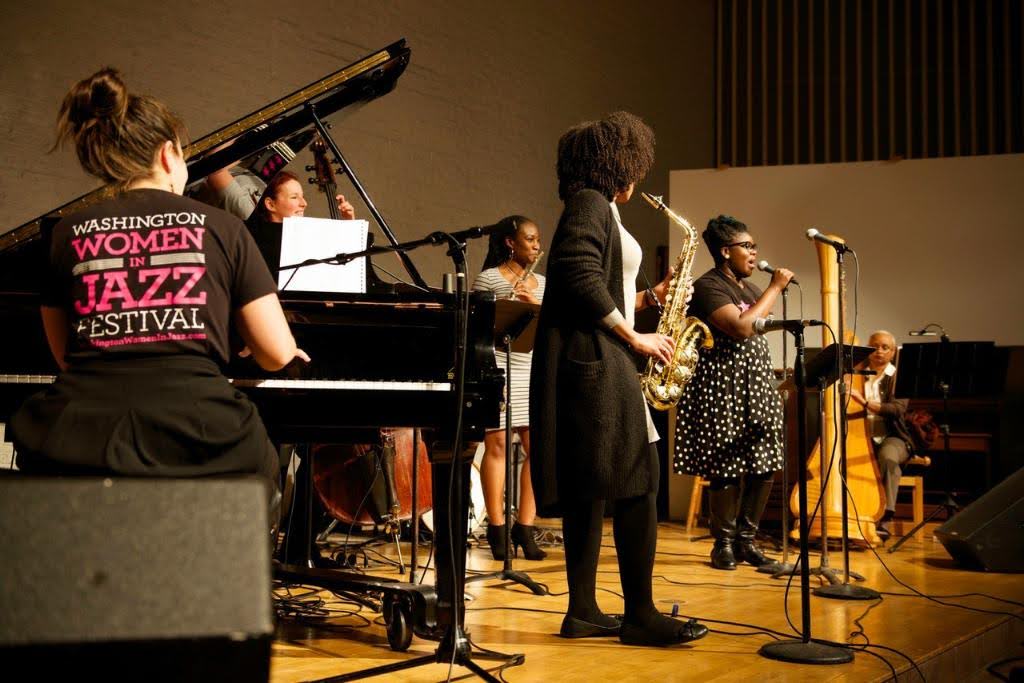
The Washington Women in Jazz Festival, like so many arts events, took a real hit during the pandemic. The WWJF was among the first major COVID-related cancellations when it was meant to take place in March 2020.
In 2021, like so many other performances the festival went virtual, but returned for live events in 2022, albeit with an abbreviated schedule. Now in its 13th year, this favorite of the local jazz community returns to its normal format from March 5-27 with some new offerings in store.
“We had to make some changes during the pandemic, but we didn’t do it happily,” says pianist Amy K. Bormet, the festival’s founder and director. “Now we’re back with our month-long debauchery.”
One positive that came out of the shutdown was the extended reach that Bormet and her team were able to achieve as a result of having to go fully online for a period of time. Bormet decided not to charge people interested in watching the streamed performances, and as a result had to develop an entirely new funding and advertising approach. This allowed her to build up a large and geographically diverse donor base.
One of WWJF’s annual highlights is its emerging artist showcase, which features aspiring female and non-binary jazz musicians. The showcase was able to draw interest from well outside of the D.C. region when virtual concerts became the norm. That outreach continued this year, but now the local audience will have the pleasure of seeing these talented youngsters in person.
Another major change is the venue that the festival is using as its hub. The WWJF used to present concert series at the still-missed Bohemian Caverns, which shuttered in 2016, and Twins Jazz, which was among the many music venues that did not survive the pandemic. This year, the festival is presenting a series of concerts at Blues Alley, the prestigious club that claims the mantle of being the oldest continuously running jazz supper club in the country.
“Breaking into that audience and that caliber of venue is super exciting,” Bormet says. “We haven’t been able to do that before.”
Bormet is also using WWJF as a springboard for a new venture. This year’s festival kickoff event is a launch party for The Turnaround, a magazine that Bormet is publishing. Inspired by the zines of yore, thepublicationwill showcase original artwork, music reviews, and in-depth features that discuss representation in jazz and its surrounding media. Many of the initial contributors are people who have been involved with WWJF, but Bormet has also tapped renowned artists like vocalist Dee Dee Bridgewater to write pieces for the magazine.
The current plan is to publish a new issue every six months, with the next one arriving in September. Bormet is forgoing a digital presence for now, but physical copies will be available at local bookstores and D.C. Public Libraries.
“We’ve got two young editors. The energy is there and the momentum is there,” Bormet says of the magazine. “A lot of people replied to our calls.”
The WWJF is an important part of the local jazz ecosystem, so seeing its growth is heartening. Bormet herself is a mainstay in the area scene, having attended Duke Ellington School of the Arts and spending most of her professional career in D.C. Among her goals with WWJF is to enmesh the jazz community into a broader cultural context.
“I think a lot of jazz musicians are connecting with the music scene as a whole in a different way,” Bormet says. “The jazz scene here and other places can feel siloed as a whole. We’re trying to counteract that with Washington Women in Jazz.”
So where are this year’s highlights taking place? There’s a full list of shows available here, but below are the events DCist/WAMU is most looking forward to at the festival:
TURNAROUND LAUNCH PARTY: The magazine kickoff and festival opening takes place on March 5 from 3-5 p.m. at Eaton DC. FREE
BLUES ALLEY RESIDENCY: The WWJF is presenting shows at Blues Alley every Monday in March. Each one of them is worth your time and attention, but an intriguing standout is Biomorphic Forms. The ensemble comprises Bormet on piano and vocals, flautist/vocalist Alex Hamburger, New York-based trumpet/synth player Nicole Davis, and Keith Butler on drums. The bass-less quartet plays music inspired by the natural world. (March 13 at Blues Alley, 7 and 9 p.m. sets; $25 + food/drink minimum and surcharge)
CELESTIAL SPLANG-A-LANG: Leigh Pilzer is an area baritone saxophonist who has a lot of experience arranging and composing for jazz big bands. Bormet sought Pilzer’s mentorship in assembling an 18-piece jazz orchestra for this year’s WWJF. The ensemble will perform material by each of these co-leaders along with compositions from members of the band during this concert, which is a collaboration between WWJF and the ongoing Intersections Festival. (March 17 at Atlas Performing Arts Center, 8 p.m.; $32)
EMERGING ARTIST SHOWCASE: This annual concert elevates promising young female and non-binary musicians from colleges in the Mid-Atlantic region by giving them a stage at a major festival. Ten performers will participate in this show at a venue that has played a major role in D.C.’s music history. (March 24 at Mr. Henry’s, 8 p.m.; $20 + food/drink minimum)