Jacob Fenston
The mighty Amur tiger once prowled vast swaths of northeast Asia, including eastern Russia, the Korean peninsula, and parts of China and Mongolia. Now, there are more Amur tigers living in captivity in zoos around the world than in the wild. Also known as the Siberian tiger, it’s the largest cat on the planet.
The Smithsonian’s National Zoo is home to two Amur tigers, Nikita and Metis. Earlier this week, zoo staff performed an artificial insemination on the female tiger, Nikita, using sperm collected from Metis. It was an attempt to boost the tiger population, passing on the two endangered tigers’ genes to the next generation.
“These animals are rapidly on the decline, and we need to intervene as humans because a lot of the problems that they’re facing are human-caused problems,” says Craig Saffoe, curator of great cats at the zoo. Out of the nine tiger subspecies that once existed in the wild, three have already gone extinct. Amur tigers are considered endangered — numbering around 360 in the wild — and are threatened by poaching, and habitat destruction from farms and urban sprawl.

Zoos help tigers and other endangered species survive by making sure there is a sustainable, genetically diverse captive population of the animals — a sort of insurance policy in case wild populations are wiped out. This is called a species survival plan, and it’s coordinated with the Association of Zoos and Aquariums.
The zoo tried natural breeding with Nikita, even swapping out male Amur tigers, but with no success. Breeding wild animals isn’t as simple as it might sound, Saffoe explains.
“We often think, just put two tigers together,” he says. “Well, try that with humans — it doesn’t doesn’t always work out so well.”
The National Zoo has been successful in breeding smaller Sumatran tigers, but it hasn’t happened with Amur tigers.
“This male, they get along, but it’s it’s effectively a platonic relationship. They get together, they head rub, they don’t get into big fights, but they just won’t pull the trigger, they just won’t breed,” Saffoe says.
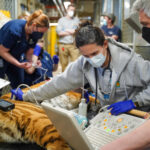
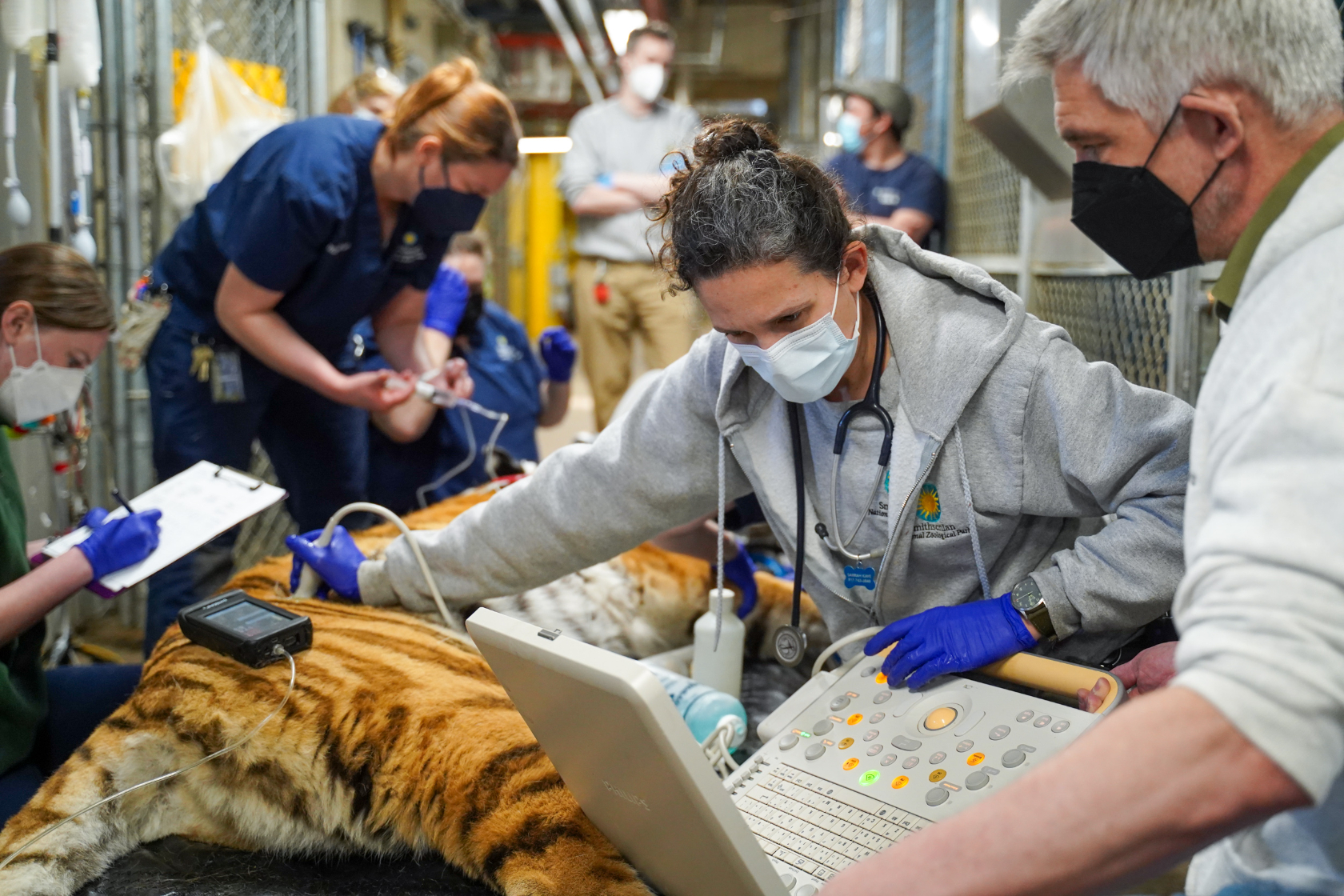
On a recent morning, more than a dozen zoo staffers gathered in the concrete caverns under the tiger habitat to perform the insemination procedure. The first step was to collect and analyze a sperm sample from the male tiger, Metis. Then, Nikita was anesthetized. It took nine people to carefully lift the 300-pound cat and carry her from her enclosure onto a padded cart. She was then wheeled down the hallway, where veterinary staff waited with equipment.
“The biggest long-term goal of this procedure is having tiger babies. The biggest short-term goal is safety,” Saffoe says.

Pierre Comizzoli, a reproductive physiologist at the zoo, led a team of scientists performing the insemination.
“Tigers are a little bit like domestic cats,” Comizzoli says. “They are induced ovulators, which means that the ovulation happens during the natural breeding by stimulation from the male. If there is not that stimulation, there is no ovulation.”
Since there was no stimulation from a male tiger in this case, zoo staff used hormone treatment to make sure Nikita would ovulate at the right time.

“We have studied animal reproduction for many decades, and we have developed all those techniques of assisted reproductive technologies that are really helping us to to produce animals when they cannot breed naturally,” Comizzoli says.
In fact, National Zoo scientists were part of the the first-ever successful artificial insemination of a Siberian tiger, back in 1991, though the cub was born at the Omaha zoo. The procedure is not without risk: an Amur tiger died in 2021 at the Cheyenne Mountain Zoo in Colorado Springs after an artificial insemination, due to complications during her recovery.
After the insemination procedure at the National Zoo, staff conducted a routine health checkup on Nikita. She also got her vaccines. She was then wheeled back to her enclosure, where veterinarians gave her drugs to reverse the anesthesia.

Then, it was time to wait. It will be weeks before zoo staff is able to tell if Nikita has conceived.
“Our fingers are crossed,” says Saffoe. “This is kind of like, for any humans out there who have had anxious moments waiting to figure out if you’ve got a little one coming — it’s kind of the same thing, where we’re the anxious parents in this case.”
This story was updated to correct the spelling of Pierre Comizzoli’s name.