Martin Austermuhle
 Matt Blitz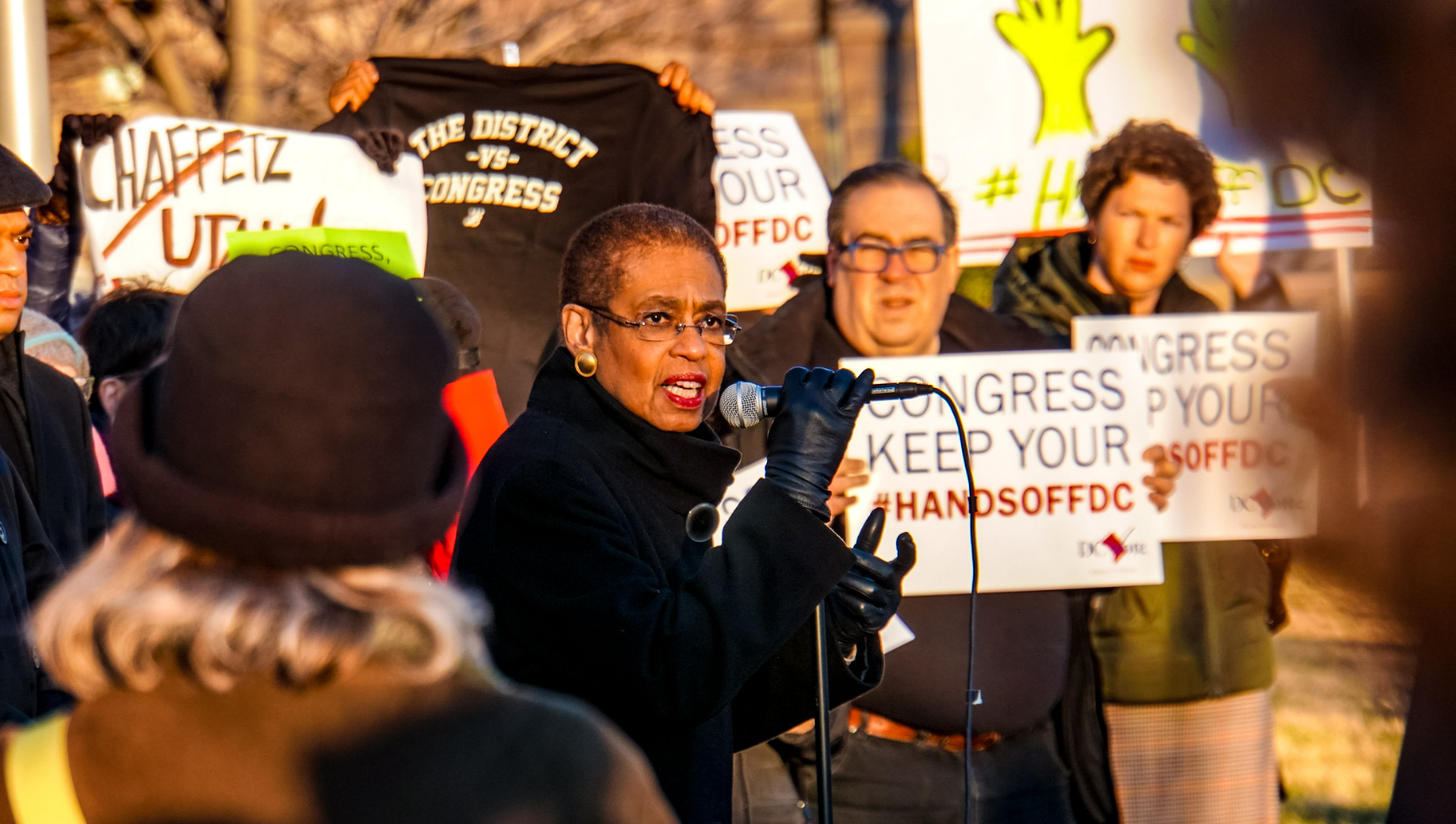
The U.S. Senate will debate and vote on a measure on Wednesday afternoon that would block the D.C. bill overhauling the city’s criminal code. The disapproval resolution — which was already passed by the House — is expected to pass with bipartisan support, a rarity on Capitol Hill.
Around 200 people gathered outside Union Station starting at 11 a.m. for a rally and march to Congress, where they expressed their opposition to the congressional meddling in the city’s affairs. “What’s happening here on Capitol Hill is not about public safety. It’s not about keeping people safe. It is about keeping people in power,” said Patrice Sulton, director of the D.C. Justice Lab and an attorney who worked on the commission the revised the city’s criminal code, at the rally.
The resolution’s likely passage will cap off a political whirlwind that started late last year when the D.C. Council unanimously passed the sweeping 450-page bill that revises and modernizes the city’s century-old criminal laws. Since then, the largely technical bill has come under unrelenting attack from Republicans, who see a political opportunity to lambast Democrats as “soft on crime.”
This push to overrule D.C.’s elected officials is an even more stinging rebuke for many in the city because so many Democrats have gone along with it, with even President Joe Biden — a supporter of D.C. statehood — scolding local lawmakers for their bill and saying he wouldn’t stop the push to block it. That comes less than three years since the House — then controlled by Democrats — made history by approving a bill to grant D.C. statehood. (The Senate never followed suit.)
“What are the stages of grief? I’ve just almost moved on. I think the vote today is a complete farce. As soon as Biden flipped, I knew it opened the floodgates for Democrats to bail on us. It’s not a true gauge of who supports D.C. and the criminal code, it’s about political perception,” said Josh Burch, a longtime statehood advocate and founder of Neighbors United for D.C. Statehood, in an interview with DCist/WAMU.
And that perception is powerful, given the impending 2024 election cycle and the aggressive GOP push to solidify and expand their congressional majorities and unseat Biden. Republicans have already started running TV ads lambasting House Democrats who voted against the disapproval resolution in February, while even liberal stalwarts like Senate Majority Leader Chuck Schumer have said they will vote to block D.C.’s bill.
Still, some Democrats in the Senate have come to D.C.’s defense.
“The debate over the D.C. crime law has gone a bit off the rails. It lowers the carjacking maximum to 24 years, but that’s IN LINE with many states,” tweeted Sen. Chris Murphy (D-Connecticut) on Thursday, referring to one provision that has attracted significant national attention. “And the bill INCREASES sentences for attempted murder, attempted sexual assault, misdemeanor sexual abuse and many other crimes.”
“I believe in D.C. home rule,” Sen. Elizabeth Warren (D-Massachusetts) told reporters this week.
Speaking at the rally, Councilmember Robert White (D-At Large) touched on the dual complaints from many residents and activists: Congress was getting involved in a local matter, and doing so based on a misunderstanding of what the revisions to the city’s criminal code would do.
“Congress feels that they need to come and say, ‘No, we know better than what you know.’ They don’t. They’re not accountable here. We don’t know them, we don’t see them in these streets,” he said. “They’re condemning a law as extreme when the law is stricter than the laws in most of their states. Yeah, these laws in this revised criminal code are more restrictive than the laws in most of their states.”
At the rally, activists also expressed a growing concern that if Congress is willing to block this bill passed by the D.C. Council, other laws could be next.
Hannah Chichester Downs with the D.C. Abortion Fund said that she continuity worries that Congress could restrict abortion access in the region, especially for abortion care later in pregnancy, which the D.C. area is a haven for.
“That’s why it’s so important that we give D.C. statehood, because if the federal government overturns abortion care in D.C., then there’s really no other place for women to go other than maybe like two other states,” Chichester Downs said.
The expected passage of the disapproval resolution also marks a new low in D.C.’s half-century of self-governance. Congress has only stepped in to block local bills on three occasions since the city gained an elected mayor and legislature in the mid-1970s, and no such effort has been successful over the last three decades. Past disapproval resolutions that cleared Congress included one to stop a building near the FBI headquarters that would have been 20 feet taller than the city’s height restrictions traditionally allow, and another bill that would have restricted where foreign embassies can be located.
But it does fit a broader pattern of Republicans targeting D.C., a majority Democratic city, on a range of hot-button social issues. In the mid-1970s, congressional Republicans unsuccessfully tried to block a D.C. bill that banned handgun ownership in the city. A decade later, they tried to overturn a D.C. bill that pulled any investments out of apartheid South Africa, and another that gave people who tested positive for HIV access to health insurance. More recently, a Republican-led attempt to block a D.C. bill that legalized physician-assisted suicide was stymied by the Senate.
Burch worries that the congressional move to block D.C.’s revised criminal code — which wouldn’t have taken effect until Oct. 2025 had it become law — sets a bad precedent for the next two years of Republican control of the House.
“The only place that this irrational and irresponsible House GOP will have legislative successes is as it relates to D.C., and those successes will be bad for us. They’re not going to be able to pass legislation that has national impact, but they can pick on D.C.,” he said. “Democrats who support statehood are also setting a bad precedent by going against D.C., because they will now pick and choose what lines they can cross. This is going to be a really weird system going forward when they’re going to choose when to meddle in D.C. based on political convenience back home.”
The weirdness of those political calculations was evident in Biden’s decision last week, where he both said he supported the city’s right to govern itself but said he opposed this particular act of self-governance. And it could well extend to other mechanisms that Congress has to interfere in local affairs, largely the provisions dropped into the federal budget that dictate what D.C. can and cannot spend money on. (Currently, Congress has banned D.C. from spending money to legalize sales of recreational marijuana or to subsidize abortions for low-income women.)
Still, Burch said he remains optimistic for the overall prospects of D.C. statehood.
“When President Obama said, ‘John [House Speaker John Boehner (R-Ohio)], I’ll give you D.C. abortion but I’m not happy about it,’ we had one co-sponsor [of the statehood bill] in the House and no Senate bill,” he said, referring to the 2011 negotiations where Obama let Republicans keep the budget provision that prohibits the city from spending any money subsidizing abortions. “The substantive progress on statehood has been made. But it does come up to the political reality that when push comes to shove, we are not protected from our foes or friends. We will be sold out. It’s too easy politically for people to turn their backs on us.”