Martin Austermuhle
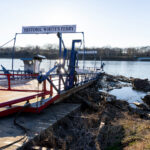
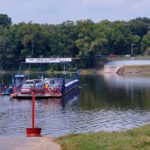
The ferry isn’t really much to look at. It’s flat, wide, and open to the elements, with little more than “Historic White’s Ferry” signs atop to identify the two-century old crossing. But in the rural western corner of the otherwise development-laden Montgomery County, Maryland, White’s Ferry isn’t just a ferry.
“It’s the heart of our community,” says Link Hoewing, a longtime resident of nearby Poolesville. “The ferry actually is our main street, when you think about it.”
Just over two years ago, that heart suddenly stopped beating, the victim of a quirky and complicated legal battle between two entities that aren’t just on different sides of the Potomac River that the ferry used to cross, but also in different states.
And since the day the ferry was grounded, Hoewing and other activists and business owners around the county’s 93,000-acre agricultural reserve have faced stiff currents in their quest to restore service across the river. The conflict that shuttered the ferry is knotty, they concede, but the inability to resolve it speaks to bigger gripes over the lack of attention the county’s rural areas get.
“The truth is the political system has failed us,” says Hoewing. “Loudoun County, Montgomery County, they should have worked on this long ago to get this done. The bottom line is that there are people’s lives affected by this every day.”
‘A living history’
For centuries, White’s Ferry was anything but distinctive; it was one of at least 100 ferries that made their way across the Potomac River, connecting various regions of Maryland and Virginia. But as modernity intervened, one by one the ferries disappeared, eventually leaving White’s Ferry the sole surviving craft of its type, the only means of convenient transit between Poolesville and Leesburg.
That a quirky cable-drawn ferry remained in operation 35 miles north of Washington — a “living history,” says Hoewing — was an additional draw for tourists. People came to enjoy the towpaths along C&O canal, or to visit the agricultural reserve that was created in 1980 as a means to maintain rural areas that could otherwise have been gobbled up by sprawl emanating out from the city.
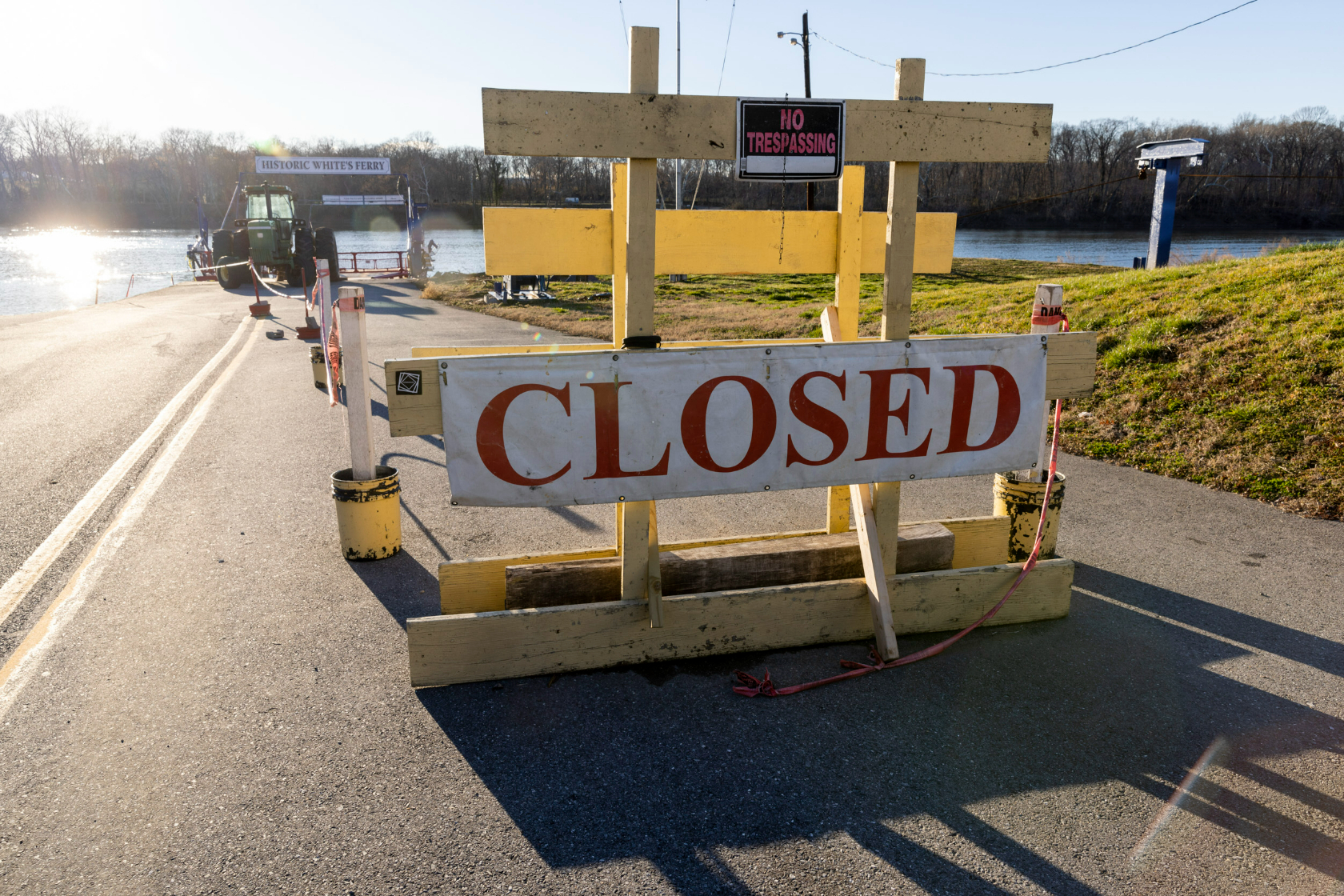
But on Dec. 28, 2020 that living history ended. A long-running legal fight between the Maryland family operating the ferry and a Virginia family that owns the ferry’s landing on the other side of the river came to an end, and years of growing disagreements between both sides over how to proceed left the ferry with nowhere to dock on the western shore.
To some, the ferry’s closure was unfortunate, though the impact was considered limited. For a metropolitan area where roads can carry thousands of cars a day, the ferry was only shuttling a fraction of that — between 600 and 800 cars daily. But for the area around Poolesville — a community of 6,000 people — the closure was felt much more intensely.
According to Tom Kettler, a longtime homebuilder and president of the Poolesville Area Chamber of Commerce, the McDonald’s in town saw a 10% drop in sales. Other locally owned restaurants and businesses, he says, saw even steeper drop-offs, largely from summertime crowds. “Bikers and recreational folks that are out going to the river and they stop at the restaurants and eat. We’ve lost all that,” he says.
Jim Brown, president of the Poolesville Town Commissioners, says the ferry’s closure also isolated the town. No longer could cars come over from Leesburg, and drivers from other parts of Maryland looking to get to Virginia would now have to drive 17 miles further north to the bridge at Point of Rocks — largely avoiding the agricultural reserve altogether.
“People think that we’re in the middle of nowhere, but we think we’re in the middle of everything,” he says. “And that’s especially true when the ferry’s running. We’re getting people coming in and going through from Virginia, from Frederick, from Montgomery County. It really turns Poolesville into more of a central location.”
No easy solutions
Good news came quickly to White’s Ferry: In early 2021, Virginia businessman and history buff Chuck Kuhn bought White’s Ferry with the intention of quickly restarting service. Any celebrations were short-lived, though, as Kuhn soon conceded that initial negotiations with the owners of the landing on the Virginia side remained stalled over a disagreement on how much he would pay to access the landing. (The landing is part of Historic Rockland Farm’s land outside Leesburg.)
Later that year another complication emerged with one proposed solution to the dispute. Officials in Loudoun County said they were unwilling to use eminent domain to take the ferry landing site, ruling out an option that officials and advocates on the Maryland side of the river had touted as the quickest and cleanest way to address the impasse. The decision made clear that while the ferry had once connected Montgomery County and Loudoun County, the jurisdictions had different views of how important the ferry was and what they would do to restore service.
“Here in Montgomery County, we are doing everything we can. And if it were up to us alone, this problem would have been resolved. But unfortunately, this is a land dispute in the state of Virginia, and that’s where a resolution will ultimately be determined,” says Councilmember Evan Glass, president of the Montgomery County Council.
But his counterpart in Virginia says there’s only so far she’ll go in resolving the dispute.
“We’ve done some analysis because when we were having the discussion about eminent domain, it’s like, ‘Well, how many people are traveling that road for the purposes of business versus pleasure?’ That was a question from our side of the of the river. Not enough to to to even come close to [justify] eminent domain. Are we losing money on our side of the river? We are not. I know they are in Montgomery County,” says Phyllis Randall, chair of the Loudoun County Board of Supervisors.
Randall says the situation could be resolved by simply replacing the ferry with a bridge, something Virginia has been pushing for years. (The closest bridges are the American Legion Bridge far to the south, and Point of Rocks 17 miles to the north.) But the idea of a bridge has long been a non-starter in Maryland, and Kettler says it remains so.
“If you bring a bridge across, that would just basically blow up the agricultural reserve,” he says. “You’re not going to be able to bring a bridge across without just fundamentally changing the land use out here.”
Facilitating an agreement
Hoewing, Kettler, and Brown all say that the quickest solution would be a negotiated agreement between Kuhn and the owner of the landing site in Virginia. But they also argue their respective governments should be putting pressure on both sides to make an agreement happen. Hoewing says that until recently, he felt Montgomery County wasn’t pulling its weight, in part because the western and largely rural part of the county is easy to forget.
“We’re basically left with a lack of urgency,” he says. “And that’s not uncommon for a lot of the issues we faced in our area.”
Late last year, Fair Access for Western Montgomery County, an advocacy group Hoewing helped create, held a rally to demand more action on restarting service on White’s Ferry. A number of the county’s elected officials attended, and Hoewing says they have since gotten a commitment from County Executive Marc Elrich that he’ll pursue the issue.
“We’ve been working with all of the entities involved: Loudoun County, the ferry owner, and the owner of the [landing] to see if we can get alignment so that both the ferry can restart and have a place to land at the same time,” says Chris Conklin, director of the Montgomery County Department of Transportation. “It’s more complicated than it seems on the surface.”
Randall says she’s been trying much the same approach in Loudoun County. Still, she says, there’s only so far that effort will go. “There’s a place for government to encourage, to put options on the table,” she says. “There’s a place for us to do that. And we do and we have, but we can’t make [the private parties] do anything. And that’s just where we are right now, unfortunately.”
In a statement, Kuhn says he’s still pursuing a negotiated settlement with Rockland Farm.
“We remain committed to getting White’s Ferry operational,” he says. “We continue to work in partnership with the state of Maryland, Commonwealth of Virginia, Montgomery County, and Loudoun County to find a solution that Rockland owners will accept so that the ferry can access the Virginia landing site. The economic impact has been real on the local communities and people who count on the ferry, and we hope for a resolution soon.”
The owner of Rockland Farm did not respond to a request for comment.
Hoewing, Kettler, and Brown say they’re all in differing states of emotion when it comes to whether they expect the best or the worst for getting White’s Ferry back on the water. Kettler says his job as a homebuilder has prepared him to deal with roadblocks, so he remains optimistic.
For his part, Hoewing is frustrated; to him, this has all been more proof that it’s easy to forget about Montgomery County’s rural areas. And Brown can do little more than remain hopeful, albeit cautiously so.
“I’ll believe it when I see it,” he says.