 Sarah Y. Kim
By now, construction noise might not even feel like noise to Arlington residents who live near Amazon’s second headquarters.
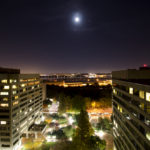
For the past three years, construction crews have been busy building two new office buildings: the first phase of HQ2. And that’s just part of the development happening in the area. Walk for a few minutes from the site toward Crystal City and you’ll find yourself passing one construction site after another. In anticipation of Amazon’s arrival, the area encompassing Pentagon City, Crystal City, and Potomac Yard have getting a bit of a serious makeover, including a number of buildings being demolished to make way for new ones. It’s even gotten a new name: National Landing.
Soon, however, residents around Amazon’s headquarters will have to adjust to silence.
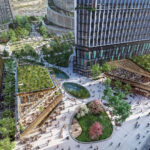
Amazon did not give a new projected end date when it announced that it was pausing HQ2 construction earlier this month, and the project’s first phase is still set for completion this summer. But the pause means a delay in the second phase, which includes the long-anticipated spiral-shaped Helix building that was poised to become a landmark for the area.
It’s not yet clear what it all will mean for Arlington’s economy, housing market, and local businesses. But there’s plenty of speculation.
The news is “not great” for Nick Freshman, a long-time resident and owner of The Freshman, a restaurant and all-day cafe. But he’s not going to panic.
“It is what it is,” he says. “We don’t know what it means. We don’t know what it’s gonna lead to.”
As the owner of a restaurant that weathered the COVID-19 pandemic, Freshman says he feels like the pause is “not even a blip.” HQ2’s completion had already seemed far off: the original projected completion date for both the first and second phases of development was 2030.
“We try to keep a level head, keep our head down, just make sure that the beer’s still cold and the food still comes out on time and my staff is taken care of and happy,” Freshman says. “That’s the kind of thing we worry about day to day.”
Still, his phone has been blowing up with messages from friends and colleagues since the announcement. Freshman says they’re concerned for him and what the delay means for his business.
They’re also concerned about what it means for Arlington’s economy. Even more worrisome is that the announcement came just after Amazon began laying off some 18,000 employees – a record high for the company. Other tech firms have also been laying off employees, causing jitters across the tech world and beyond.
“There’s just a really broad anxiety out there as to what’s going to happen here and nationally over the next few years,” Freshman says. “Are we going to enter into a recession? Is inflation going to take over? Are there going to continue to be layoffs?”
Amazon, however, has said that it has not changed its plans to eventually hire 25,000 workers for HQ2. And more than 8,000 of those workers are supposed to start their jobs this summer.
Terry Clower, director of the Center for Regional Analysis at George Mason University, thinks the pause is a temporary setback. Right now, he doesn’t foresee the delay as having any long-lasting negative impacts on the local economy.
“It actually to me is kind of good news,” he said. “Amazon’s behaving in a business rational fashion.”
The shift may be more about workplace changes wrought by the pandemic. Clower says hybrid work is here to say, and that Amazon shouldn’t create more space than it needs. That would only add to Arlington’s already sizable vacant office problem. (The company had said that it was “evaluating space needs” when it announced the pause).
The pause isn’t such good news for construction workers who were relying on Amazon’s expansion, and Clower says there has been a slight lull in building projects. But Clower says they won’t necessarily be unemployed, due to a shortage of construction workers.

He also speculates that local businesses could take advantage of the pause, hiring tech workers who might otherwise have gone to Amazon.
And Clower says it isn’t just HQ2 that’s boosting the local economy here. Boeing, for example, announced that it’s moving its headquarters from Chicago to Arlington last year.
“We’ve had some really very positive economic development announcements in the last few years,” he says.
But the pause could signal a potential slowdown in the region’s economic growth, says Brett Theodos, senior fellow at the Urban Institute’s Metropolitan Housing and Communities Policy Center. Moreover, if workers at HQ2 don’t have to be at the office, it’s very possible these remote workers won’t be moving to Arlington, especially with high housing costs in the area.
That’s not exactly good news for the region, Theodos says. But there could be a silver lining: rents may not shoot up as quickly.
“That said, it doesn’t mean that rents are falling,” Theodos says. “And it doesn’t mean they’re not increasing.”
Inflation could still contribute to rising prices, and Theodos says the cost of living in Arlington is already well beyond what a lot of people can comfortably afford.
This pause is a good opportunity, he says, for local and federal leaders to preserve affordable housing in the area and invest in more.
“We simply don’t have enough units at enough affordable price points to allow people to stay in the community,” he says.
Rachid Maalouf, a server at Freddie’s Beach Bar, pays about $1830 a month for his one bedroom. That rent is “acceptable,” he says, because he works multiple jobs. He’s expecting his rent to climb to about $2000 to $2100 in his next lease term.
“Arlington was already super expensive,” Maalouf says. “Now it’s skyrocketing.”
He’s hoping that local leaders and Amazon do more to regulate the cost of living. The county is well aware of the housing crunch; the Arlington County Board will soon vote on a “missing middle” proposal to expand the number of multifamily units in an effort to address the shortage of options between affordable housing and pricier single family homes. Amazon is also partnering with the county and investing in affordable housing to offset the added pressure its HQ2 will bring to the local housing market; so far that investment has totaled more than $800 million via its Housing Equity Fund.
Maalouf is also a software engineer, and is interested in working for the company someday. But with the pause on construction, he isn’t convinced that Amazon will stick to its pledge to hire 25,000 workers for the new headquarters.
“It’s pretty hard to believe that right now, in this economic climate,” he says. That would be a “big letdown” for those who came to Arlington in the hopes of working for Amazon.
Some locals are more worried about something else: would Amazon cancel the Helix, the flashy, mirrored glass twist of a building set to anchor the complex that Amazon is calling PenPlace?

That was the first concern of some of his neighbors, says Eric Cassel, president of the Crystal City Civic Association.
“Many of our buildings are boring,” Cassel says. “People are looking forward to something unique.”
While not everyone is as enthusiastic about the Helix’s design as Cassel, the delay likely has economic implications. An “architecturally unique” building like the Helix could be a tourist attraction.
Crystal City, a stone’s throw away from the Pentagon and home to numerous office complexes, wasn’t exactly the sort of place you’d visit to have fun. The area became even quieter following an exodus of thousands of Department of Defense workers when the DOD shifted employees and closed bases. That exodus left a “hole,” Cassel says, that Amazon is expected to fill.
About a decade ago, Nick Freshman says, no one was coming. That’s changed. Every day, Freshman says he sees traffic from Amazon workers at his restaurant. He envisions National Landing becoming a “live-work-play destination.” Already, there is more “play” in an area once mostly filled with large office blocks: There’s the Alamo Drafthouse, a revamped Crystal City Water Park with a bar coming this year, and new restaurants. National Landing, he says, is already a D.C. area “jewel.”
“I’m still very bullish on the future of our area,” he says.
In an earlier version of this story, we incorrectly described The Freshman. It is a restaurant.