Héctor Alejandro Arzate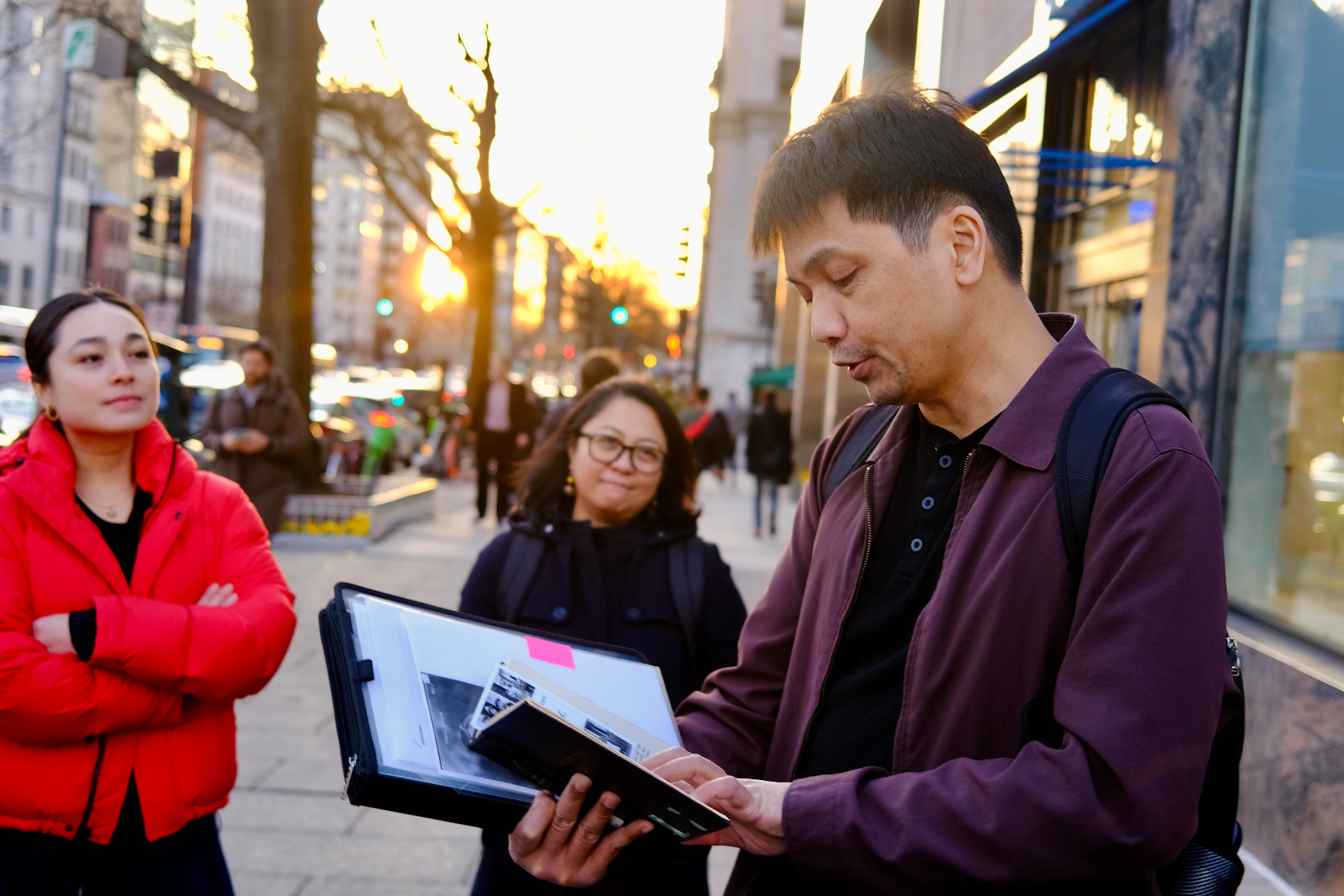
Erwin Tiongson usually starts his D.C. tours on Filipino history with a disclaimer: He’s not a professional historian, but that doesn’t mean he’s an unprofessional historian.
Tiongson is a full time economics professor at Georgetown University so the tours are more of a personal passion project. As such, most of them are booked by word of mouth and he’ll usually lead with a single sheet of printer paper held inside a plastic sleeve. The paper holds just a few dates from which he says can summarize more than 100 years of Filipino history.
“I’m a community historian,” says Tiongson. “I guess that’s how some people refer to the work that I do.”
For about a decade, Tiongson and his family have been compiling stories about the Philippines and how its citizens have left a lasting mark on the District. They’ve combed over local archives, diary entries, and have even interviewed the living descendants of key historical figures. True to his nature as an economist, Tiongson even put together an Excel spreadsheet that identified over 250 different heritage sites in D.C. and throughout the region. The motivation, says Tiongson, was straightforward.
“We wanted to tell our kids more about their cultural heritage.”
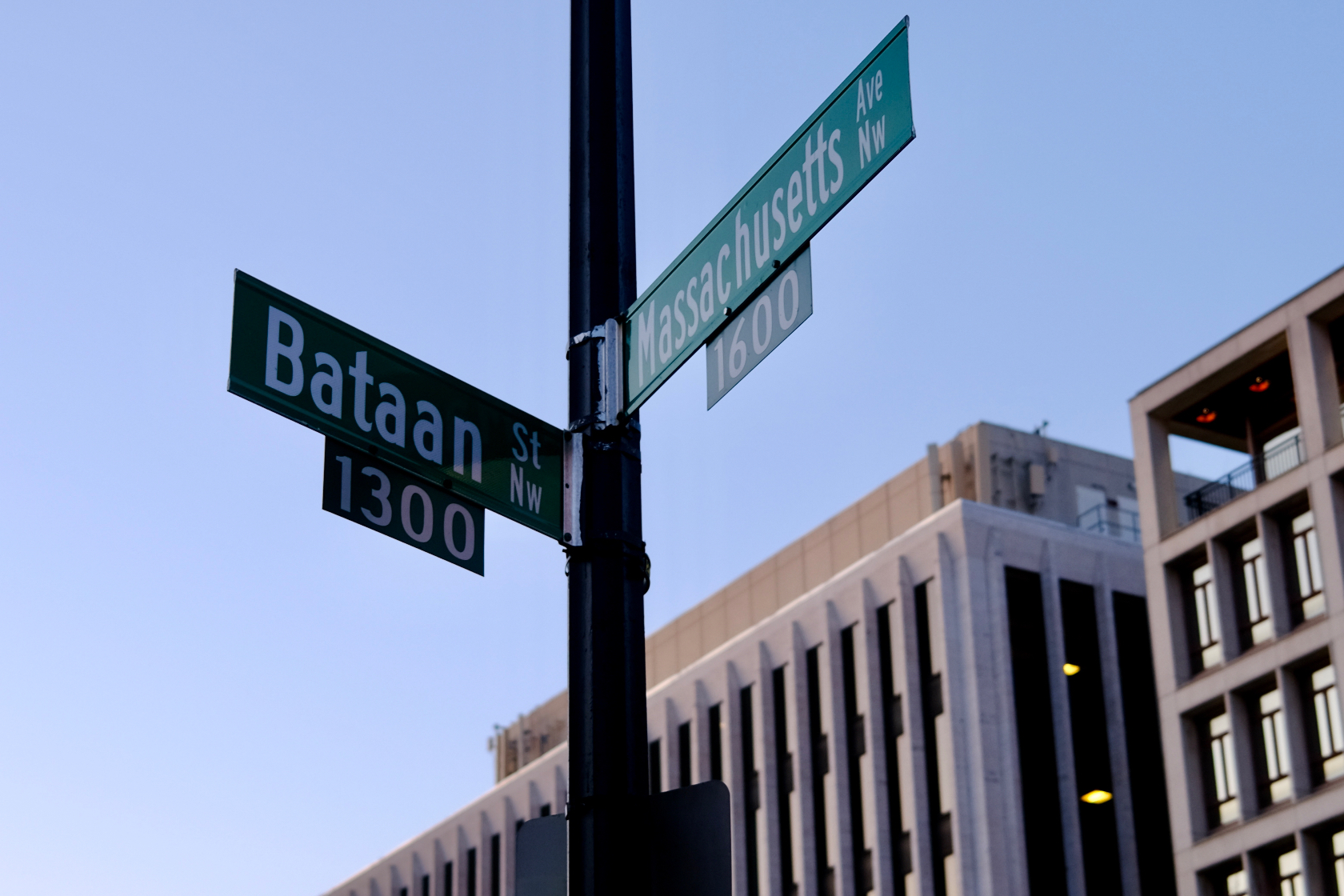
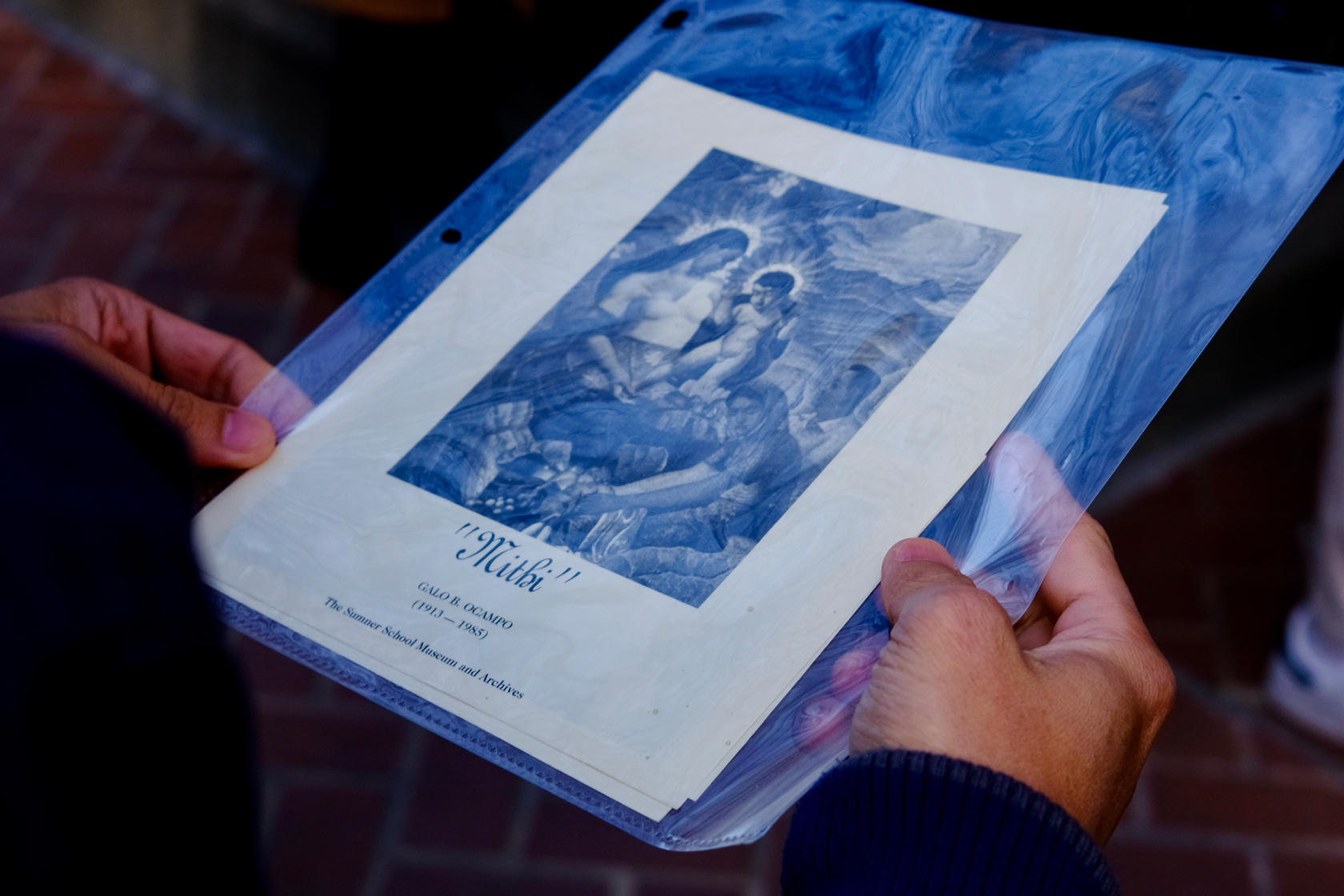
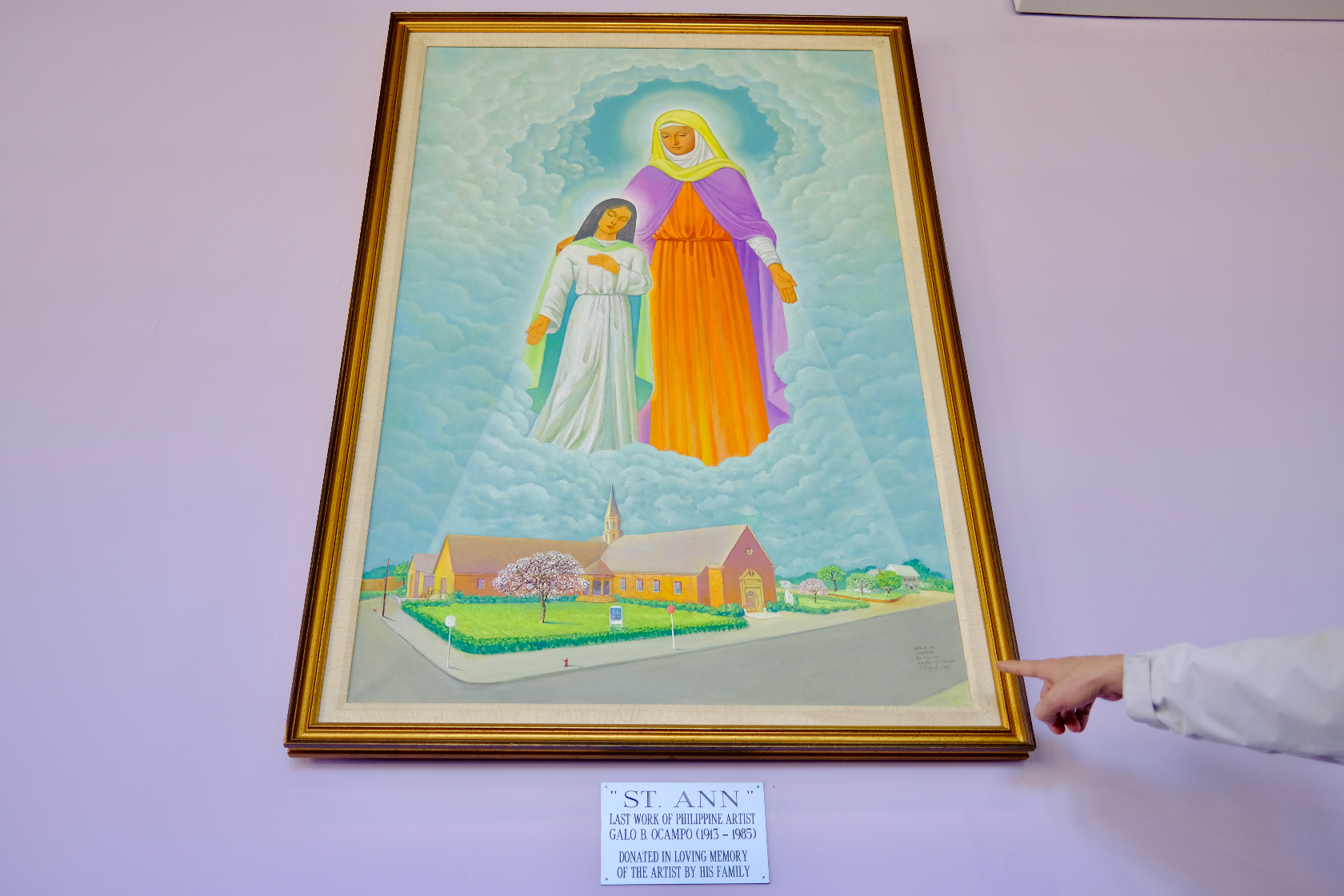
This week, Tiongson’s work to highlight that history was released in written form, through a book titled Philippine-American Heritage in Washington, D.C. It features stories like how West Potomac Park – famous for its blooming cherry blossom trees around the Tidal Basin – was modeled after a park in Manila. It reveals how Bataan Street NW in D.C. came to be named after the Battle of Bataan in the Philippines, the site of an intense conflict during World War II. Tiongson also writes about Galo Ocampo, a renowned Filipino painter, and how he spent his later years in Arlington – bequeathing one of his last works to St. Ann Catholic Church.
Tiongson says the book’s debut has been “… very exciting and terrifying, both at the same time.”
While the book is the culmination of about three summers of work and research, the tours themselves are something Tiongson has been conducting for the community over the last decade or so. According to Tiongson, they are free and typically draw a crowd of at least 10 people – many of them students, professionals, and even diplomats.
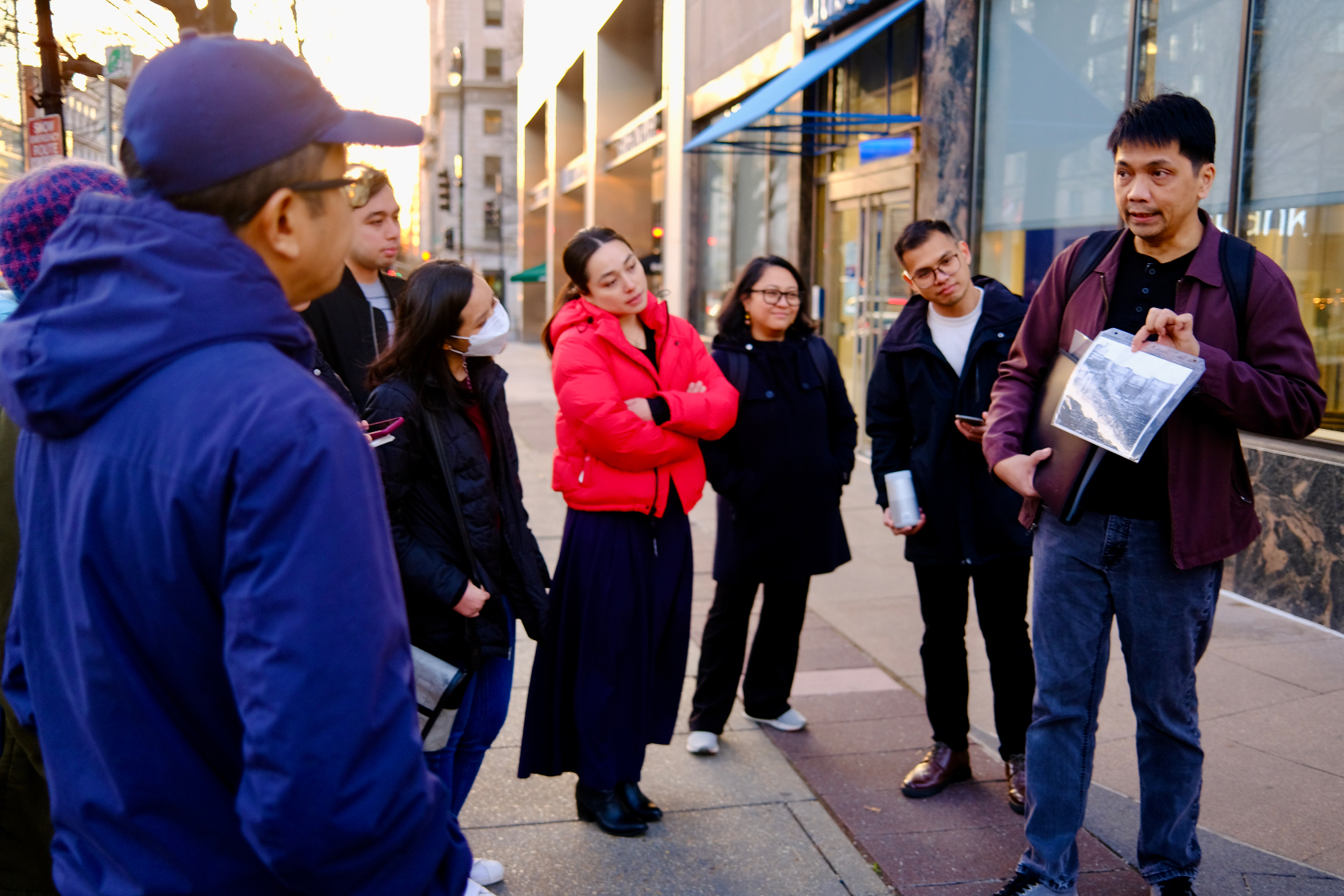
Limon Rodriguez, who is a Filipino student at Johns Hopkins School of Advanced International Studies, says his time spent with Tiongson on the tour helped him better understand the relationship between the U.S. and Philippines.
“By knowing the country’s history, you get to know more yourself, right? And your people,” says Rodriguez, who’s been living in D.C. for about two years.
A recent tour began across the street from the Embassy of the Philippines and took attendees to sites scattered around Downtown, including the Department of Veteran Affairs and the White House. Not only does Tiongson take people to a handful of notable sites, he also shares small pieces of memorabilia such as buttons, prints, postcards, and photos – all artifacts he’s collected over the years.
“It’s been a joy collecting all these stories over the past 10 years or so. And it’s also equally joyful being able to share these stories. And I think these stories are best preserved when we share them with other people. And as we tell and retell these stories, maybe we can all help keep them alive,” says Tiongson.
Sojin Kim is a curator at the Smithsonian Center for Folklife and Cultural Heritage who has been working to highlight the history of Chinese and Korean-Americans in D.C. through the 1882 Foundation. She says the work that Tiongson is doing is deeply important not just to highlight the legacy of Filipinos in the region but also to preserve it for future generations.
“I think it’s great because it just shows you that history is way more complex than the versions that we get or that we promote or that we memorialize,” says Kim.
Pat Escalante finds the efforts being made by Tiongson and his family to compile and share local Filipino heritage empowering. She’s been living in D.C. for about five years and says she didn’t really know as much about local Filipino history before going on the tour. Escalante and her brother, James, attended a recent tour after hearing about it from friends.
“[It] makes me feel like D.C.’s a little bit more familiar now, or more like home because there’s like other Filipinos who are here too,” says Escalante. “It just makes me also feel like, a lot prouder that I’m Filipino.”
Father Mel Portula has been a pastor at St. Ann Catholic Church in Arlington for the last 10 years since making his way from the Philippines. He says there’s a growing community of Filipinos in the area, and he’s proud and appreciative of Tiongson’s work.
“I’m glad we have somebody doing that because we need to continue the storytelling and Professor Erwin is an excellent historian,” says Portula. “And just to know that we have a scholar who can actually tell the stories and be proud of the Filipino contribution here in Virginia or in D.C. or the United States as a whole, is amazing.”
Portula’s church is home to St. Ann, a painting in the rectory which is thought to be one of the last works made by the renowned Filipino artist Galo Ocampo. According to Tiongson’s research, Ocampo settled in the region and became a devoted parishioner. For Portula, seeing the artwork and Tiongson’s dedication to preserving their shared heritage is a personal joy.
“Every time I come to this room and look at this, it actually remind me of the great works of the many Filipinos, not only back home but also here in the U.S,” says Portula.