Jacob Fenston
It’s no small feat keeping hundreds of elementary school students still and silent for nearly ten minutes.
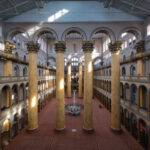
That’s what high-wire artist Philippe Petit accomplished on Friday morning, as he crossed the National Building Museum’s Great Hall, more than 50 feet above students’ heads.
Petit, now 73 years old, gained international fame with his death-defying (and very illegal) high-wire walk between the still-under-construction Twin Towers in New York City in 1974. Since then he’s been the subject of numerous books and films, including the Oscar-winning documentary Man On Wire.
Petit crossed a wire strung across the museum’s cavernous Great Hall several times, as students below sat craning their necks in awe. Philippe also performed at a $300-a-plate fundraiser for the museum on Thursday evening. The performance for schools was free.
https://twitter.com/DCist/status/1639362031244435484
This was Petit’s first time performing in D.C., and he says he loves having an audience of kids, even though they can be tough critics.
“I like the impetuosity and the freshness of a kid’s mind,” Petit said in an interview after the performance. “I try, even though I’m 73 years old, I try to conserve the child in me. When I talk to children, I try to speak their language.”
Petit says he has had an eye on the museum for a while, ever since he saw a photo of the Great Hall some 15 years ago.
The Great Hall is spectacular: the room is as high as a 15-story building at its tallest point, the roof supported by ornate, 75-foot corinthian columns that are 25 feet in circumference. The grand building was constructed in the late 1800s as the the headquarters of the U.S. Pension Bureau.
“I fell in love,” Petit says. But, it was a “missed connection” — because the photo didn’t identify the room, Petit was in love with a place whose name and whereabouts he didn’t know.
Aileen Fuchs, president and executive director of the museum, says it wasn’t until 2021 that Petit learned the room he’d fallen in love with was here in D.C.’s National Building Museum.
“Within weeks, we were in partnership,” Fuchs says.
“One of the guiding pillars of the museum is wonder,” Fuchs says. “He has brought that to some of the most iconic buildings in the world, so it’s so fitting for it to come to the National Building Museum.”


After the school performance, Petit took questions from the audience.
“Can you walk on the telephone wire outside our classroom window?” asked a class from Malcolm X Elementary in Southeast D.C.
“I am a man who always says nothing is impossible, but a telephone wire is not strong enough,” Petit responded. Plus, he said, whoever was talking on the phone probably wouldn’t want to hear his crunching footsteps through the wire. “That wouldn’t be nice.”
Asked if he’s afraid a bird will fly into him on the wire, he said no, he’s never afraid on the wire.
“I know the wire is safe,” Petit said.
But he admitted there are two things that do scare — no, terrify — him: animals with no legs (like a snake), and animals with too many legs (like a giant spider).
A student from Garfield Elementary, also in Southeast D.C., asked what advice Petit would give to his younger self, if he could.
“I’m going to be very honest, I hated when adults gave me advice. I almost did the opposite,” Petit answered. “I am not going to give you any advice, but I am going to share with you something useful.”

“When a kid tries something, very often they try it once or twice and they say, ‘I cannot do it.’ Of course you can do it! But you have to do it 10 or 20 times or a hundred times,” Petit told the audience of kids. “Don’t be afraid of making mistakes. Mistakes are very good because mistakes are the best teachers.”
Petit is French — his first unauthorized high-wire walk was between the towers of the Notre Dame Cathedral in Paris, when he was 21. He now lives in New York and has performed in cities all over the world. He says he’d love to come back to D.C. in some capacity: “as a high-wire walker, as a street juggler, as a lecturer, maybe as a teacher in a circus school.”
What about stringing a wire from one of D.C.’s famous structures? Maybe the Washington Monument?
“Yeah,” says Petit. “Why not?”
This story was updated to correct the size of the columns in the Great Hall.