Spring theater is in full swing, which led our critics to see three more shows in March — but don’t worry, all of these are running into April. Want to know what else is playing? Check out our monthly theater preview.
Push the Button
Review by Nathan Pugh
Superhero movies are going through a rough patch. Screenwriters of recent box office flops would do well to take in the joyful energy of Push the Button, a hip-hop musical by Drew Anderson and Dwayne Lawson-Brown making its world premiere with D.C.’s Keegan Theatre. Push the Button is a superhero tale that’s pop-art colorful, incredibly easy to follow, and still a thoughtful fable on systemic injustice.
The musical opens with Hero (Quincy Vicks), a Superman-like protector of the city with braggadocio to spare. His antithesis is Villain (Tre’mon Mills), an evil mastermind who’s currently awaiting trial for “pushing the button” — an apparently horrible act that initially isn’t explained. An enterprising Journalist (Ashanti Symone Branch) is digging into the case, much to the dismay of the Judge (Gary Dubreuil).
Push the Button’s plot is so archetypal, you’ll see plot twists coming a mile away, but the show still succeeds due to anarchic, megawatt performances. Vicks and Mills bring verve to the show’s songs, made up of rap verses that sample artists like Jeezy, Billie Eilish, and Silk Sonic. Director Duane Richards II successfully leans into the camp elements of the production, creating a storybook world that feels borne out of a frenetic fear.
Fear does creep into the story: the song “Lock ‘Em Up” is lyrically brutal, and a monologue performed by Branch is a haunting exploration of familial guilt. Push the Button may exist because of the writer duo’s open mic history, but I wonder what would happen if they stripped away the show’s sonic layers. Anderson and Lawson-Brown have written prescient words that deserve to be heard beyond the realm of musical parody.
Push the Button’s relentlessly straightforward quality could prove frustrating to audiences, but the story is performed so boldly that it’s hard to quibble about narrative simplicity. Superhero stories are often the most complex when dealing with the elemental human emotion — and Push the Button thoughtfully engages in this contradiction.
Push the Button runs at The Keegan Theatre through April 7. Tickets are $40-55. Run time is approximately 60 minutes with no intermission.
Angels in America Part 1: Millennium Approaches
Review by Peter Tabakis
To paraphrase an old vaudevillian chestnut often attributed to Mel Brooks: Angels in America is like sex or pizza — even when it’s bad, it’s still pretty good. Millennium Approaches, the first half of Tony Kushner’s sprawling opus currently running at Arena Stage, remains bulletproof and trenchant as ever on the page. But as reimagined by János Szász, a Hungarian director known for bold choices, this revival of Angels confounds even as it takes flight.
Set in mid-1980s New York City as well as some places the characters hallucinate, Millennium revolves around a collection of verbose characters who speak with sparkling prose. They strain to cope with the AIDS epidemic, in particular, and a Reagan-era America, in general.
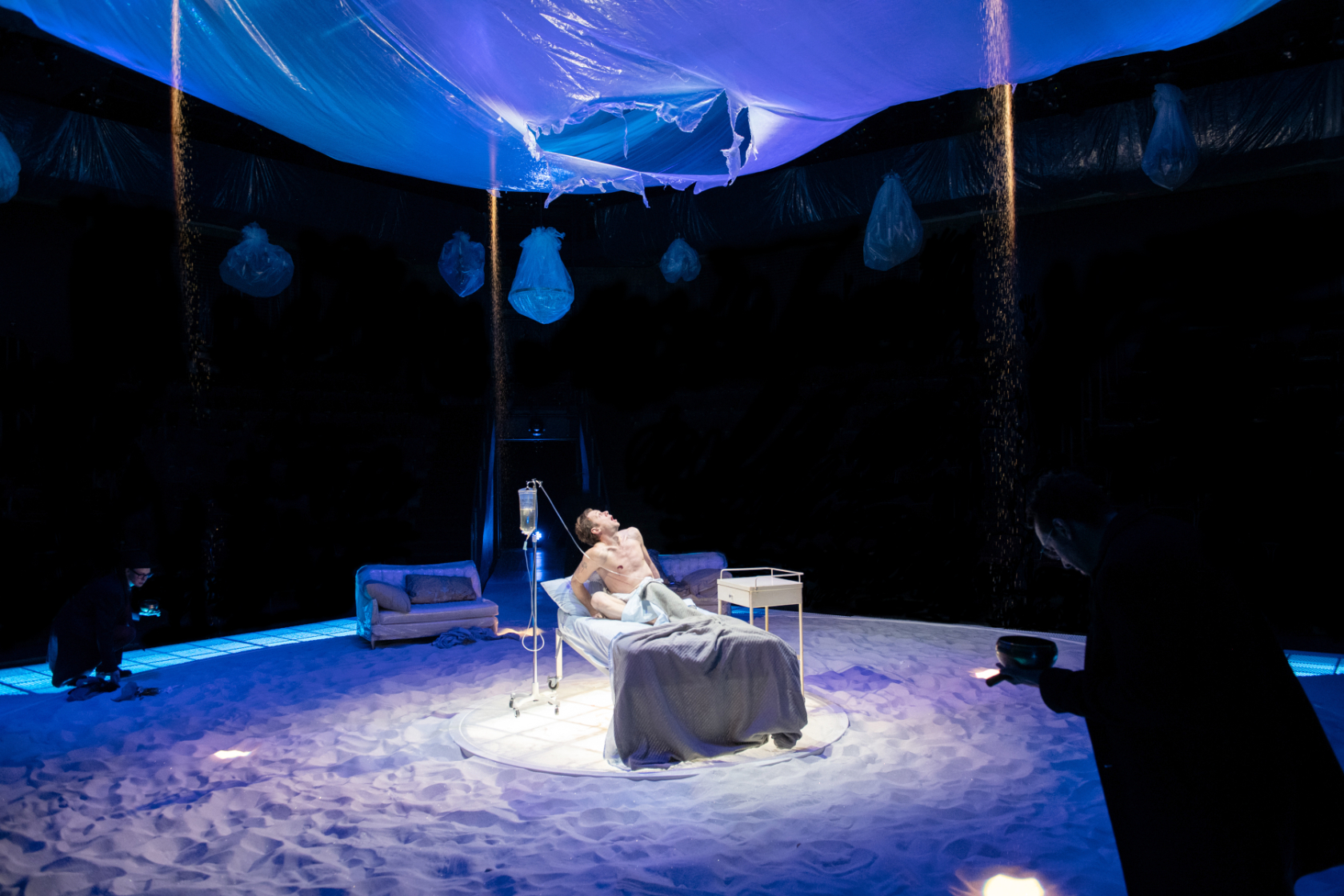
Szász’s most striking stamp on Millenium is his in-the-round staging. Every actor comes and goes, in multiple guises, from various entry points during the show’s famously rapid scene changes. They sometimes descend from the aisles beside you onto a performance space fashioned into a ring filled with ankle-deep sand, handfuls of which are flung around to underline Tony Kushner’s immortal words. At the center of this donut-shaped sandbox is a gaping maw, one that’s plugged, here and there, by a hydraulic piston that raises and lowers scenery as needed.
This overly fanciful execution regularly distracts from the actors, all of whom are excellent — especially the fabulous Nick Westrate as Prior, channeling Justin Kirk’s performance in the HBO adaptation; and the scene-stealing Edward Gero as Roy Cohn, a closeted gay man and real-life villain — and their performances, which are near-perfect. When compared to the cool remove and minimalism of Marianne Elliott’s Broadway revival of Angels from 2018, this version seems eager to draw attention to its director’s theatrical somersaults, which seem unnecessary given the sterling material Szász is working with.
Despite being written more than 30 years ago, Kushner’s moral indictment of his main devil Roy (Donald Trump’s actual tutor) needles and prods at us today. And yet, there are wild tonal missteps here, particularly in the second act, that diverge from the original script (such as its representation of two old British ghosts). Only telling a portion of the story, with no plan to stage Perestroika, part two of Angels, isn’t Szász’s fault, but it feels like a missed opportunity. So, by the time this Millennium Approaches concludes, with the spectacular revelation of its divine being, the whole endeavor resembles a hasty afternoon tryst or a fresh slice of Domino’s: in other words, just good enough.
Millennium Approaches runs at Arena Stage through April 23. Tickets are $56-$72. Run time is approximately 3 hours and 30 minutes with one 15-minute intermission.

Sometimes the Rain, Sometimes the Sea
Review by Nathan Pugh
Sometimes the Rain, Sometimes the Sea, making its professional world premiere at D.C.’s Rorschach Theatre, is the latest play to revise and complicate our understanding of a fairy tale. Though this idea is nothing new — see Into the Woods and Once Upon a One More Time, both of which have played in D.C. in the past year alone — the sheer inventiveness of Julia Izumi’s writing means audiences find a refreshingly mature variation on a subversive but popular genre.
The play opens in the modern day, when a rain cloud with a soul humorously represented by actress Sydney Dionne falls in love with the idealistic — but taken — Ralmond (Jordan Brown). The rain cloud discusses this dilemma with her cow friend Bessie (Arika Thames), and they hatch a plan to better understand human love.
Running alongside this storyline is a more antiquated story: in medieval robes, a prince Edvard (Colum Goebelbecker) professes his love for the young woman Ina (Jordanna Hernandez) who wants nothing to do with him. Soon Dolan (Nick Martin), the narrator of the rain cloud’s story, tries to regain control of the competing stories on stage.
Much of the joy of Sometimes the Rain, Sometimes the Sea comes from its anachronistic use of pop culture references alongside classic romance tropes. For example, Ralmond explains that he’s in love with the “digital music interface” Midi, before revealing that’s just the name of his girlfriend. Director Gregory Keng Strasser gracefully finds a nice balance between the silly and the sincere, and gives ample room for actors Dionne and Thames to deliver pitch-perfect comedic performances.
Sometimes the narrative layers don’t quite fit, however. A section with audience participation arrives out of nowhere, while mention of the “childish, outdated, or problematic” nature of fairy tales, a subject ripe for discussion, goes sadly undramatized. Eventually, Izumi’s theatrical collage becomes a more conventional portrait (messy characters are soon revealed to be one-to-one allegories for historical figures, and it feels too cut and dried).
Still, for most of its runtime, Sometimes the Rain, Sometimes the Sea achieves something that other subversive fairy tales don’t: a real sense of danger. Fiction authors often say at a certain point that they’re not writing their stories, their characters are. This show captures that literary dynamic exquisitely, and unearths the mature stories that fairy tales sometimes can only imply.
Sometimes the Rain, Sometimes the Sea runs at Rorschach Theatre through April 16. Tickets are $30-45. Run time is approximately 95 minutes with no intermission.