Colleen Grablick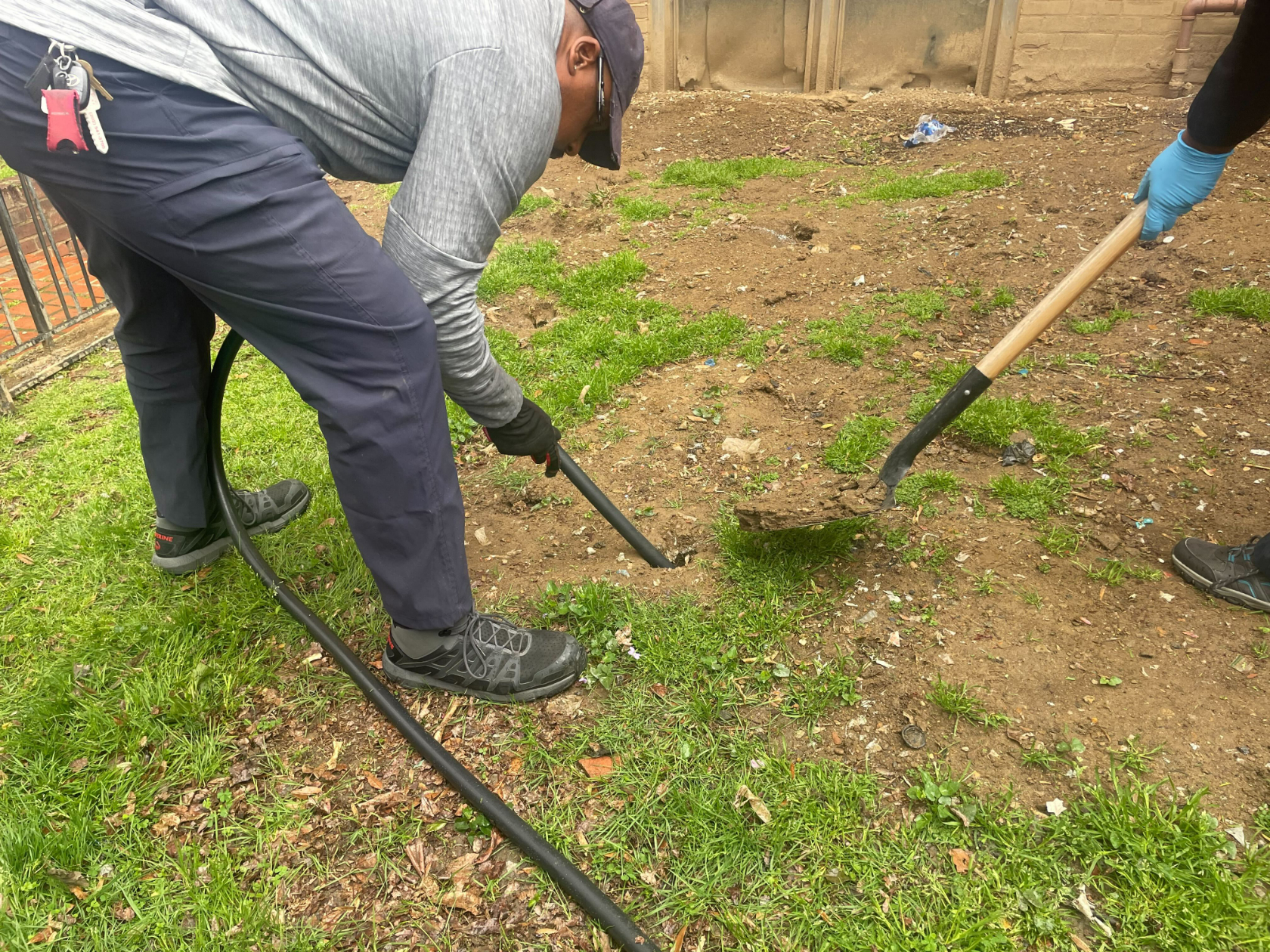
Rats — they’re as much a stitch in the fabric of D.C. life as the Metro and mosquitos.
They’re scurrying down our sidewalks, milling about our alleyways, and feasting on our half-eaten take-out containers. They’re chewing car wires, shutting down entire Popeyes locations, maybe even crawling up our toilets.
According to DC Health numbers, rodent service requests have ballooned since the pandemic. While the city received a little over 8,000 requests in 2020, in 2022 that number climbed to more than 13,000, with Ward 1 acting as the city’s rat epicenter. So far in 2023, the city has already fielded 6,141 rodent-related reports, with Ward 1 residents again submitting the most service requests.
Program manager of DC Health’s Rodent and Vector Control Division Gerard Brown attributes this in part to the pandemic; with stay-at-home orders and the rise in remote work, the rats — just like us — had to pivot. Instead of scrounging around restaurant dumpsters and parks, they bathed in the bounty of over-flowing residential garbage cans and discarded Uber Eats orders. Then, when restaurants and bars opened back up again in 2021 and 2022, it was like a rodent renaissance — they could return to their humble abodes near eateries and businesses. Meanwhile, healthy colonies had already been successfully repopulating in our backyards and alleys.
Despite ongoing efforts to control the rodent population in the District, their creativity and adaptability makes their presence nearly inescapable — a fact made clear in Friday’s rodent abatement demonstration. DC Health officials sent out an email on Thursday morning, offering every reporter’s dream assignment: an interactive and informative “rodent walk,” where we could learn firsthand about rodents and their behavior. We learned, but the rats didn’t behave.
Outside a soggy rat burrow on Sheridan Street NW, we gathered ’round as DC Health Rodent and Vector Control Division specialists showed us how they respond to rat burrows. And in return, the rats showed us how tricky they can be to eradicate.
11:05 a.m.: Under dressed and umbrella-less, I arrive at the corner of 14th and Sheridan Streets where a few reporters are gathered with a crew of DC Health officials for the “rodent walk.” As we’re waiting for the Mayor’s camera crew to arrive, I spot what appears to be another group preparing for a different walk one street over. They’re holding a wooden cross and I remember it’s Good Friday — the Christian holiday that marks Jesus’ crucifixion. The lapsed Catholic in me wants to pull out some metaphor comparing Jesus’ walk up Calvary Hill to our 50-foot walk down to witness a rat decimation, but I lack the creativity.
11:07 a.m.: The mayor’s crew arrives moments later. Gerard Brown, the program manager for DC Health’s Rodent and Vector Control Division, introduces himself and tells the group we’ll be walking down the block to a “heavy infestation,” where we will see how the crews treat the rat burrows. (A generous DC Health employee hands me their umbrella.) We begin our one-minute trek.
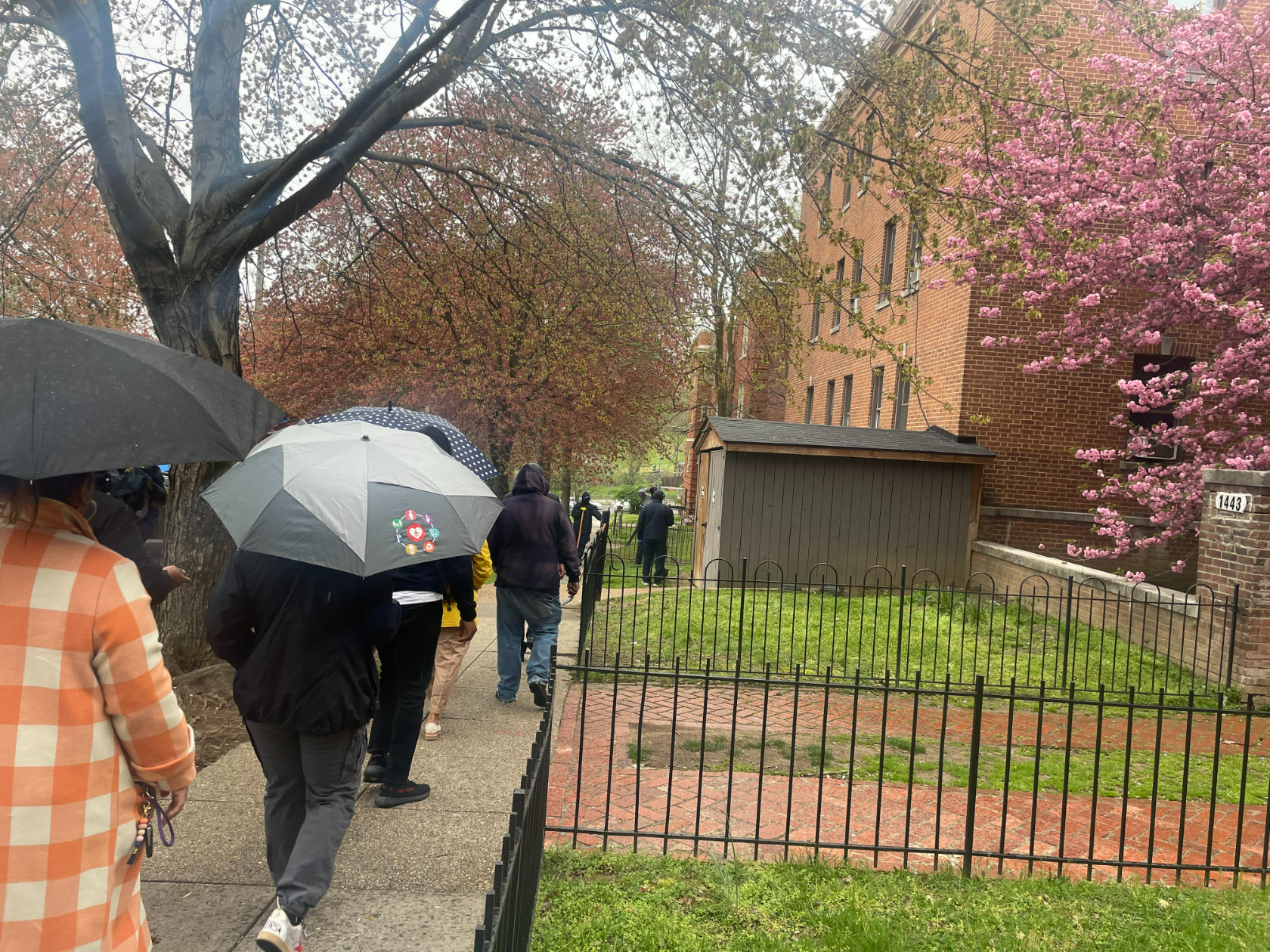 We begin our solemn march to the rodent burrow down the block.
11:08 a.m.: Literally one minute later, we arrive at a fenced-off patch of dirt outside an apartment building. The patch is prime real estate for rats, as it sits directly next to a shed that houses the dumpsters for the apartment building. The ground is polka-dotted with little holes about the size of a fist — indicating a vast underground network of interconnected tunnels. Wisely, rats rarely dig themselves a hole with only one way out. Rule of the Rat Number One: always have a back door!
11:10 a.m.: A DC Health worker begins treating the holes with a rodenticide, a powdery substance that can coat the rat’s fur and eventually kill them. As he is walking from hole to hole, a rat scurries up out of another hole and runs across the burrow. Already, it’s a bit of a losing battle.
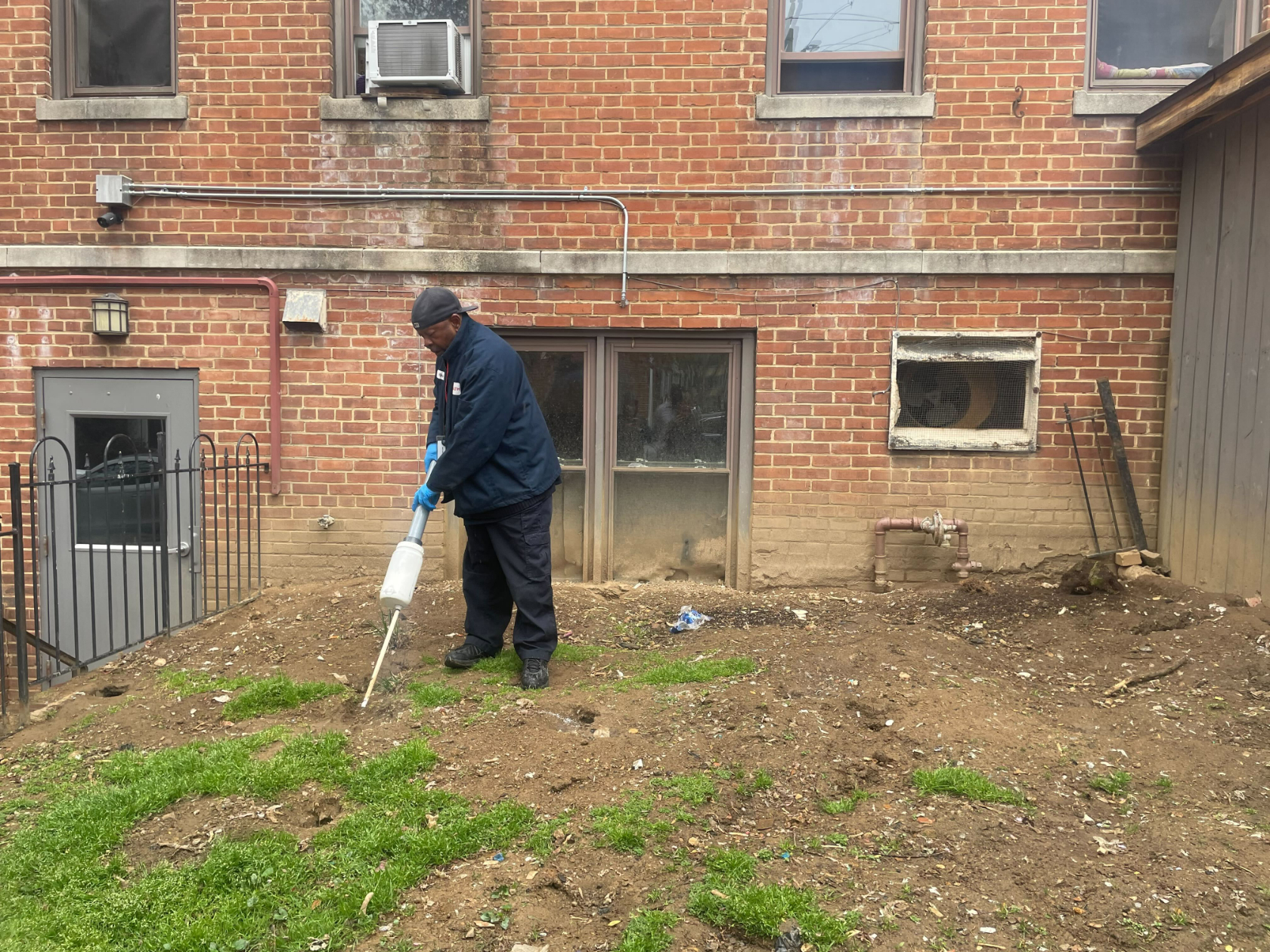
11:10 a.m.: After treating the holes with the rodenticide, another specialist enters the arena with a long black tube, attached to a truck parked in the street. Brown explains that this tube is used to deliver carbon monoxide into the burrows. The machine attached to the truck turns on, and the crew members begin to spray the carbon monoxide into the holes, as another crew member stands with a shovel ready to fill the burrow with dirt, essentially suffocating the rats below.
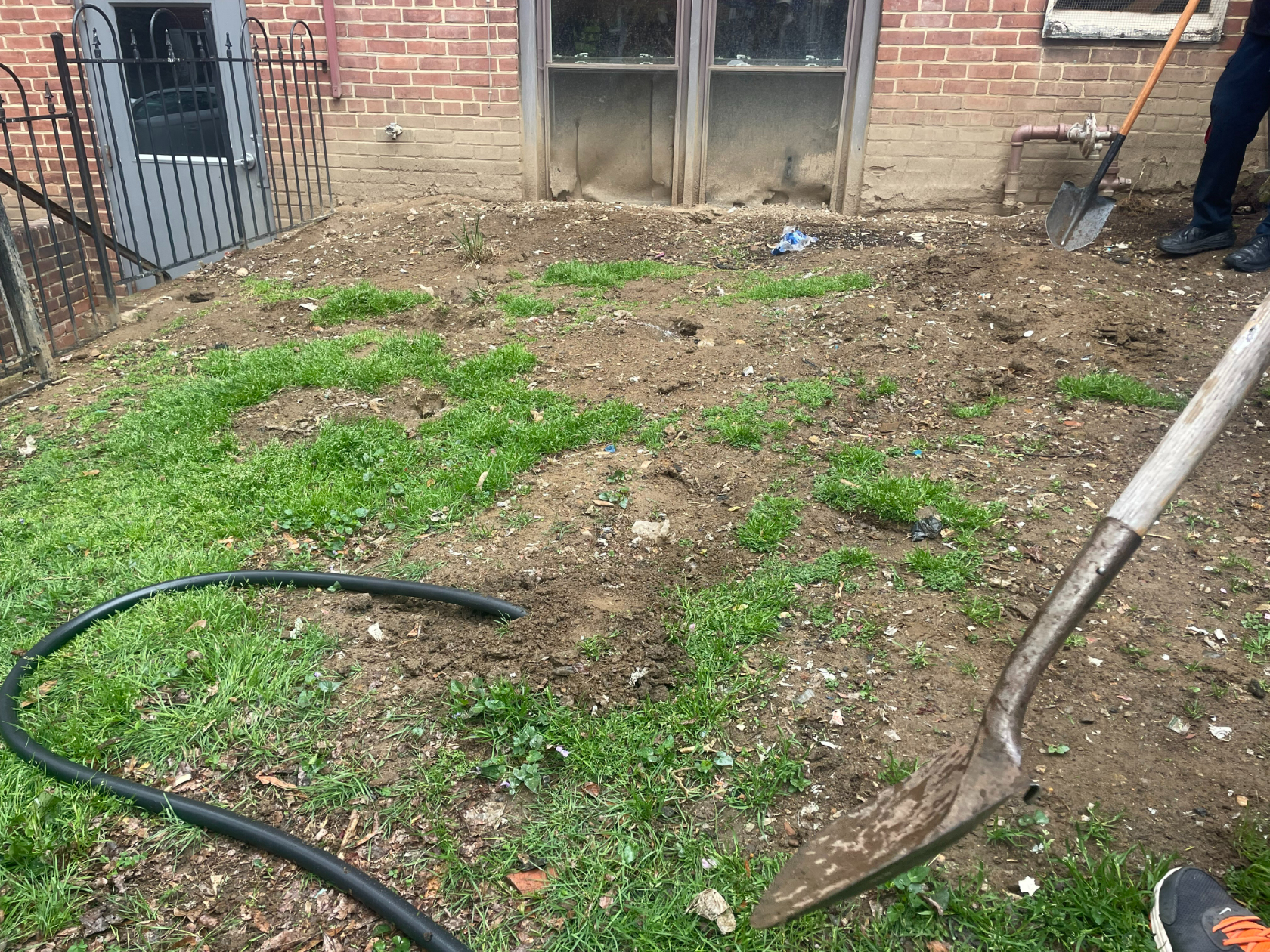
11:11 a.m. This is where things began to get a little hairy. While they move the tube from hole to hole, additional crew members go in with shovels to clog the remaining burrows, attempting to block exit paths for any rats in the burrows.
But the problem is there are just so many holes, and the rats have what I imagine is a Triwizard Maze under that patch of dirt, with numerous hallways and corridors for escape. One rat makes a break for it from the left side of the patch and runs over to the camera crew on the other side of the fence. Then, like an athlete showing off after a touchdown, or whatever, they run directly through the line of reporters and staff huddled in front of the fence, prompting a chorus of shrieks (including one from yours truly) before ending up where? Yes, the neighboring dumpster shack — the Rat Eden!
Sometimes when I watch rats pittering across the sidewalk, they look like they don’t know where exactly they’re supposed to be going or what they’re supposed to be doing, like it’s their first day being a rat. Their chaotic zig-zags seem hurried and directionless, like they’re just hoping that they’ll end up where they need to be. On Friday, I learned I have wildly underestimated rats and their determination.
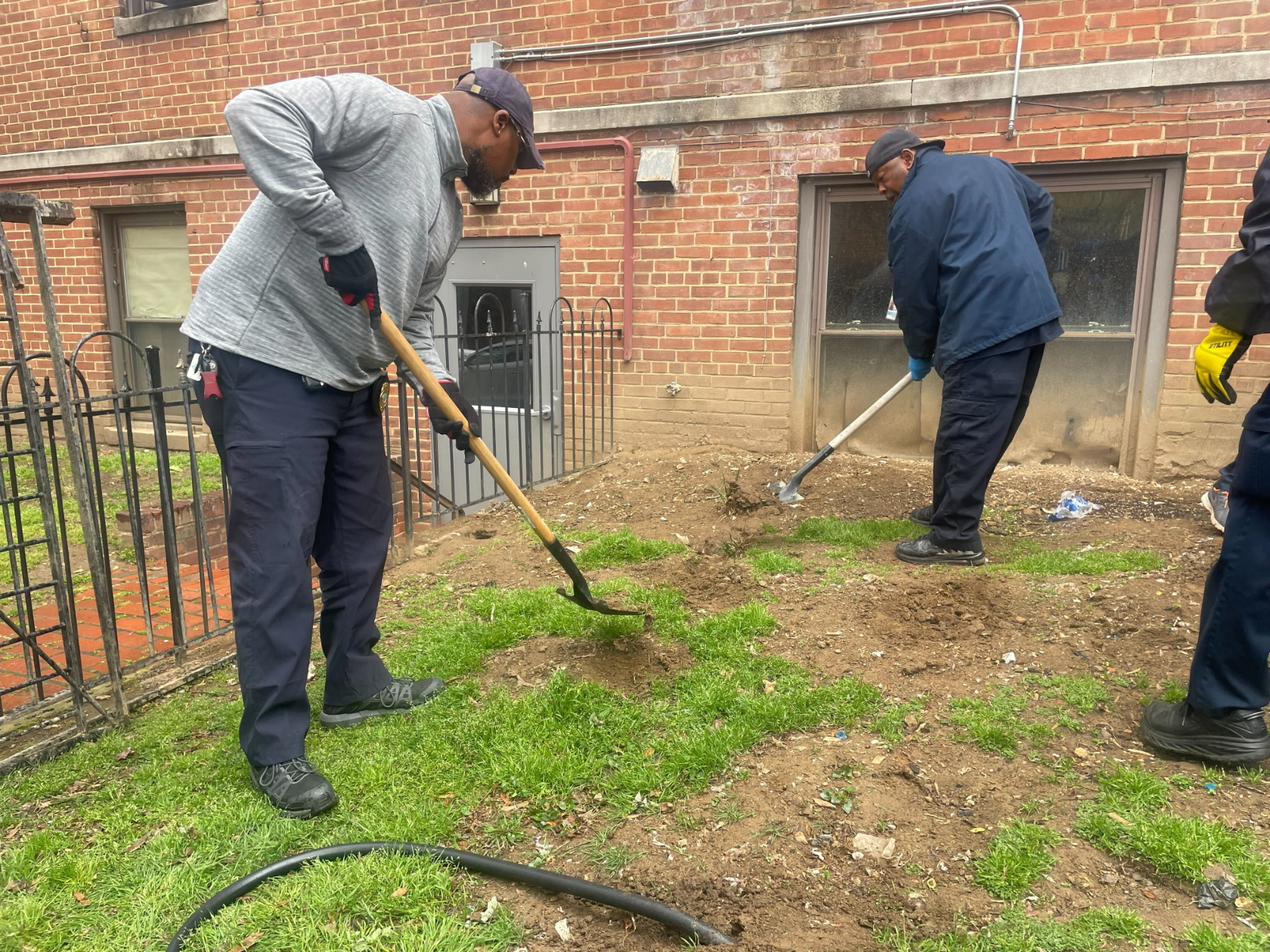
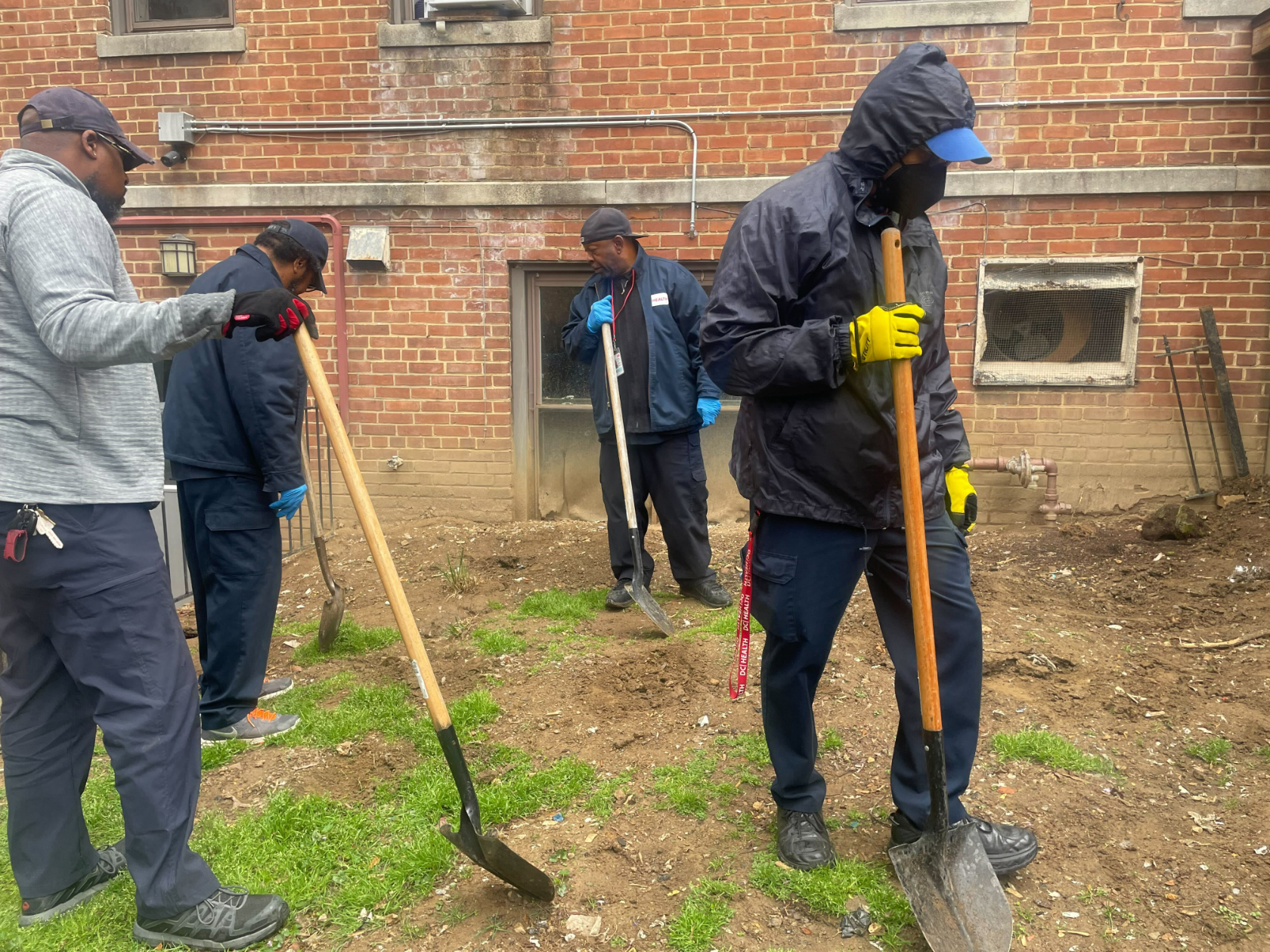
11:18: a.m. The carbon monoxide drilling and patching goes on for a while. A rat will pop up out of a previously unnoticed hole, and the crew will attend to that, before another one will pop up. At one point, at least five crew members huddled around one poor rat, boxed into the corner of the fenced-in area. I asked Brown if they ever, you know, take matters into their own hands with those shovels, and bash the rats. He winced, and said “No, I don’t like to do that.”
11:20 a.m. The demonstration has all but wrapped up at this point. Brown says that the rats covered in the rotenticide powder will likely die. 311 responds to calls within 14 days, and then after a treatment, checks in two weeks later to assess their success and may repeat the process if necessary. He clarifies that this level of intervention is only done outside of properties. If a resident has a problem inside their home with rats, that will need to be handled by a private pest control service.
11:23 a.m. My poorly chosen hood-less coat now damp (I ditched the umbrella to capture better photos) and my stomach feeling kind of funny, I begin my walk back to the bus stop. A person wearing a DC Health Inspector hat hands me an orange envelope with information, saying this is what they give to residents while doing community engagement. Inside there is a memo titled “RAT RIDDANCE,” with tips on managing pests, like removing weeds and debris outside your property (English Ivy, Periwinkle, and Pachysandra are known favorites of the four-legged fiends) and adding metal weather stripping to the trim of doors to prevent rodents from gnawing their way inside your home. Behind that, there’s a list of busted rodent myths, like no, rats and mice do not get into small spaces because they don’t have bones. They do have bones. It remains a mystery how they can fit through a hole as small as an eighth of an inch.
12:04: p.m. I come home and give a big pet to my cat Mouse, happy that I have my own in-home rodent control.