Matt Blitz
This story was republished by El Tiempo Latino. Puedes leer este artículo en español aquí.
Late last year, Oleg Tomilin found an eviction notice at his Woodner apartment door.
It was a difficult moment for Tomilin, who had lived at the 16th Street NW apartment complex for about seven years – and who initially moved in partially because The Woodner has long been a bastion of affordability in an increasingly unaffordable city. Rents range from about $1200 to $1500, per Woodner’s website.
But money started getting tight when he was let go from his job working in the Woodner’s package receiving room, Tomlin tells DCist/WAMU. The job loss and recent medical expenses have left him unable to pay his full rent.
“Of course, I’m depressed and anxious because of this uncertain situation,” he says.
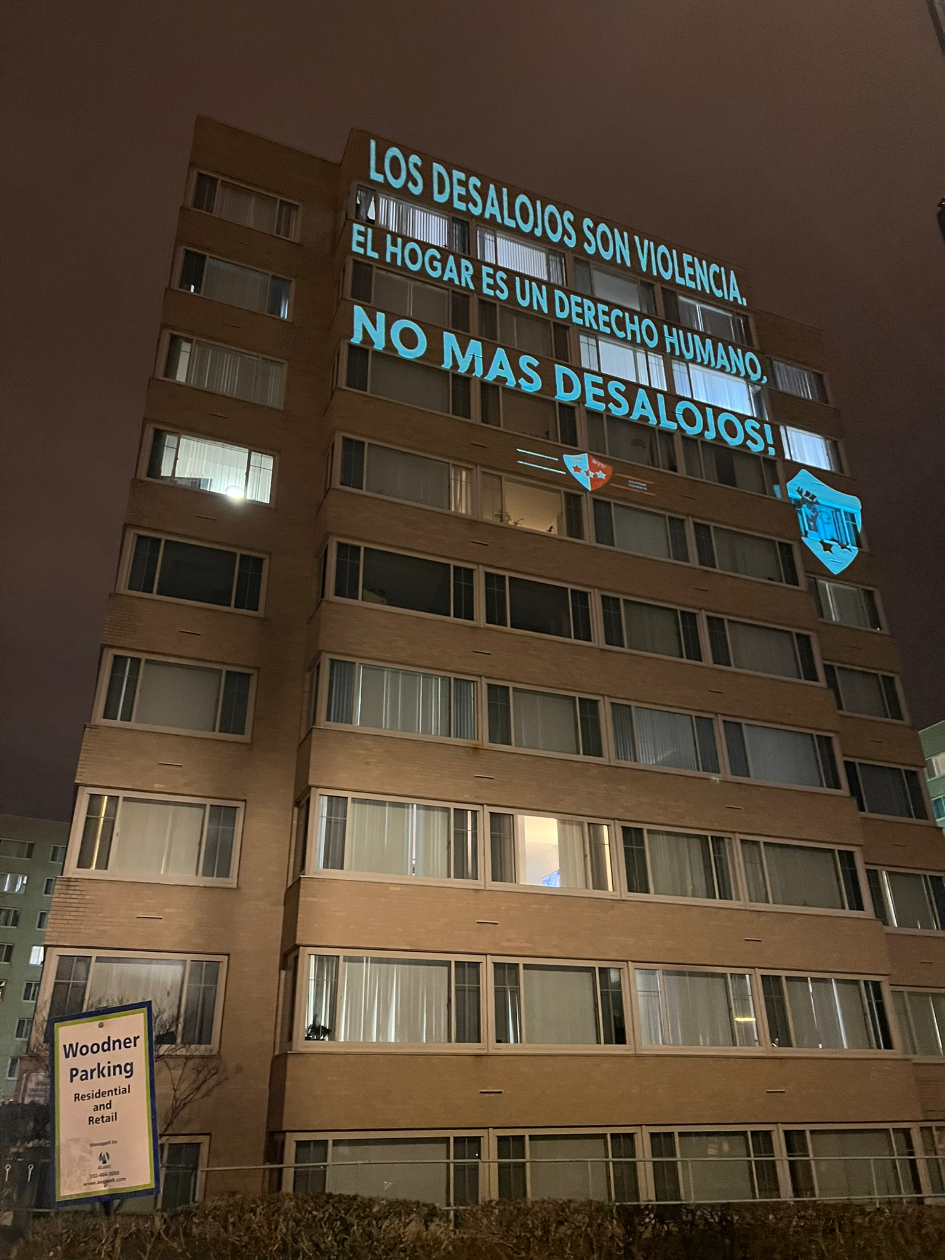
Tomilin is one of a number of tenants at The Woodner who are currently facing potential eviction. So far in 2023, eight tenants have been evicted — a spike compared to the months before, tenant organizers tell WAMU/DCist. Organizers also say they were able to delay or halt a number of others in that time frame. They did this through financial help, providing access to pro bono casework, supporting appeals, and direct actions like rent strikes and projected video messages.
But dozens more evictions are potentially underway, creating a sense of fear among some tenants in the building – and among tenant organizers, who are beginning to feel the effects of the end in widespread rental assistance enacted at the start of the pandemic.
“Up until the end of [2022], no individual who had worked with [the Woodner Tenants’ Union] directly had gotten evicted at all,” says Sierra Ramírez, a tenant organizer with the Woodner Tenants’ Union and a resident of the building herself. “Right until January 3, when we lost our first person.”
The Woodner is a historic 70-year-old building that lived its first life as a swanky apartment hotel — Duke Ellington, First Lady Mamie Eisenhower, and Bob Hope once walked the halls, and Teamster boss Jimmy Hoffa lived in a suite there. It’s also the largest apartment complex under one roof in the city — in 2017, it housed about 2,000 people. Decades later, it’s become a rent-controlled, affordable housing option in the Northwest quadrant of the city.
It’s been said before that changes at The Woodner reflect changes in the city as a whole, and that’s true now, too: The eight evictions and 41 open eviction cases filed against tenants at the Woodner as of April 10 reflect what’s happening across D.C.
“There are definitely a lot of people who are worried about impending evictions and people are very cognizant of the fact that they had a reprieve and….that’s coming to an end,” said Rob Wohl, an organizer with local tenant advocacy group Stomp Out Slumlords. “There are people who are trying to apply for economic assistance, [but] there’s not just as much to go around.”
Eviction moratoriums were enacted both at the city and federal levels in 2020 along with a number of programs that provided emergency rental assistance to low-income residents. Those continued throughout 2021, providing residents with much-needed help in paying rent as well as utility bills.
But many of those guardrails ended and programs ran out of money during the back half of 2021. While some programs that residents can turn to for assistance remain, the pot of money has significantly shrunk as the pandemic stretches beyond the three year mark.
And because evictions take so long to wind through the courts, some people are only now facing the loss of their homes.
“The economic hardship caused by and the fallout from the pandemic is not over. There are people who still haven’t found employment or are still struggling with childcare or medical expenses,” Elena Bowers, a supervising attorney in Legal Aid D.C.’s housing law unit, told DCist/WAMU. “And there are fewer financial supports to address them at this point.”
And it promises to get worse, advocates say. Come May 1, the city will allow a nearly 9% hike in rent , which organizers say is the largest increase since the city passed its 1985 rent control law. Most of the apartments at the Woodner are rent-controlled. (It’s unclear whether Woodner management intends to raise rent, or by how much).
Woodner management denies that there are 41 open eviction cases in the building, despite court records. A Woodner spokesperson, who declined to give their name, also noted that management is not doing anything unusual in its eviction filing practices compared to many other D.C. apartment buildings. (The tenant union says that it’s in fact fighting 66 evictions, noting that they’re still fighting several that have been closed in the courts).
“There are evictions for many reasons,” they said. “It can be complicated and each has its own unique circumstances.”
It’s true that the Woodner is just one of many affordable buildings across the city with dozens of open eviction cases on the court docket. About a year ago, management at the sprawling Park 7 Apartments in Northeast filed 50 eviction cases against tenants who thought a government program was supposed to be paying their rent.
Tenant organizers contend that continuing affordability problems at the Woodner illustrate the increasing difficulty of making a life in the District.
“We recognize that this is happening [due to] structural reasons,” Emily Paul says, another organizer with the Woodner Tenants Union. “This is happening because there is a legal process that prioritizes people being able to profit off of property over people having a home. And that’s wrong.”
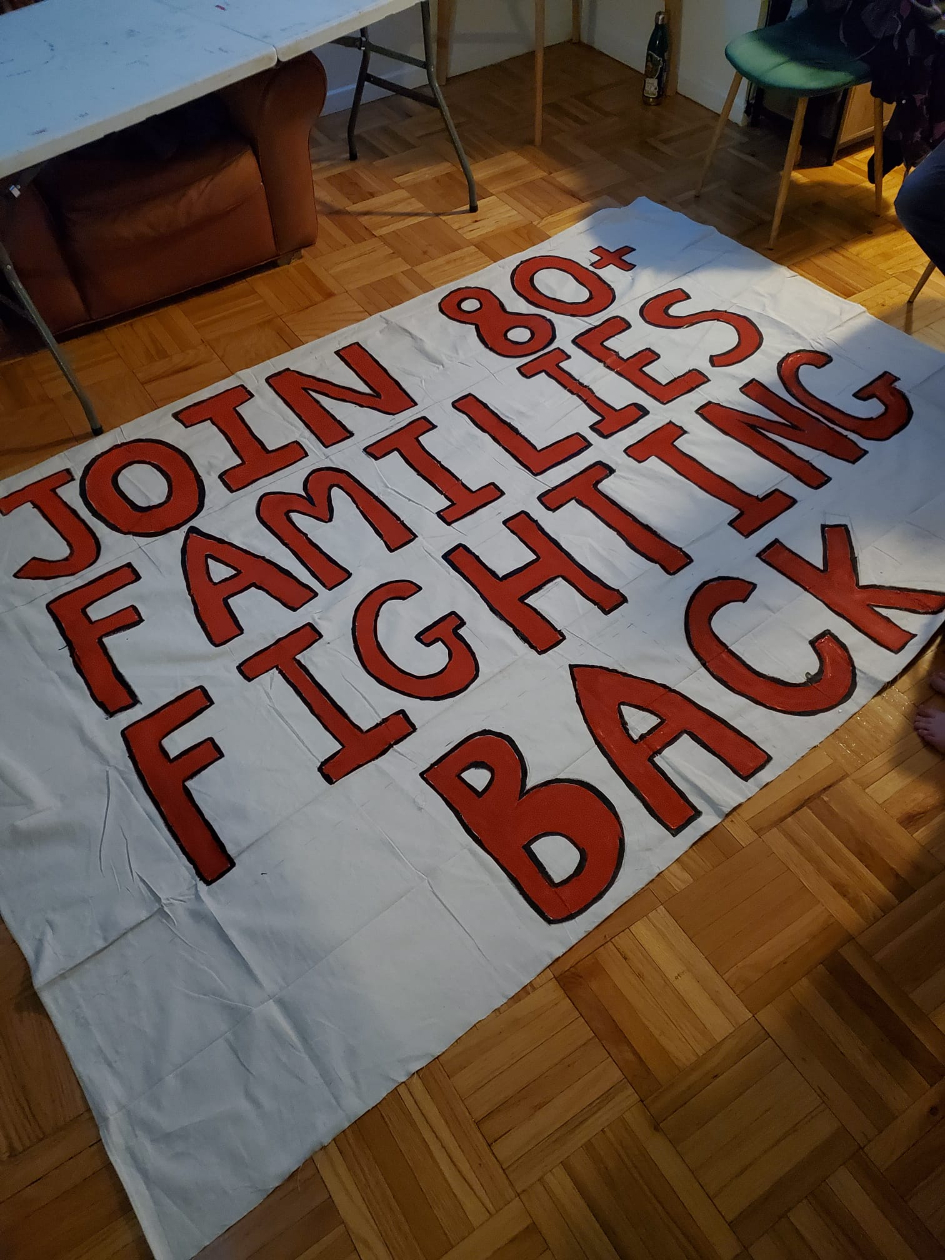
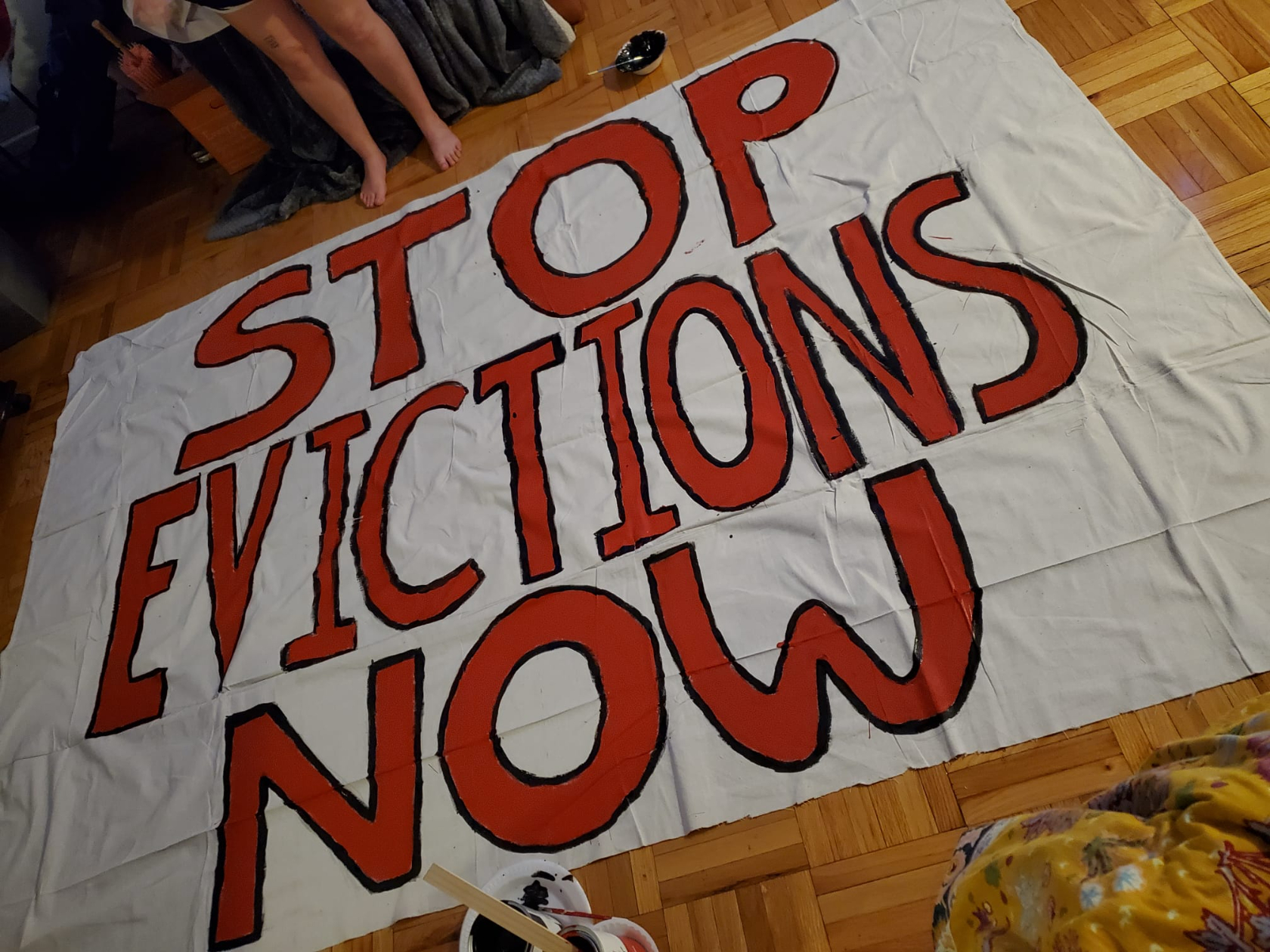
With the number of evictions rising, Ramírez wants residents to know they are not alone.
“We want to make people in the building realize that [being evicted] is not something to be ashamed of,” she says. “We want them to know how many people have received [notices] in the last several months.”
Arman Youseff also found an eviction notice on his apartment door at the Woodner late last year. He had lived there close to two years, also originally moving in because it was cheaper than a number of other options. But a rate increase plus a job change, which didn’t pay him as much as his previous one, left him struggling to make rent.
He applied for rental assistance, but the application was ultimately rejected.
“With [my] salary, I could pay the higher rent. But that would just be it. I wouldn’t have enough for food or anything like that,” Youssef said. “I had to sacrifice a few things.”
Tomilin and Youssef are both still in their Woodner apartments, but have more eviction hearings coming up in the next few weeks and months.
“I’m moderately optimistic,” Tomilin said about his chances of winning his case. “I know that the tenants union is not like God. They can’t help with everything, but, anyway, they try. So, I hope that everything will be good.”
That’s why organizations like the Woodner Tenants’ Union are important, Ramírez says. “You got a human right to housing,” she says.
As a leader in the Woodner Tenants’ Union since it was founded in 2020, Ramírez has marched, protested, and worked to prevent evictions at one of the city’s largest apartment complexes.
Earlier this year, she and the union projected a giant video message onto the building calling for the end of evictions. They also published an action statement in January that read, in part: “Unhousing a person is an act of violence.”
Ramírez believes there are a number of factors contributing to the increase of evictions at the Woodner so far this year.
When the eviction moratorium ended in 2021, landlords were able to begin the process of eviction. But it can take time for the process to play out, particularly if the tenants are able to show up for their initial court date.
“If you show up to court, [the court system] will usually give extra time to find a lawyer and apply for rental assistance,” Ramírez said. “Once [you do] that, it makes the process go a lot longer. Which is good for us and our neighbors so that they have time to figure out what they want to do and have a level of stability.”
(Of course, not everyone knows they need to show up in court. That’s part of what the Woodner Tenants’ Union helps with as well, Ramírez noted.)
The D.C. Council did enact several tenant-friendly laws over the last few years, including banning evictions for owing less than $600 in rent and helping to fund a hotline staffed by counselors that have helped reduce the overall number of evictions. Plus, some rental assistance is still being offered by the city, but that tends to help those who have lower balances owed.
Additionally, Ramírez said a large portion of those she works with at the Woodner are employed in the hospitality industry, which remains a sector that’s struggling to come back.
She also said there are a number of people who have been hit with huge medical bills, be it through accident or even giving birth, that has made paying rent for them nearly impossible.
Tomilin tells DCist/WAMU that his rent was increased for the first time last year, from $1400 to $1504 – equivalent to about 7.4%. It has played a significant factor in his being unable to pay rent.
The Woodner spokesperson confirmed that they have raised rents over the last year, but again, they said that management isn’t doing anything out of the ordinary.
“We pay all utilities. Our expenses are still high and we bear all those costs,” they said.
The Woodner Tenants’ Union is helping Tomilin through his eviction proceedings. They assisted him in finding a lawyer, applying for available financial assistance and, when he had his court hearings, several union members joined via Zoom.
“I felt their support,” he said.
Tomilin’s next hearing is later this month and he feels he’ll likely be able to sort out his situation, either by finding needed money to stay at the Woodner or by moving to another building.
In a show of his own support, Tomilin has joined the union himself, one of 200 members. He goes to the eviction defense meetings on weekends, delivers meals to those in need, and shares his experiences with those going through similar situations.
Ramírez says that’s exactly what they are trying to build with the union.
“Capitalism creates…waves of chaos. And you can expect that will come with a wave of interest if you are ready to receive it,” she says. “But in between those waves, you have to do basic organizing. And, if you are doing that, [the organization] will maintain.”