Amanda Michelle Gomez
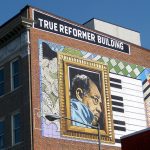
The interactive mural of the Black civil rights activist and artist, Paul Robeson, on U Street NW was defaced over the weekend. Video of an individual tagging over the mural went viral on social media and sparked outrage online.
The lead artist behind the Robeson mural, Cory Lee Stowers of ART B.L.O.C, says this isn’t the first time someone has sprayed over his team’s work and they already have plans to repair it.
The video posted on the popular Instagram Account, Washingtonian Probs, shows a person spraying over one of the portraits of Robeson. The person filming can be heard asking, “Why are you defacing Black history in D.C.?” The person who reportedly filmed the incident said the person fled on their skateboard when approached by police. The WashProbs account posted alongside the video: “We understand there’s a culture of tagging, but is nothing sacred anymore?” People on social media echoed that sentiment. Some people were more troubled because the individual defacing Robeson appeared to be white.
Robeson was a man of many talents — he was an actor, athlete, lawyer, and singer. He became the first Black actor to perform the role of Othello on Broadway. He was also a political activist, speaking out against segregation, lynching, and voter suppression during the civil rights era. The FBI associating him with communism helped ruin his career.
ART B.L.O.C is a D.C.-based artist collective behind many of the city’s murals, including the one of Robeson along U Street, which used to be known as “Black Broadway.” One of U Street’s longtime businesses, a martial arts academy called Hung Tao Choy Mei Leadership Institute, approached ART B.L.O.C. Robeson is a personal hero of the academy’s president, Abdur-Rahim Muhammed, according to ART B.L.O.C founder Cory Lee Stowers. Stowers says he and Andrew Katz designed the mural located at 1351 U St. NW. They and a group of local graffiti artists painted the homage, “Living Timeline: Paul Robeson,” in 2015. Those artists include Maria Miller, Eric B. Ricks, Nessar Jahahbin, Ernesto Zelaya, and Zarina Zuparkhodjaeva.


Stowers says the mural was the first he publicly commissioned. ART B.L.O.C also received support from the D.C. government, a $50,000 grant from the D.C. Commission on the Arts and Humanities, according to the Washington Post. The mural ended up occupying the full side of the building, with two large 30-foot portraits of Robeson and smaller ones in between that illustrate his various accomplishments. People can learn more about Robeson by interacting with the mural and scanning it with an app on their phone.
The defacing of the Robeson mural over the weekend is not the first time this has happened, according to Stowers — it’s not even the first time within the last month. Neighboring businesses will share security footage if someone tags over his team’s work. He says a few weeks ago another individual tagged over one of the large portraits. Over the weekend, he says, a separate person tagged over two of the smaller images.
Stowers says he is already trying to engage with one of the taggers. That’s what he did when someone tagged over the Robeson mural a year-and-a-half ago. By asking around within the local street art community, he says he was able to get in touch with the young person responsible and have them help fix the mural.
“For some folks, it might be a little bit disheartening to watch that video,” Stowers tells DCist/WAMU. “I’m not going to say that that I’m used to it. But I’ve had the experience before — of seeing somebody spray painting over top of something that took us a long time to put together and to realize. That part of it is always sad.”
At the same time, as a longtime graffiti artist himself, Stowers says he could understand why someone would do this. He says it is part of a greater tension between graffiti and murals of public space. It also speaks to a generational divide between newcomers who are still interested in “street bombing” graffiti and longtime graffiti artists turned muralists.
Stowers says the initiative Murals DC used to engage young graffiti artists, attempting to cut down on illegal tagging, but not so much after the city’s Department of Public Works absorbed it. He says now the city relies on professional artists. He’s more disturbed by that than the recent defacing of his Robeson mural. Stowers thinks that tagging generally speaking is not malicious and that tagging of a figure like Robeson could speak to someone’s ignorance of his cultural significance more than anything else.
“Unfortunately, in D.C., we no longer have an apparatus in place that would lead those young people towards what I call a path to public service,” Stowers says. “So all of these young people that are out there running around right now, doing this, don’t really have a space or there’s no engagement towards them to get them to stop doing this or to start creating something more substantial, that’s community focused. Because the program that’s supposed to do it has not been performing its service.”
A DPW spokesperson did not immediately respond for request for comment, nor did the mayor’s office.
Stowers says ART B.L.O.C will repair the Robeson mural but will need the public’s help with funding the project. He says that the mural was in need of a spruce-up anyways, because trucks would sideswipe it and a new business painted over part of it.