 Aja Drain
Children’s National Hospital is pursuing legal action against the Committee of Interns and Residents (CIR) for their demonstration in November for better working conditions, including paid sick leave and safer staffing levels amidst union contract negotiations.
In November 2022, resident physicians held a “Unity Break” demonstrating across the street, off of the Children’s National Hospital campus, during their time off. At the time, the hospital was operating at full capacity during a surge of RSV. Resident physicians were demanding pay that reflects inflation, better mental health care, paid sick leave, more long-term hires to fill staffing gaps, a transportation budget, and “patient caps” – limits to the number of patients a resident cares for at once.
In December, their union contract was recognized. It will be up for renegotiation every three years.
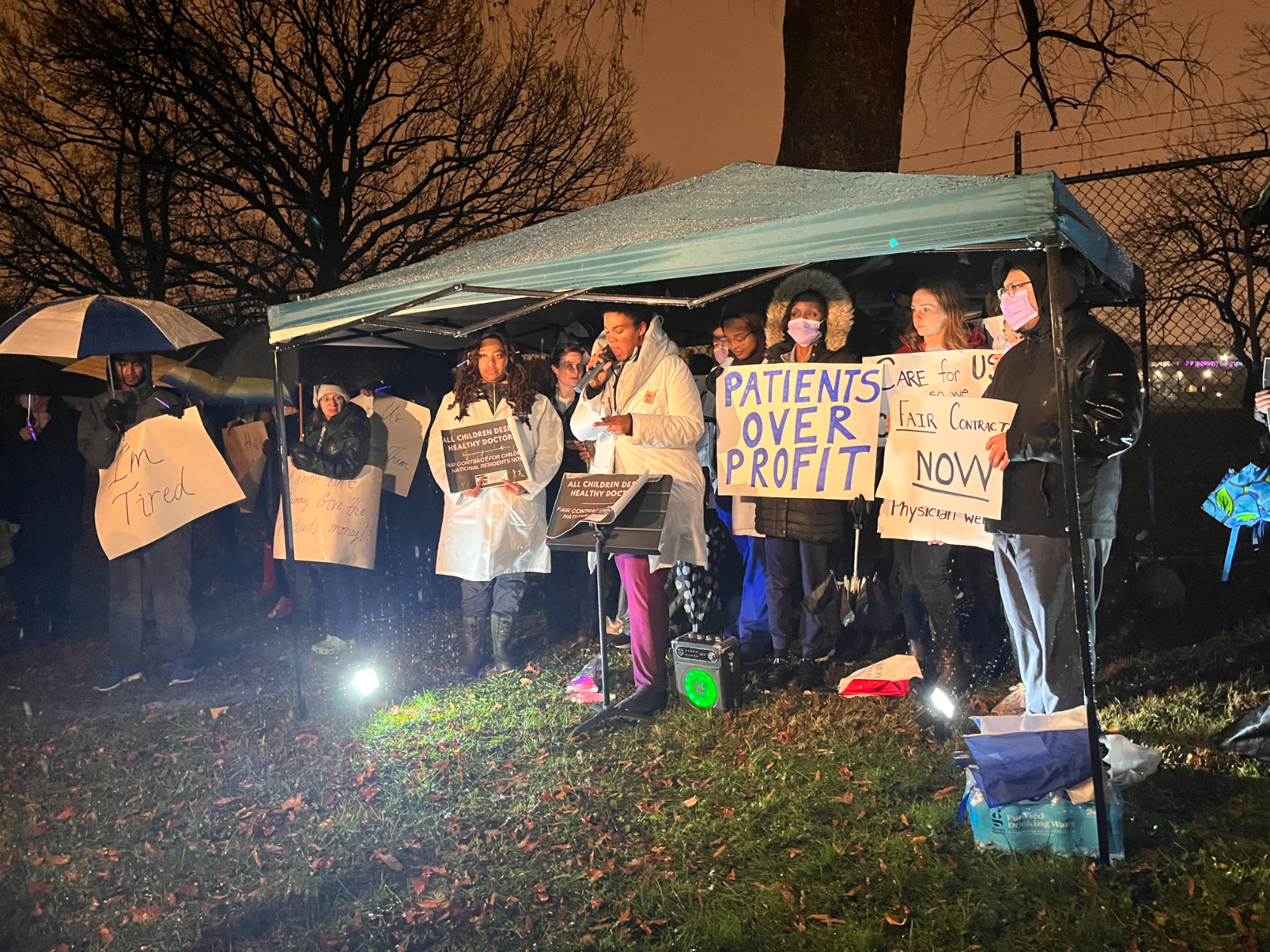
“We basically got everything we asked for,” Dr. Lydia Lissanu, a first-year resident at Children’s National Hospital, says.
Now residents have a salary increase upwards of 12.5% over the next three years, a $5000 annual mental health stipend, and their most unique win, a Patient Safety Committee – a working group of union members, elected residents, and hospital administrators to discuss patient caps.
“This is really something that is actually pretty remarkable to have achieved with our contract,” Dr. Hannah Kilcoyne, a first-year resident at Children’s National Hospital, says. “There are different types of programs, as like in internal medicine- or just fully different types of programs – that do have different patient cap rules and regulations; pediatrics does not have a national cap guideline.”
Kilcoyne says patient caps are like a “moving target” with different staffing needs depending on the time of day, the week, and the type of rotation residents are on each year.
“Part of the reason that we have this working group is because there is no easy answer,” Kilcoyne says. “I think a lot of it is going to come down to needing to hire.”
Kilcoyne says that could mean expanding the residency program and hiring more attending physicians to help distribute the patient load. But she adds that there’s a lot of nuance to the issue – hiring isn’t going to look the same for every unit, for example, the Intensive Care Unit, general floor, and hematology-oncology units all have different needs. But residents are happy that the conversation has started to ensure patient and physician safety.
However, despite meeting residents’ demands, Children’s National Hospital claims that residents violated the “no strike clause” within the contract, while the residents’ union believes they were within their legal right to demonstrate. Residents were careful to describe the action as a “Unity Break,” recognizing that they were not allowed to strike. The direct clause within the contract states:
“It’s common that workers have to accept no-strike clauses in order to get their crucial first union contracts finalized,” a union representative for CIR told DCist/WAMU. “In the Children’s residents’ most recent round of negotiations, which was a long, tough fight, residents chose to prioritize economics and crucial patient care protections as doctors on the frontlines of care. But this is also why it’s so important that they retain their ability to take contractually protected action outside of striking.”
A Children’s National Hospital spokesperson said they were not able to comment on pending litigation or define “strike” — which isn’t explicitly done within the confines of the contract.
However, in law, a strike is defined as “an organized and intentional stoppage or slowdown of work by employees, intending to make the employer comply with the demands of the employees.” Kilcoyne says after a long bargaining season and the contract finally being signed, it was frustrating to hear about the legal action.
“I think that in some ways it feels retaliatory of the hospital to be doing this now when really I think a lot of us were really looking forward to having a good working relationship with the hospital and continuing to work with them to further support our patients,” says Kilcoyne.
Over 100 residents at Children’s National Hospital are a part of the Committee of Interns and Residents, a union local of Service Employees International Union (SEIU) which represents more than 25,000 resident physicians and fellows across the country, including in California, New York, Florida, and D.C. While union density in the United States remains at historic lows, many labor experts have noted an increase in labor activity amongst healthcare workers. Some groups have responded with strikes, while others have also demonstrated with “unity breaks.”
Since the residents’ union denies that physicians’ violated their labor rights in the “Unity Break,” Children’s National Hospital is filing for arbitration – which differs from a lawsuit in that it’s more binding to the contract established, and there are fewer opportunities to appeal.
“If the hospital were to win this legal action, what limitations will be placed on us in our next round of bargaining?” Kilcoyne says. “I think we really worry about how much strength we’ll be able to have moving forward as a union.”
Their next round of bargaining will be in 2025. Kilcoyne adds that residents want to be able to exercise their labor rights by participating in unity breaks, speaking with the press, and other actions.
Lissanu shares similar concerns but says that there is comfort in knowing they’re not facing this pressure alone, with solidarity from their colleagues and being inspired by other doctors’ unions across the U.S. facing and overcoming similar challenges, despite being overworked.
“I think it would be disingenuous to say there’s not some fear associated with it because we’re, like, fledgling doctors,” Lissanu says. “I don’t think it has anything to do with us and everything to do with how scared these hospitals are of all of the residents unionizing and being active; so if anything, it’s like, ‘Oh, like we’re way more powerful than they anticipated.’”
Resident physicians are hoping the hospital will drop the claims before going through arbitration.
This article has been updated to reflect who CIR represents and that Children’s National residents are already a part of CIR.