Amanda Michelle Gomez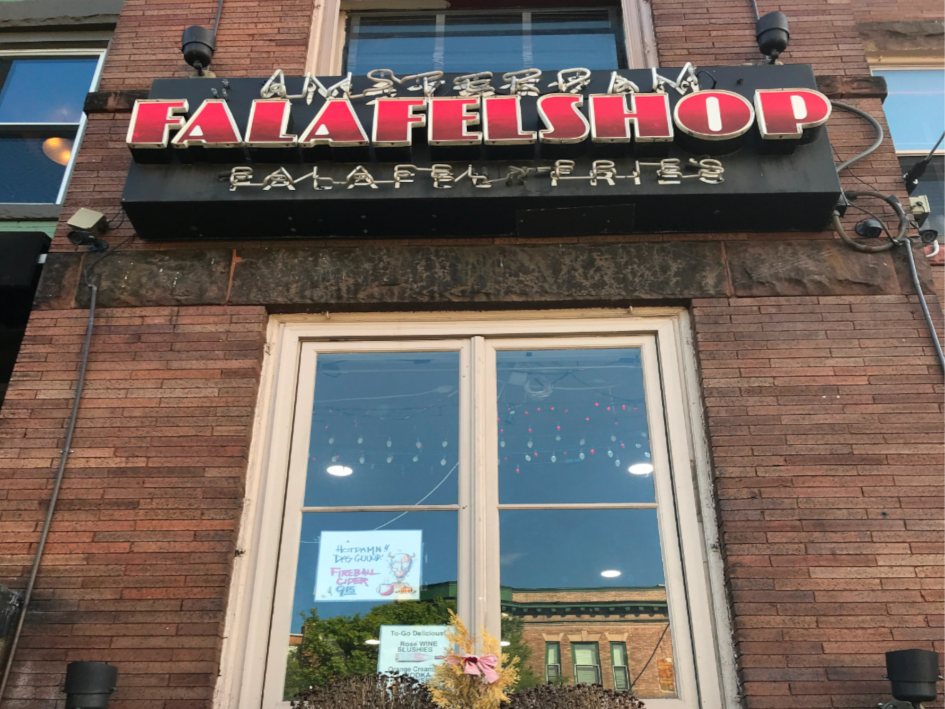
Amsterdam Falafelshop will close at the end of May, after nearly two decades of business in Adams Morgan, according to co-founder Arianne Bennett.
Washington Post food reporter Tim Carman first reported the news on Twitter.
The restaurant that’s located on 18th Street NW and prepares falafel sandwiches or bowls has become a beloved fixture of D.C.’s Adams Morgan neighborhood for a quick meal or late night bite since opening in 2004. Bennett says she didn’t plan on closing the shop, which she opened alongside her late husband, Scott. But she says she has no choice — her landlord wants to sell the building and she can’t afford the asking price.
“There is so much of my history and my history with Scott that is wrapped up in this restaurant and in this concept. And we’ve met so many people through it, and it’s just been a major force in my life,” Bennett tells DCist/WAMU.
The landlord is Neil Seldman, who did not immediately respond to request for comment.
Bennett says over the summer, her landlord shared that he and his family were ready to sell the two-unit building, which not only houses Bennett’s business but is where she lives with her dog. She says the landlord wants to sell the 1610-square-foot building in the commercial corridor for $2 million, which she cannot afford, particularly coming out of the COVID-19 pandemic.
“Ultimately, you get to sell your building for what you want to, right?” says Bennett. “This was the card that we were dealt, and so we just had to deal with it. And that’s what we’re doing.”
She is not interested in relocating Amsterdam Falafelshop, especially without her partner in business or in life, Scott, who died due to complications with COVID-19 last year. While she says she doesn’t have the energy to start over in a new location, Bennett says she would love to see Amsterdam Falafel continue on, even without her. She says anyone interested in moving forward with the restaurant’s concept should reach out to her.
Bennett says her greatest concern is ultimately for her staff. She has seven employees who are now in need of a job. She is trying to help them get work elsewhere, describing them all as experienced food service workers who can work in a team or independently.
“I spent a significant time over the past couple of days crying for and with my staff because they are just hearing this for the first time over the last 48 hours. And it’s really hard on them. They’ve spent a significant part of their lives here. They know the customers very well. They’ve built relationships with people and with each other,” she says. “And they too lived through the terror of the pandemic and the passing of my husband.”
Bennett says that she has also cried over the last several months because of the closure, but nowadays is more accepting of the fate of her and her husband’s business. Still, she did not speak ill of her landlord, calling Seldman “a very nice man” who was accommodating and kind during the height of the pandemic. While she does not want to leave D.C., given that she’s lived in the city since 1974, she says will temporarily relocate and live with a friend in Virginia until she gets a new job and home. Ultimately, Bennett said she’s certain she’ll land on her feet — her journey has given her perspective.
“I have told many a friend this, that the worst thing that has ever happened to me in my life has already happened. The loss of my spouse was the number one worst thing. There can’t be anything worse than that. And so as awful as it is to change your path so suddenly, at the same time, it just isn’t as bad,” says Bennett. “And so there’s perspective and there’s calmness that comes with that, but there’s also a hopefulness for the future.”
The struggles that Amsterdam Falafelshop faces are not unique. Tens of thousands of restaurants across the country closed during the height of the pandemic, including some in the D.C. region. Closure rates do not account for the operators who are still running their businesses but in debt.
Bennett says that her business has not fully recovered since the height of the pandemic, which forced restaurants to temporarily shutter and constantly pivot. Had business returned to pre-pandemic levels, she says she maybe would be in a different position and could possibly afford to stay open in Adams Morgan. Bennett says a big problem for restaurants owners is rent, a problem cited by others in the industry. She says pegging rent to a percentage of sales could help many struggling owners.
“We were here for 18 years. That was very good run. There are very few places that can stand the weight of the increased rent over time,” she says.
Bennett says Amsterdam Falafelshop’s last day is May 27. “We really appreciate every time someone has come in.”