 Jordan Pascale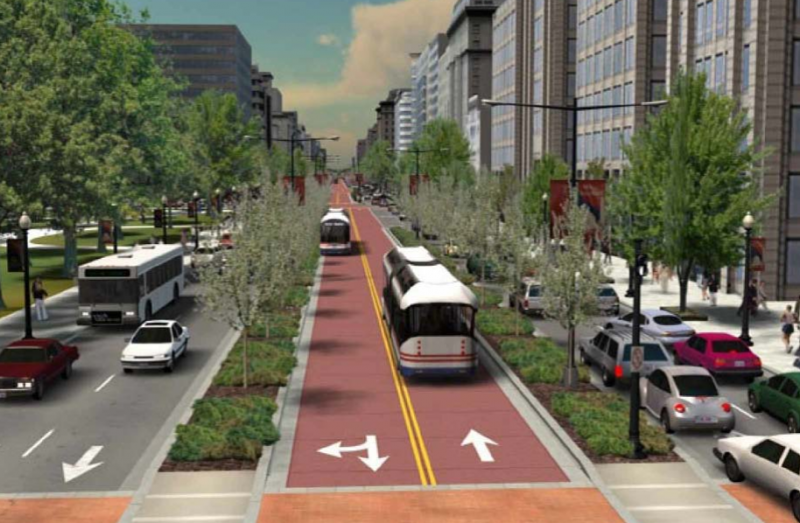
The D.C. Council’s transportation committee is set to make a transit tradeoff in the budget — free bus fares for the entire city while pausing the long-planned K Street Transitway downtown to pay for it.
The Transitway project would’ve converted vehicle lanes to bus-only lanes through the heart of downtown on K Street NW from 12th to 21st streets. The $123 million project was set to speed buses through a congested downtown and has been a priority for Mayor Muriel Bowser for years. Now its future is in question.
The fare-free bus program, championed by Councilmember Charles Allen and Council Chair Phil Mendelson, was supposed to begin this summer with the annual $34 million cost being covered by revenue above budget expectations. That extra revenue never materialized. So Allen decided to take the money from the transitway project, which he says no longer reflects the needs of downtown.
“The K Street Transitway can and should be a transformational project – but it was designed for a downtown that no longer exists, and it only covers a few blocks,” Councilmember Allen said. “By reinvesting this funding, DC is poised to be a national leader by making our WMATA buses fare-free for riders, a move that will save District residents money, help WMATA recoup more of its operating costs, bring more people to all of downtown, and improve service across the city, in one fell swoop.”
He says funding free Metrobus is a “faster way to ensure this investment equitably benefits residents in neighborhoods that depend on transit and have experienced historic disinvestments in transit.” Fare-free buses in D.C. could begin in January 2024.
Metro General Manager Randy Clarke was asked about the tradeoffs and he said, overwhelmingly, customers tell Metro that they want speed and reliability in the bus network. The transit agency is undergoing a network redesign that capitalized on the K Street Transitway plans to move dozens of buses a day through downtown.
“We don’t own the street,” Clarke said of the decision. “We want to be collaborative, good partners with the District, but we’ve been very clear: We want all of our partners — D.C., Maryland, Virginia, you name it — to work with us on bus transit priority, because the better we can move the busses, the better the system is for everyone.
“I defer to the council… there are competing priorities. That’s not our place to talk about that, but I think it is our place to say we have a better bus network redesign and we want to move busses in our network really efficiently.”
The committee’s plan is also unpopular with transit advocates who say they want better service over free fares, which are $2 normally. They argue that the time saved in traffic with bus lanes is more significant.
Several negative responses flooded in after a tweet of the news.
“The status quo of buses isn’t bad because of fares. It’s bad because they’re deprioritized on streets, are too slow, and too rarely come,” Twitter user BeyondDC wrote. “Don’t do this, @charlesallen. Don’t lock us into a bad status quo in order to pay for a short time of operating.”
Some advocates have been saying fare-free service would degrade service and experts are now pointing to D.C. as an example.
“Here’s a story for fare-free advocates who insist there is no tradeoff between quality transit service and going fare-free,” David Zipper, a visiting fellow at Harvard, wrote. “The District of Columbia is now facing **exactly that tradeoff** — and council members want to degrade transit service so they can eliminate fares.”
Some money to pay for the buses will come from charging ride-hailing companies $2 to enter or exit downtown between the hours of 7 a.m. to 7 p.m. Chair Mendelson will also need to find a bit more money to completely fund the bill that includes free fares, a dozen new 24/7 bus lines, and a $10 million annual bus service improvement fund. When more funds become available, Allen plans to fund a $100 monthly SmarTrip balance for DC residents.
Meanwhile, some advocates say the transitway loss isn’t bad since it was already watered down. The plan for the transitway had been in flux in recent weeks as the District Department of Transportation said it would have to move planned bike lanes off K Street and onto an adjacent street. Officials said they couldn’t fit the bus lanes, bike lanes, and car travel lanes in one corridor.
Moving Camera Ticket Revenue To Street Safety Projects, E-Bike Rebates Coming
Other issues in the committee’s budget changes include moving automated ticket enforcement revenue back to street safety projects and beginning a new e-bike rebate program. Bowser’s proposed budget moved the ATE funds to the general fund to cover revenue shortfalls.
The revenue will now again be dedicated to safe streets capital projects, multi-modal lanes, traffic enforcement, and implementation of laws that make streets safer, including Allen’s Vision Zero Enhancement Omnibus law, Councilmember Janeese Lewis George’s Safe Routes to School legislation, Councilmember Christina Henderson’s Safe Passage to School Expansion Act, and former Councilmember Mary Cheh’s Safer Streets Act.
“This was a missed opportunity to make significant progress in transforming our most dangerous roads,” said Councilmember Allen. “I fought to move the ATE program to DDOT specifically so the program’s data about where people were driving dangerously could help us prioritize our street safety projects.
“The next step was to tie speeding fines to making those safety improvements. Separating the fines from safety sends a message that these cameras are a cash grab, not to save lives on our roads.”
The committee is also setting aside $500,000 for an e-bike rebate program that was introduced earlier this year.
“E-bikes unlock the city for many, many more residents,” Allen said in a statement. “Aside from all of the compelling testimony we heard from families, people with long commutes East of the River, and small bike shops, I can see the impact of e-bikes nearly every morning when my colleagues bike into the Wilson Building.
“We should absolutely be encouraging as many DC residents as possible to take advantage of this mode of transportation, especially those lower-income residents under my bill who couldn’t afford one otherwise.”
This story was updated with a comment from WMATA General Manager Randy Clarke.