Colleen Grablick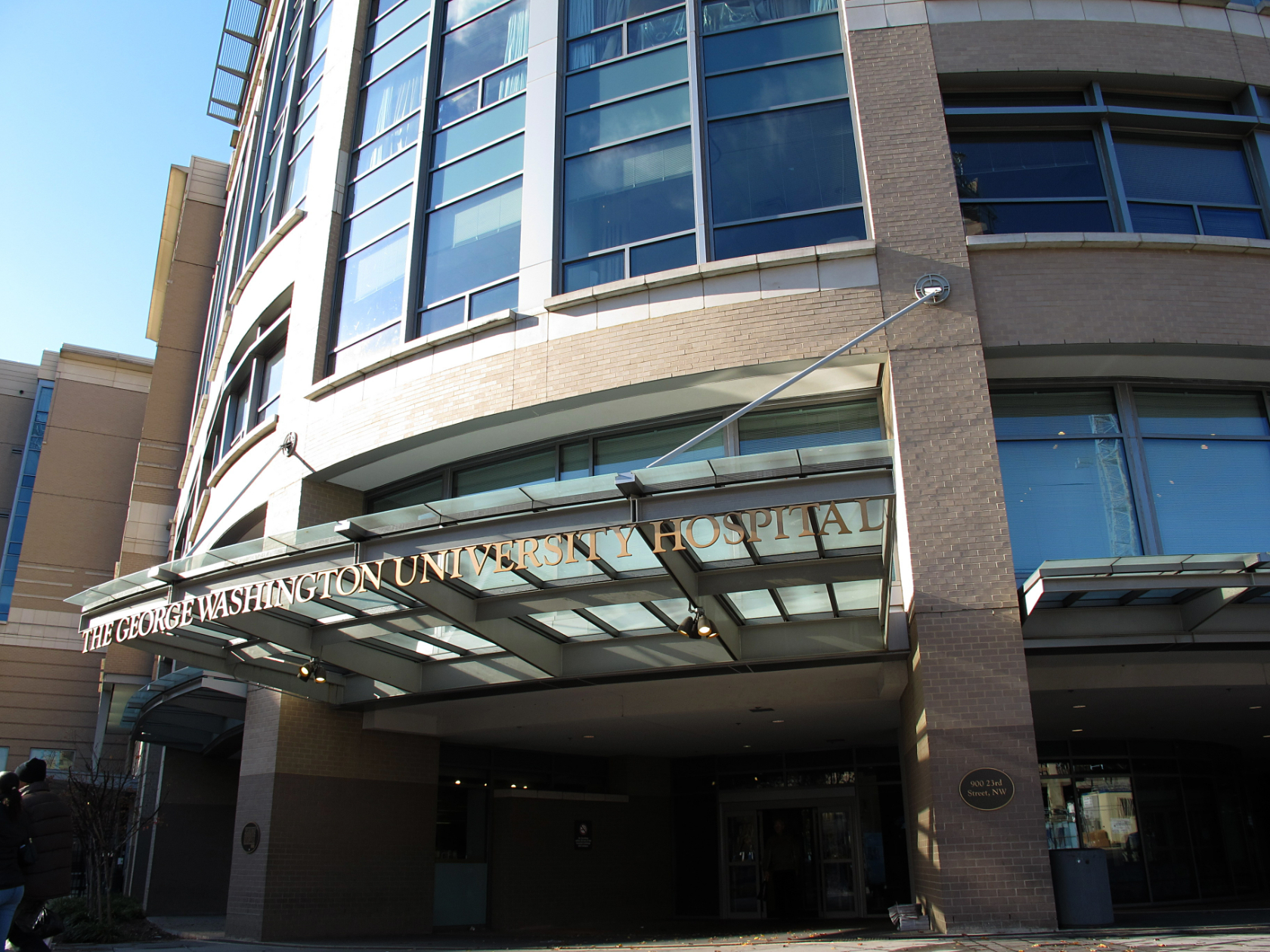
Medical residents and fellows at George Washington University voted to unionize Thursday, joining a growing list of employees organizing in residency programs across the U.S.
Of the 455 residents and fellows eligible to vote, 253 ultimately cast their ballot in favor of organizing a unit, with 16 voting no. (To win, the group needed a simple majority.) They’ll be represented by the Committee of Interns and Residents (CIR), an arm of Service Employees International Union (SEIU). CIR also represents the residents and interns at Children’s National Hospital and Howard University Hospital.
With a bargaining unit, they’re planning to negotiate higher wages, better benefits, and more transparency from one of the region’s top hospital systems — and one that has taken steps to push back against organizing efforts.
“Ultimately at the end of the day, everyone agrees we want a seat at a table,” said Maryssa Miller, a first-year internal medicine resident at GWU. “We have this unique window into what would make the system better and we’re the voices of our patients.”
The organizing campaign began around the fall of last year as Miller and other colleagues gauged interest amongst their coworkers and connected with residents at other programs who had led similar unionization drives. Before filing for the election, a majority (67%) of residents and fellows signed authorization cards to be represented by CIR. GWU declined to voluntarily recognize the union, prompting organizers to file for a ballot election with the National Labor Relations Board — which took place Thursday.
Now, they join a wave of residents across the country demanding better treatment in a job that presents unique challenges with little room for negotiation. While nationwide union membership decreased in 2022, organizing among healthcare workers — from nurses, to residents, to physicians – increased, as the pandemic revealed and exacerbated chronic issues within the healthcare system. CIR currently represents more than 24,000 residents and fellows across the U.S., an increase stemming from six union drives from 2021 to 2022.
“I really hope that this will be what also negotiates strong contracts … being able to supply for our lives, outside of just working every single day and also feeling like you’re a little broke when you’re not working,” said Jenn Luk, a first-year emergency medicine resident at GWU.
Residency creates unique labor issues
Unlike in other jobs, where a potential employee might be able to negotiate their benefits, salary, or work hours before agreeing to employment, residents are “matched” into a hospital residency program without a period to negotiate the terms of their employment.
At the end of medical school, a mathematical algorithm matches students into a residency program based on a list of programs the student has ranked, but also how a program has ranked that student in return. The matching process is binding, meaning that a resident agrees to the employment conditions at whatever hospital they match with — before they know where they’ll be placed.
The binding nature of the residency process makes it difficult for the doctors in training to change jobs, and easy for their work to be exploited; they can either stick it out, or give up years of schooling, thousands of dollars, and an entire career path. (More than two decades ago physicians challenged the matching program in a class-action lawsuit, arguing it violated antitrust laws by allowing for lower-than competitive wages and exploitation, but the suit was dismissed two years later.)
By unionizing, Miller said she hopes residents can take some of the power that’s lost in the matching process — and feel as though they have a say in a workplace that could not function without them.
“Just having that say… just simply being able to afford to live and to take care of our patients is what we all want,” Miller said. “We’re not asking for anything crazy. We’re not asking to make a million dollars a year — just enough so we can pay our rent, and be able to take care of ourselves so that we can better take care of our patients.”
Wages, patient care among the top concerns
Top among demands and likely to be included in the bargaining process are higher wages. When Miller works an 80-hour week, her hourly wage comes out to around $15 an hour, less than the city’s minimum wage. To afford to live in D.C., half of her paycheck goes to rent every month.
Many residents also face mountains of student debt, child care costs, or medical bills of their own. GWU offers a package for residents’ health care, but they still have to pay for it in each paycheck. A five-minute telemedicine visit with her primary care doctor cost her $100 recently, prompting her to rearrange her monthly budget in order to afford groceries.
“I can’t even afford for myself to have the medical care that I’m providing and recommending to my patients,” Miller said.
Other demands include more transparency from the hospital when it comes to funding patient care, and better working conditions — like clean rooms to sleep in during long shifts. According to Miller, GWU Hospital has had a bedbug infestation in call rooms (where residents rest overnight) that has led to them sleeping on their 24-hour shifts in upright computer chairs.
But overall, the demands for improvements in the workplace and wages ultimately come back to the patients — which for Luk is the reason she got into medicine.
“I wish I could be able to give 150% to all of my patients, but because of the load there feels like there’s no time, and I’m only able to give what’s strictly necessary and not what I think is my best,” she said. “It comes at the cost of thinking, ‘well, I could still stay late and give this patient everything… or go take a mental health walk, cry a little bit, and then come back and reset.”
Residency — even in the most ideal circumstances — is a stressful period full of uncertainty and long hours. The mental health toll of the job has been exacerbated by COVID-19 and the pandemic-induced staffing problems across the health care industry. A quarter of medical residents are expected to develop depression (a higher rate compared to peers in other fields), and are more likely to experience suicidal ideation. Luk joked about the signs in the residents’ break room that read “days since last breakdown,” or “favorite crying spot.”
“Everyone kind of has their own personal spin, be it a stairway, a hallway, third floor bathroom,” she said of the aforementioned spots.
Union drive continues among GWU nurses
The vote comes as GWU Hospital nurses wage their own campaign for fair treatment and pay with Universal Health Services, the company that owns the hospital. (The nurses are employed by the hospital’s owner, while the residents are employees of the university.) Nurses began their union push earlier this year, working to form a unit with the D.C. Nurses Association as its bargaining representative.
A date has not been set for an election, according to DCNA executive director Ed Smith, but the group has filed unfair labor charges with the National Labor Relations Board, accusing the hospital’s administration of suspending a nurse involved in organizing efforts, and taking additional efforts to identify union organizers.
Residents told DCist/WAMU that GW’s School of Medicine and Health Science has also engaged with anti-union messaging, including a recent Instagram post by GW SMHS highlighting the cost of union dues. Several people commented objecting to the post, and said their comments ended up deleted; SMHS denied deleting the comments. (DCist/WAMU reviewed users’ frustrated and angry comments via screenshots; those c which taken before they were deleted.)
SMHS Dean Barbara Bass also stated plainly her objections to a union in a letter to residents and fellows dated April 3, telling residents they should advocate for themselves without an “outside group.”
“I do not think a union is necessary for residents and fellows to effectively advocate for yourselves, individually or collectively, with GW,” Bass wrote. “At the day’s end, there will never be a better advocate for your patients or yourselves than you, and as you train at GW. You are the professional and you have earned the professional right to advocate on your own principled convictions without limitation from any outside voice.”
Bass also touted the implementation of the Housestaff Council, a group of residents meant to act as a liaison with the administration, as a means of creating change at the hospital. Miller is on a specific internal medicine arm of that council, and told DCist/WAMU it has served largely as a formality, where she says nothing residents “[bring to] the table gets ultimately listened to.”
“A university’s response — or any institution, any hospital’s response to their residents unionizing said a lot about how they thought of their labor, how much they respected the work, how much they respected the time,” Luk said. “How much they respected people who wanted to just be able to have some control in a process that is very unforgiving.”
In a statement on Thursday before the final count came in, a spokesperson for GWU said the university is “committed to supporting and training residents and fellows,” regardless of the vote outcome. But Miller said both union drives happening in short order should serve as a “wake-up call” for the university and its hospital.
“I think it really shows something when literally the majority of the people that are physically in George Washington Hospital are unionizing,” she said. “Having the two biggest units in the hospital knowing that they need to make a change … I think that’s really impactful.”