 Jordan Pascale
Metro’s board heard a series of complaints from the Riders Advisory Council on Thursday, which interviewed 100 riders about their biggest gripes about Metro and their proposed solutions. The study, while unscientific, gave a glimpse at rider concerns.
The board also gave an update on a series of public safety items, including taller faregates.
Fare evasion
Nearly 40 of the 100 people interviewed by the RAC were upset about fare evasion, a problem Metro is trying to address with more secure entries and police enforcement.
“Riders indicated that witnessing fare evasion on a frequent basis made them feel insulted and is a constant reminder that Metro is not in control of its system,” the RAC wrote in its report.
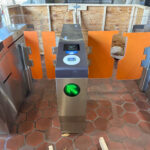
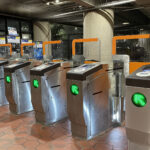
WMATA has been working through several iterations of its faregates to deter fare evasion. The test pilot at Fort Totten currently has five-foot-tall fences and four-foot-tall gates. Transit officials say the gates have reduced fare evasion there by 50%. This reporter did observe people climb on the cabinets to get up and over the taller gates.
Metro General Manager Randy Clarke says the final interaction will include gates that are another foot taller, making them five feet, and stronger hinges so people can’t push their way through.
“We’ve tried three different versions and now we finally think we got the right ingredients,” Clarke said. “We’ve driven down fare evasion, pretty significant for Fort Totten, but it’s still not to where we want to be.
“So there’s still a little bit more reinforcement to go.”
https://twitter.com/JWPascale/status/1651639001906913288
Nine stations — Wheaton, Bethesda, Vienna, Courthouse, Mt Vernon Square, Pentagon City, Federal Center SW, Congress Heights, and Addison Road — will get the new gates this summer, followed by the rest of the stations by 2024.
Smoking
Mike Lebowitz, the Riders’ Advisory Council’s new chair, told the board about a Silver Line ride where a man rolled a joint and started smoking it, blowing smoke in the direction of morning commuters. He recounted riders getting off downtown and started talking about the scene.
“They were impressed by the brazenness of it,” he said. “They had thoughts and they had passion about it.
“And so the reason why this is a big deal is because, again, it’s the death by a thousand cuts.”
Riders said that smoking makes them want to drive instead of taking transit.
“It’s every single day,” a rider told the RAC. “Every day someone’s smoking.”
The report notes that incessant smoking also contributes to rider perception that the system is increasingly lawless. The RAC is encouraging Metro to crack down on enforcement, make no smoking announcements in the system, and beef up the police tip line.
WMATA board member Tracy Hadden Loh reminded riders to save the number on their phones and report smoking when they see it.
Crime and contacting the police
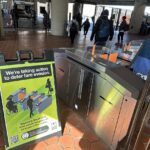
Metro is promoting its text tip line to police by placing stickers with the number 696-873 in every station, bus, and train.
https://twitter.com/JWPascale/status/1651621390787702784
MTPD Chief Michael Anzallo gave a briefing on the police’s efforts to deter crime.
Twenty-five stations now have additional patrols during rush hour thanks to partnerships with local police. Anzallo says crime at those stations is down 20%.
The stations include Potomac Ave, Fort Totten, Georgia Ave-Petworth, Stadium-Armory, Rhode Island Ave, Congress Heights, Minnesota Ave, Columbia Heights, Union Station, Foggy Bottom, Shaw-Howard U, Mount Vernon Square, U Street-Cardozo, Brookland, Gallery Place, Eastern Market, Benning Road, Metro Center, Cheverly, Greenbelt, National Airport, and Dulles Airport.
Clarke said more focus on stopping people for fare evasion has also caught people with multiple warrants. He cited two specific incidents where one man was wanted to assault, another had multiple warrants.
“There are people that hurt people in society and we want to keep those individuals off of our public transit system,” Clarke said. “And we’re hearing that overwhelmingly (is a top priority) from everyone from the RAC to customer surveys.”
Anzallo says not everyone that fare evades is a serious criminal, but many people involved in serious crimes like assault have jumped the faregates, according to video evidence.
“I would say 99.5% of the time, the person that committed what we call a part one crime has fare evaded into the system,” Anzallo said.
Other findings
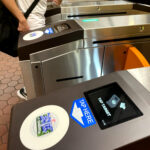
There was an assortment of other rider complaints found in the report. It included frustrations about the faregates not being sensitive enough and taking multiple taps to get in. Riders complained about the high cost of parking lots, infrequent buses, and the general sense that they are often waiting for another shoe to drop. More than 60% of respondents said there seem to be never-ending “Metro meltdowns,” construction work, and other delays.
Meanwhile, Metro has hired its first “Chief Experience Officer” who will solely focus on customer needs. Sarah Meyer joined Metro earlier this month after serving in a similar position at New York City’s MTA.
Wayfinding
Clarke tweeted that Metro is in the process of revamping wayfinding in the system.
A rider asked Metro to look into numbering exits, similar to Seoul’s subway, instead of the current setup with exits being listed as cross streets.
https://twitter.com/the_transit_guy/status/1651587497120391168
https://twitter.com/wmataGM/status/1651665718184640515
It will be interesting to see what the Metro staff comes up with, but it’s clear that riders have created their own way of figuring out which exit to take.
https://twitter.com/airlievh/status/1651746013210718209