Matt Blitz
Puedes leer este artículo en español aquí.
With early voting kicking off on Friday, Arlington will be among just a few localities in the country to use ranked choice voting (RCV) in a primary to decide two seats on the county board.
Late last year, the county officially gave the go-ahead to a trial run of a new election system for the Democratic primary: rather than choosing one candidate, voters will rank their top three choices.
The Virginia General Assembly opened the door to the change in 2020, passing a law allowing jurisdictions to use ranked choice voting. Arlington then surveyed residents, and a majority of respondents said they favor this type of voting.
Six candidates have entered the race for the two open seats on the board. Board members Katie Cristol and Christian Dorsey both announced they would not run again. Other Arlington races, including Commonwealth’s Attorney, Sheriff, and General Assembly seats will not be determined by ranked choice voting.
Arlington is the first Virginia locality to adopt ranked choice voting, and county officials believe that the use of ranked choice to fill two seats simultaneously is a rarity, making it perhaps one of the first jurisdictions in the country to do so.
Ranked choice voting itself is nothing new, but it seems to be getting more popular. New York City used it for its last mayoral primary in 2021, as has Maine for a number of local elections. In our region, Takoma Park has used ranked choice voting as far back as 2007, including to fill seats on its city council and when choosing a mayor last year. (There’s also been interest in Montgomery County, though the Maryland General Assembly hasn’t yet given the county permission.) The D.C.Council has considered ranked choice voting, but so far efforts have not succeeded.
“We are definitely getting some firsts in terms of national and maybe even international… in terms of ranked choice voting,” Arlington’s Director of Elections Gretchen Reinemeyer tells DCist/WAMU.
Whichever two candidates win the June 20 Democratic primary are strongly favored to win in November’s general election, given the overwhelmingly blue tilt to the
county (though an independent candidate is also set to run in the fall).
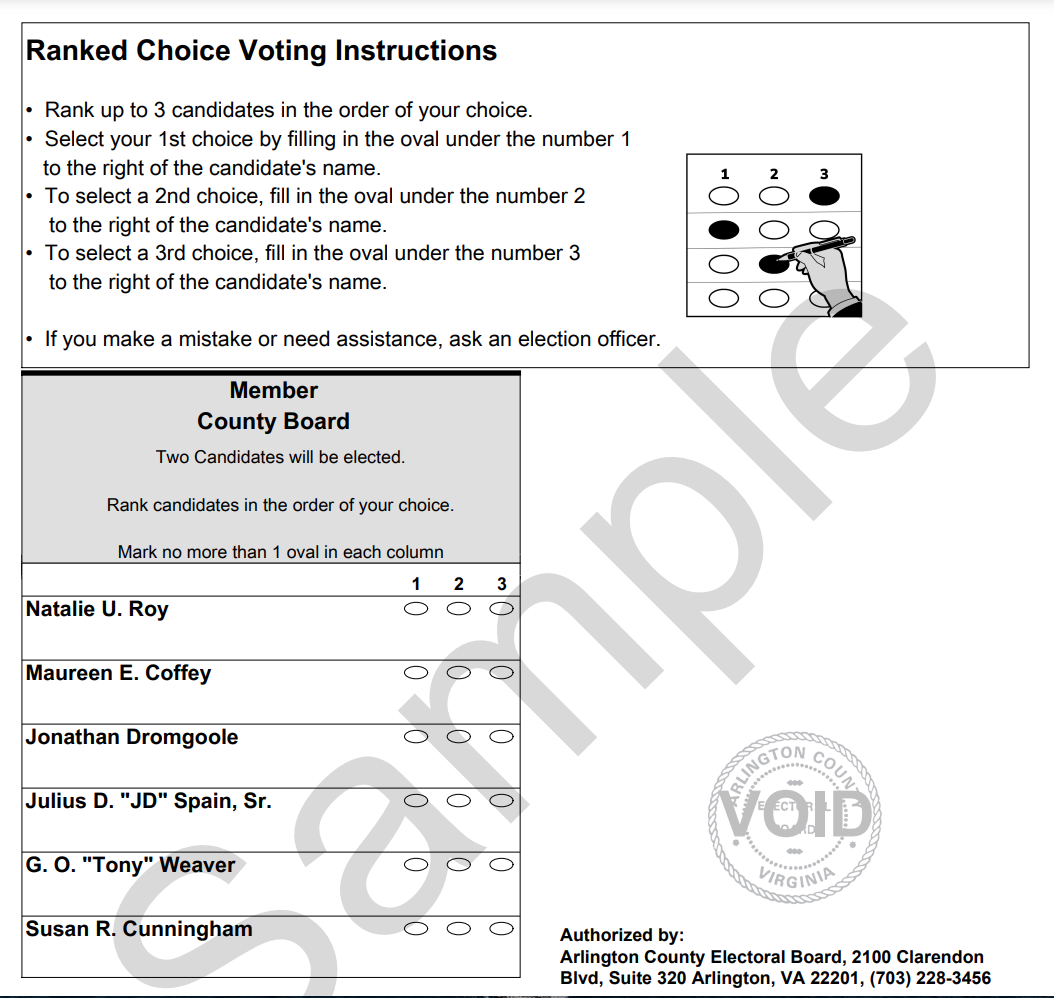
In order to help familiarize residents with the new process, the county came up with a fun exercise. A practice ballot is now posted on the county’s website, allowing residents to try the new process by ranking their favorite ice cream flavors. Voters just need to fill in the oval next to their first choice of ice cream underneath column one, then the oval next to their second choice underneath column two, and the oval next to the third choice underneath column 2.
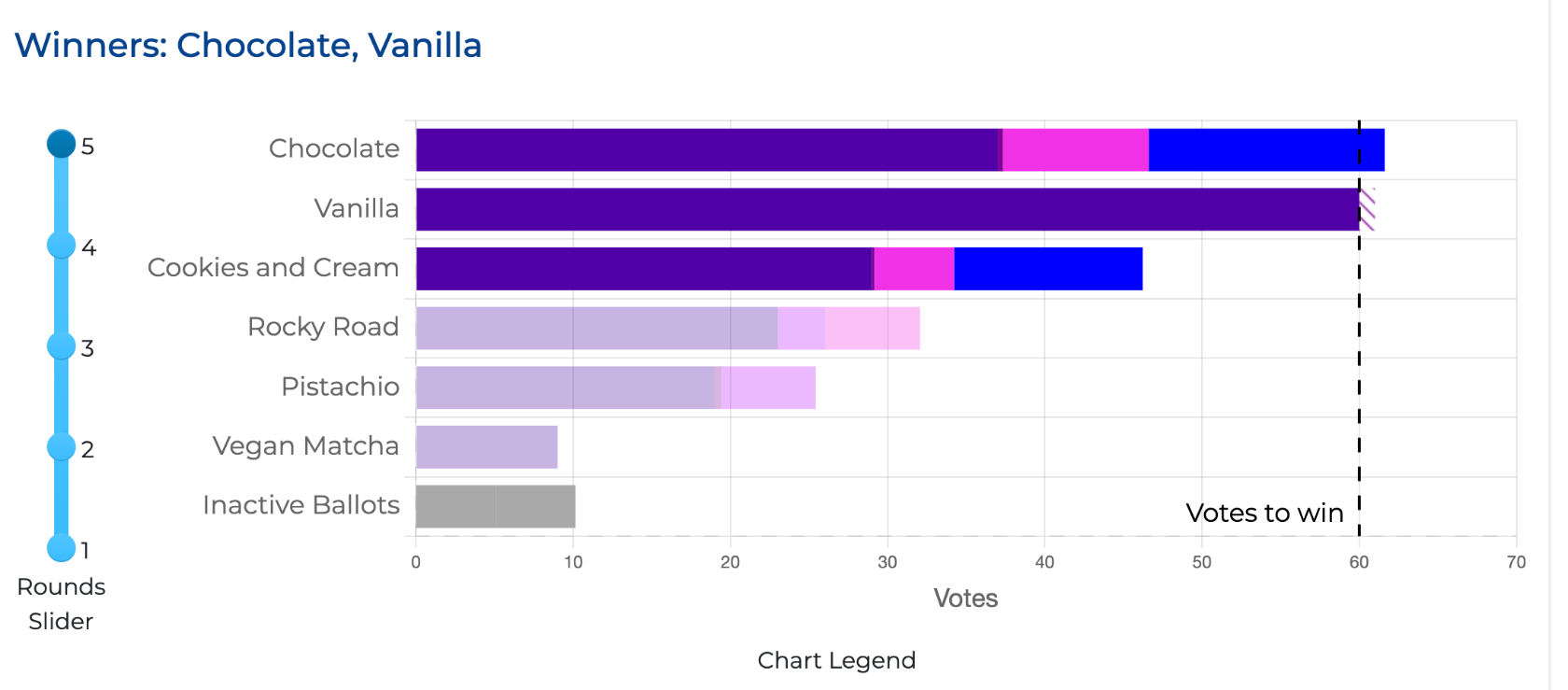
At the time of publication, chocolate and vanilla were in first and second place respectively, beating out cookies and cream, rocky road, pistachio, and vegan matcha. (It’s a political scandal that strawberry didn’t run.)
The ballot Arlington primary voters will see starting Friday will look similar, with candidate names instead of ice cream flavors. It will be a two-sided ballot, with the front including all non-ranked choice contests. County board choices are on the back side.
Some tips: Ranking your preferred candidate in all three slots– first, second, and third will not increase the candidate’s chances of winning. Also, you aren’t required to make a second or third choice on your ballot.
Despite the format’s uniqueness, Reinemeyer does not expect primary voters to have too much trouble navigating the ballot.
For starters, those who vote in a primary tend to be more engaged and more likely to be aware of this new process. Plus, people rank things every day so this should be familiar territory for most, she says.
What has proven to be a bit more difficult, though, is explaining how votes are tabulated and winners determined.
“One of the biggest challenges that I think people are afraid of when we talk about ranked choice voting is that it does involve math,” Reinemeyer says. “And so every time you talk about fractions and math, people just stop listening to you.”
The threshold for election depends on the number of needed winners. So, with two winners needed out of six candidates, the threshold is one more than 33.3% of the vote (for one candidate, the winner would required more than 50% of the vote). Once a candidate exceeds that percentage point, they are a winner for the Democratic nomination.
The first step for election officials in tabulating votes is to count all first choice votes. If no candidates receive the required number of votes to reach the percentage needed to win, the candidate with the fewest votes is eliminated. Ballots with the first choice candidate eliminated will then have the second choice candidate counted instead.
So, if your first choice candidate is eliminated, your second choice candidate becomes your vote; if your second choice candidate is eliminated, your third choice candidate is counted.
This continues for however many rounds are needed until there are winners, which in Arlington’s case is two candidates passing the 33.3% threshold.
This somewhat-complicated sounding method of tabulation will not be done by hand but rather by software purchased by the state’s Department of Elections in 2015.
The software limits the number of ranked choices voters can make to three. Upgraded voting systems slated to come in 2025 at the cost of $2 million would allow for ranking up to six candidates. If this year’s pilot goes well, Reinemeyer notes, there is a possibility that the voting systems could be upgraded sooner.
The new process could also lead to results taking a little longer to be finalized. The plan is to release the first round of results on election night (June 20), showing who residents ranked as their first choice candidate.
But if counting has to proceed to subsequent rounds, election results may not be released for a “couple of days,” says Reinemeyer.
“That’s mainly because, in the event of a close election, we’re still counting ballots up until three days after the election,” she says. “And, so if any of those ballots are enough to change the totals, we want to wait to release the results until after all of the votes have been tabulated for this election.”
A tie is also a greater possibility with ranked choice voting. A primary often has far fewer votes cast than a general election, and because of how the ranked choice voting system is set up, there’s a greater statistical likelihood of a tie.
While the county has put together a complex formula to break a tie, there’s also a “last resort” option that might be familiar to those who pay attention to local politics.
“If anybody has followed Virginia elections, you’ll know that if any election ends in a tie, then we determine the candidate that wins by a lot,” Reinemeyer says. “By drawing a name out of a hat, essentially.”
Beyond an increased chance of a tie, many experts believe that ranked choice voting may have another effect on the final outcome: more middle-of-the-road winners. David Ramadan, a professor of practice at the Schar School of Public Policy at George Mason University, says that allowing voters to mark down their second and third choices is more likely to lead to a “consensus candidate” being ultimately selected.
“The conventional wisdom on ranked choice voting is that more centrist candidates will make it versus extreme ideological candidates,” Ramadan told WAMU/DCist.
Ramadan says localities across the commonwealth will be closely watching how it plays out in the primary in Arlington.
“I think it could become a model to be used in primaries for both parties in the commonwealth,” he says.
However, Ramadan doubts it would ever be used in a general election, mostly due to the limited number of candidates on the ballot.
County officials hope that ranked choice voting will encourage positive campaigning, lead to more diverse candidates running for office, and help the candidates with the broadest support win.
It could also encourage more people to vote in Arlington.
“I do think with the amount of outreach we are doing, I think voters will be more aware of the Democratic primary,” says Reinemeyer. “Which might have increased turnout as well.”
Early voting in Virginia starts on Friday, May 5 and continues until June 17. Election Day is June 20, with polls open from 6 a.m. to 7 p.m.