Jacob Fenston
There’s good news for the Chesapeake Bay’s famed blue crabs — and for people who love to eat them. After a dismal 2022, which saw the lowest crab population on record, blue crabs appear to be on the rebound.
The latest winter blue crab dredge survey, conducted jointly by Maryland and Virginia, was released today, and shows there are an estimated 323 million crabs living in the bay, a 42% increase over last year.
“We were very happy to see some glimmer of hope for the blue crab population in this year’s numbers,” says Allison Colden, Maryland executive director at the nonprofit Chesapeake Bay Foundation. “The total numbers are up, and we were also happy to see that every class of crabs — adult males, adult females, and juveniles — were up too relative to last year.”
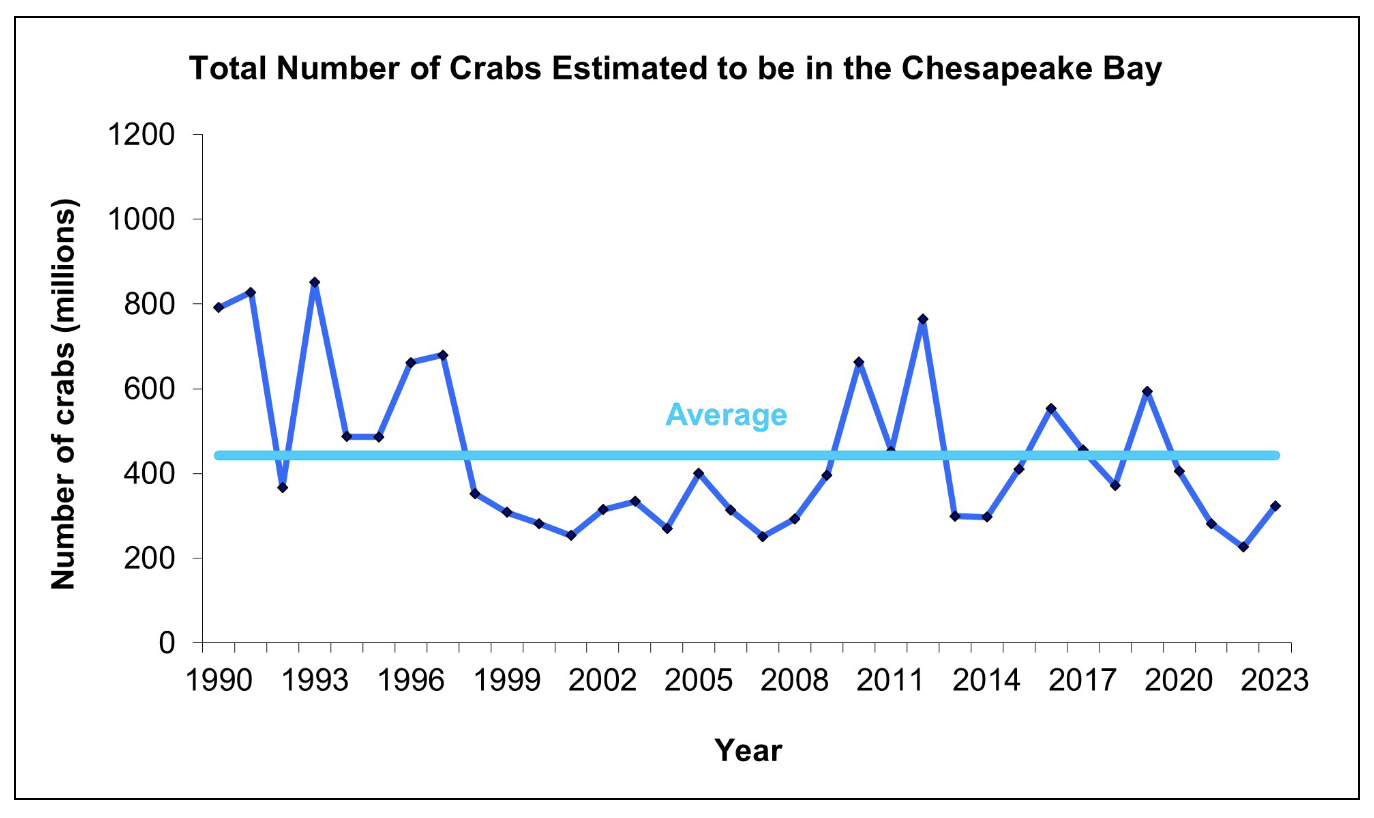
Despite the increasing numbers this year, the Chesapeake’s crab population is still well below the 30-year average. It’s also the fourth year in a row that juvenile crab numbers are below average, meaning there might not be enough youngsters to sustain a healthy crab population.
As for why crabs are doing better this year, Colden says it may be partly due to the warm winter weather the region experienced, allowing more crabs to survive over the winter. There were also new harvest limits put in place last summer that may have played a role in stabilizing the population.
Colden says blue crabs are “not totally out of the woods yet.” (You could also say: they’re still in hot water.) Crab populations naturally fluctuate year to year based on lots of different factors, but there are several ongoing threats that are impacting the crustaceans. In recent years there’s been a decline in underwater grasses in the bay — a key habitat for crabs — and efforts to improve water quality haven’t kept up with targets. In addition, invasive blue catfish are rampant in the bay, feasting on crab.
The dredge survey has been conducted every year since 1990. Crews sample 1,500 randomly selected sites across the bay, dredging each spot for one minute at a speed of three knots. They then count and measure any crabs picked up. Those counts are then used to estimate the density of crabs in the Chesapeake, as well as the total population.