Martin Austermuhle
“Uhh, thank you so much Optimus Prime,” said the mildly bemused D.C. bureaucrat, responding to the iconic leader of the Autobots.
“Can we get his last name for the record?” asked another city worker.
“I think it’s P-R-I-M-E,” responded his attorney.
That almost surreal exchange followed an even more surreal moment in the city’s regulatory history: A sentient robot known for transforming into a truck and battling the evil Decepticons spoke at a public hearing on Thursday in defense of a controversial sculpture of his likeness outside a Georgetown home.
Well, kind of.
It wasn’t really Optimus Prime speaking, but rather a recording by Peter Cullen, a Canadian voice actor known best for playing the leader of the Autobots during the original 1980s “Transformers” animated series. And he was joined by Dan Gilvezan, the original voice of Bumblebee, whose sculpture also stands outside the Georgetown home.
Cullen and Gilvezan’s robot voices were on hand for the monthly virtual meeting of the D.C. Public Space Committee, a government body that decides whether public space can be used for things like sidewalk cafes and fast-food drive-thrus to retaining walls and, well, massive metal sculptures of cartoon characters that technically occupy a portion of a sidewalk outside a private home. (Spoiler alert: The committee said no to Optimus Prime and Bumblebee.)
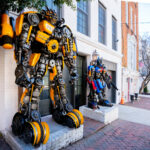
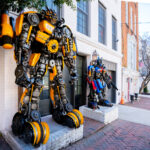
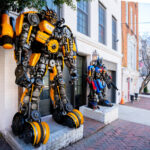
The committee was the latest stop in what has been a convoluted and sometimes cartoonish two-and-a-half-year saga involving a pair of massive Transformers sculptures that a Georgetown University neuroscientist placed outside his rowhouse in the historic neighborhood. The metallic pop-culture icons have, by almost everyone’s admission, become a public draw, but whether or not that’s a good thing has been up for debate.
But popularity hasn’t so much been the issue in the ongoing battle between Dr. Newton Howard, the owner of the sculptures, and some of his neighbors on Prospect Street NW. Rather, critics say the sculptures not only unlawfully occupy public space on a narrow sidewalk, but also don’t conform to the strict codes of the historic neighborhood. Last month the Old Georgetown Board — the the three-person federal board that reviews any exterior changes made to homes and businesses in the Georgetown historic district — agreed, ordering Howard to remove them.
It’s not the first setback Howard and his Transformers have faced, but he’s never shied away from continuing the fight through its multiple regulatory permutations. And this time he did so with legal representation. “I am here as counsel for my good friend Optimus Prime,” said Paul Strauss, an attorney and longtime D.C. shadow senator, at the start of the committee’s meeting.
Strauss argued that many homes in the neighborhood have the same type of brick planter boxes jutting into the public sidewalk that Howard has used as perches for his sculptures, and that historically few other homeowners have ever had to request permission or even permits to use those planter boxes. He also pushed back on complaints from some neighbors that the hulking metal sculptures — each is roughly 10 feet tall, and weigh thousands of pounds — posed a risk to the public, both in terms of possibly toppling over but also in the crowds they attract. (Some neighbors say they’ve even attracted motorcycle gangs to the quiet street.)
“They do not endanger the public. If anything, they have a long and glorious history of protecting the citizens of earth. In their capacity in Georgetown, they just sit there peacefully,” he said. “The allegations that they are contributing to a traffic or dangerous activity is just laughable. The idea that a couple of guys riding around on $20,000 Ducatis constitutes some type of street gang, well, speaks for itself.”
Strauss said the sculptures have been fixed to home’s facade, and that a phone survey he commissioned — a robocall, naturally — found that most Georgetown residents who had heard of Optimus Prime and Bumblebee’s presence were supportive.
Tracy Thermak, an attorney for the Prospect Street Citizens Association, the chief critic of the sculptures, countered that whether people like the Transformers is less the issue than whether they should be placed outside Howard’s home. She said he had regularly ignored the established process for using public space, and that leaving them there would open the door to other residents following suit. Thermak urged Howard to take up invitations to place the sculptures in a more appropriate place elsewhere in Georgetown.
“With no permit… this is a safety issue. They have resulted in crowding, trash, bottlenecks, and pedestrians having to walk into the street,” she said. “This would set a dangerous precedent. If these are allowed to remain, nothing is off limits.”
And nothing was off limits as public testimony continued. Cullen briefly introduced himself by name, before morphing into the recognizable voice of Optimus Prime. (The meeting was virtual, and his avatar was… you can guess.) In his brief testimony, which had been pre-recorded, Prime commended Howard for his work on neurodegenerative diseases.
“I, Optimus Prime, pale to his heroism. Georgetown should be proud to share his visions of transformation. Peace is the right of all sentient beings. Autobots, humans, let us transform until all are one!” said Prime.
Gilvezan followed, speaking as Bumblebee. (He spoke live during the session.)
“It seems fitting to me that we heroes who fight every day for freedom and liberty belong in a place so closely associated with those very qualities, the capital of this great country,” he said. “Now, I understand some people think that these statues don’t fit the character of the neighborhood, that they stand out like a sore thumb. Well, first, I resent being compared to a sore thumb. A healthy, well-functioning thumb, maybe, but a sore thumb? It’s also been said that they don’t reflect the historic nature of the district. Are you kidding me? We Autobots have been around for millennia. You want to talk historic? We’re prehistoric.”
Bob Vanasse, a Georgetown resident, also spoke in defense of the sculptures, noting that other residents had placed sculptures of their own outside their homes and not faced the same controversy. “It’s not the function of government to serve as taste police,” he said. “Are the sculptures a tad eccentric? Yes, but if we outlaw eccentricity, most of my neighbors will have to leave.”
But even the testimony of the two Autobots — along with Emily Swallow, the actress who plays the Armorer in “The Mandalorian” — wasn’t enough to sway the five-person committee, which denied Howard’s request for a public space permit. Elliot Garrett, the committee chair, said Howard had ignored past conditions for temporarily keeping the sculptures in place and had also not gotten a separate permit to secure the sculptures to the front of his house.
Strauss tells DCist/WAMU that he and Howard and reviewing their options on how to proceed.
“It’s not over yet,” he says. “Obviously there’s a variety of legal options but we want to get a better sense of whether reapplying with certain modifications may make some sense.”
But what of last month’s ruling by the Old Georgetown Board, which said the sculptures conflict with Georgetown’s historic character?
“I don’t know it makes sense to single out this one area and have federal oversight over what a D.C. resident can put in front of their house,” says Strauss. “At the end of the day, this should be a decision made by D.C. residents, not federal appointees. Dr. Howard’s front porch does not involve a federal interest.”
The saga, it seems, will continue.