Martin Austermuhle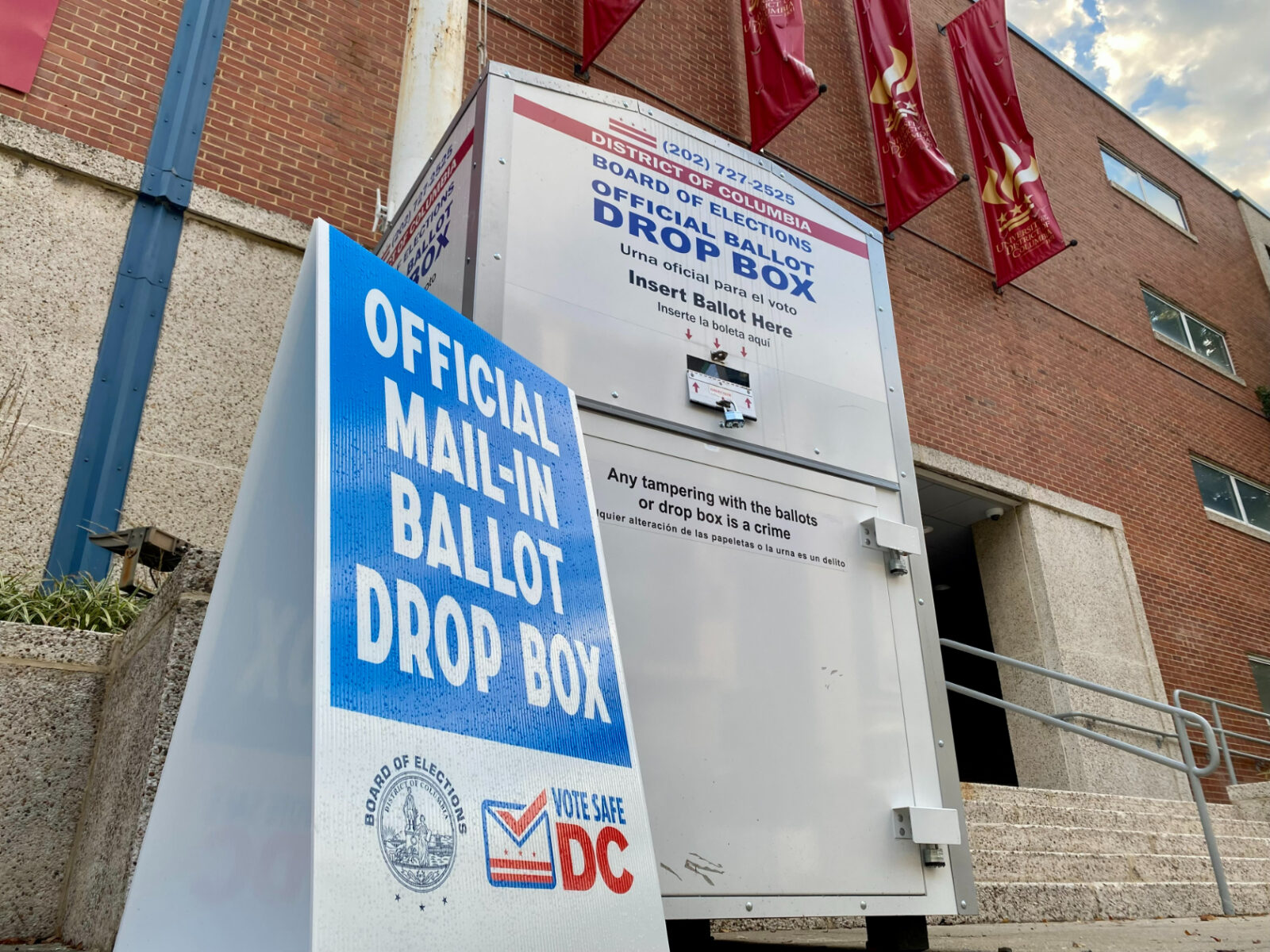
A pair of House committees have scheduled a hearing for next Wednesday on elections in D.C., which could build towards legislation that would require photo ID for voting, eliminate same-day voter registration, and largely do away with the practice of mail ballots being sent to all voters automatically — but only in D.C.
The joint hearing, titled “American Confidence in Elections: The Path to Election Integrity in the District of Columbia,” will be held by the House Committee on Oversight and Government Accountability and the House Administration Committee. On Friday evening, the committees announced the witnesses who will testify: Monica Evans, the director of the D.C. Board of Elections; former Virginia Attorney General Ken Cuccinelli, who now advocates for election security; election attorney Charles Spies; and Wendy Weiser, vice president of the Brennan Center for Justice.
It’s the fourth in a series of hearings on a Republican bill-in-the-making — the American Confidence in Elections Act — that would “provide states with tools to build voter confidence and enhance election integrity.” Given that elections are managed at the state and county level, an initial version of the bill, which was introduced last year, would have made many of those new tools voluntary. During a late-April hearing, Rep. Bryan Steil (R-Wisconsin), who chairs the House Administration Committee, said the bill “isn’t a one-size-fits-all federal mandate.”
At the same time, it would be a mandate for D.C. — which Congress has control over.
At the April hearing, Steil said the bill would implement “much-needed reforms in D.C. to clean up years of elections difficulties here and to clearly demonstrate the positive effects of strong election integrity policies.” A past sponsor of the bill, former Rep. Rodney Davis (R-Illinois), wrote that D.C. could be used as something as a testing ground for certain election-related policies and practices that Congress couldn’t mandate for the states.
“A lot of false narratives on the left will quickly be debunked when commonsense measures like requiring a photo ID are implemented in such a liberal area with no negative impacts on turnout or effects in the outcome,” he wrote in an op-ed on the bill.
Initial versions of the legislation would impose sweeping changes on D.C.’s elections. It would require residents to present a photo ID to vote or request an absentee ballot; prohibit same-day voter registration; forbid the city from proactively sending out mail ballots and restrict the use of ballot drop boxes; require that unofficial election results be posted by 10 a.m. the day after an election; and repeal a new law that allows non-citizens to vote in local elections.
In past hearings, Republicans argued that measures like these would make elections more secure and thus increase voter confidence and turnout. But Democrats have responded that the proposals are unnecessary responses to incredibly rare cases of voter fraud, and that any doubts in election security have been sowed by Republicans who have questioned the outcome of elections they lost.
That point was echoed on Thursday by D.C. Council Chairman Phil Mendelson, who said there have been no credible claims of fraud in the city.
“So-called [election] reform has been an issue with conservatives in many states across the country, and it sounds like those same conservatives now want to impose that on the District,” he said. “As we know, there’s no evidence in any of these states of the fraud that they purportedly seek to prevent. It’s about disempowering Democrats and minorities. In the District, it’s again about using the city for national campaign purposes.”
Outside of D.C., same-day registration is currently available in 22 states — including Wisconsin, which Rep. Steil represents. It is a popular option in D.C.; more than 4,700 same-day voter registrations were processed ahead of the Nov. 2022 election. Critics say it’s an administrative burden and a possible security risk. However, D.C. requires proof of residence to register, and will provide a provisional ballot and proof of residency must be confirmed before the provisional ballot is counted.
Like in many states, mail voting was adopted in D.C. during the pandemic, and the city started proactively mailing ballots out to voters ahead of the Nov. 2020 general election. (For the primary earlier that year, voters had to request them.) They have since been made a permanent part of the city’s elections, and have gained in popularity: Of the more than 205,000 ballots cast last November, 63% were returned by mail or at one of the 55 drop boxes placed around the city. Republicans have said mail ballots can be stolen or otherwise used for fraud, though there has been no indication of that in D.C. to date.
The city has faced challenges with the number of mail ballots that are returned as undeliverable — 17% in the 2022 general election cycle, far above the national rate. D.C. election officials say this is because the city is transient or voters will move without updating their address, though some election experts have argued it indicates problems with the city’s voter registry. Proponents of mail voting say that the longer D.C. does it, the better the system will get.
The city has also historically faced some challenges reporting results in a timely fashion. During the 2022 cycle, the large number of mail ballots returned on Election Day meant that final unofficial counts weren’t available until a few days after the election.
A more recent change in D.C. law — allowing non-citizens to vote in local elections, starting as early as next year — has drawn significant opposition from Republicans in Congress, and would potentially be banned by the election bill. Critics say it dilutes the votes of citizens; a small group of D.C. residents has sued to overturn the law on those grounds. In a hearing last week, Steil also said that it would open the city’s elections to foreign interference.
“For example, in the District of Columbia, non-citizens, like embassy staff from Russia and China can vote after living in our country for only 30 days. This vulnerability to nefarious foreign interference in our elections raises serious concerns,” he said.
Neighboring communities like Takoma Park, Maryland have allowed non-citizens to vote in local elections for years, without any credible claims of fraud or foreign interference.
Since taking control of the House in January, Republicans in the House have held two hearings on crime in D.C., and voted to overturn three pieces of local legislation. (Only one was ultimately blocked.) When asked about the election hearing, Mayor Muriel Bowser was dismissive of its purpose.
“They don’t know anything about D.C. elections,” she said of Republicans. “I’m very proud about the way we conduct elections here and the election reforms that have been made. People are voting, and that’s what we should be focused on: how do we expand the franchise, not limit it.”
This post was updated with the names of the witnesses who will testify at the hearing.