Morgan Baskin
Fifty-four-year-old Earnest Wilkerson didn’t foresee leading his neighbors through the sale of their apartment building when he moved into Minnesota Commons five years ago.
One of the younger and newer tenants of the 83-unit complex in Ward 7, Wilkerson had lived there for only a couple of years before its owner listed it for sale in January 2021. Minnesota Commons is a developer’s dream, sitting kitty-corner from the Minnesota Avenue metro station just across from D.C.’s Department of Employment Services. Many of his neighbors have called the complex home for 20 or 30 years, some of them seniors whose children gently but persistently urge them to move.
But Wilkerson, who watched conditions at the property slowly decline after he moved in, felt a sense of resolve. The native Washingtonian – who also happens to work in construction – knows all too well what can happen when renters living on prime land get a notice that their home is changing hands.
“I am trying to make myself and this neighborhood a better place,” he said. “I’m fighting not just for me, but for all of these people who live here. We don’t want to go.” When the tenants of 4089 Minnesota Ave. voted Wilkerson in as their new tenant association president, he didn’t object.
The group saw their forthcoming sale, and subsequent rights under the Tenant Opportunity to Purchase Act, as a way to leverage some much-needed repairs. Under TOPA, tenants in certain apartment complexes have the right of first offer when the buildings go up for sale. They can also assign those rights to a development partner of their choice – a carrot that incentivizes developers to include tenants in rehabilitation plans or offer them hefty buyouts to move.
At Minnesota Commons, tenants wanted two things: affordable rent and clean homes. Longtime resident Christine Smith says she won’t use her bathroom sink to brush her teeth because the tap water smells like sewage – just one of three households that reported that condition to DCist/WAMU. 75-year-old Josie Thomas told us that she and her husband refuse to cook anything more complicated than boiling water because of the mice infestation that has only grown worse since all of the neighbors on her floor vacated their apartments, and squatters moved in.
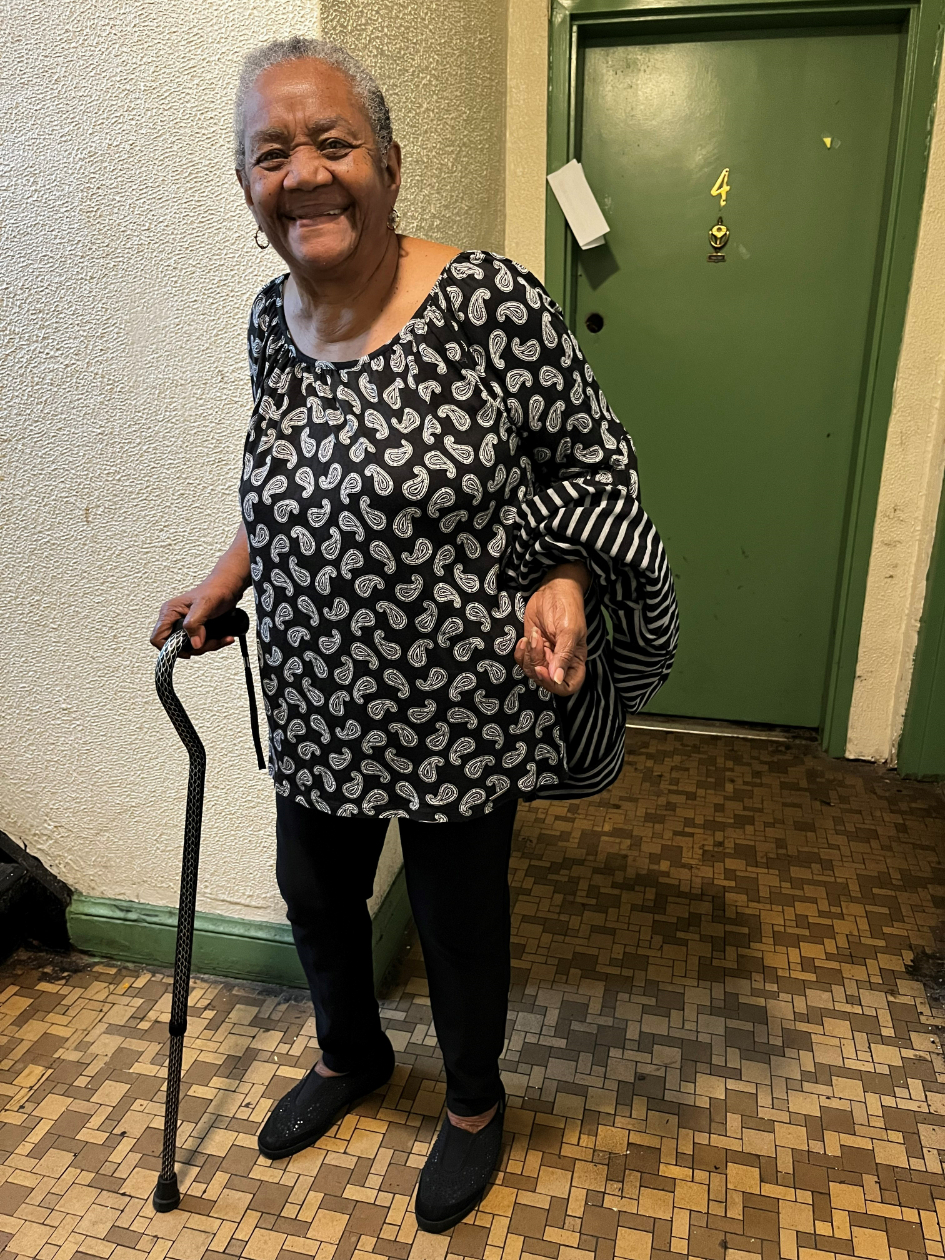
“Now the roaches have decided to come down and party on this end. And the mice,” says Thomas, who moved into the building about 30 years ago when she worked for Marriott and liked being so close to a metro station. “If you throw water in [the apartment next door], it’d grow some grass.”
Todd Forster, counsel for the building owner, wrote DCist/WAMU in an email that “Prompt action is being taken to address and remedy the tenant concerns.” He added that the complaints “are being addressed and, with the assistance of the Department of Buildings, we will continue to identify and respond to all legitimate complaints.”
DCist/WAMU attempted to contact the current owner of Minnesota Commons, which is listed on D.C. government websites as an LLC and does not name an associated agent. DCist/WAMU asked Forster, who is named in sale documents, for the owner’s name. Forster did not respond to that question.
For a cool $10.79 million, the building could be owned by the tenants – or, thanks to TOPA, the development partner of their choice. They went with NFP, a local affordable housing nonprofit that promised to keep the building rent stabilized even after undergoing substantial remodeling. The pending sale was slated to close May 15, and tenants grew cautiously optimistic.
But in early May, the equity partner who planned to help finance the purchase backed out, and NFP was forced to pull its offer. The deal that Wilkerson and his dozens of neighbors worked so hard to close ultimately fell through.
Minnesota Commons is now poised to go to the seller’s hand-picked buyer: A business entity managed by Sam Razjooyan, a local developer who targets rent stabilized apartments to turn profit. Razjooyan’s business model, as DCist/WAMU reported in March – and that Razjooyan himself referenced in a business proposal he submitted to tenants last year – sees him offering buyouts to existing tenants, then filling the vacant apartments with housing choice voucher holders. Housing choice vouchers, a federal housing subsidy disbursed through the DC Housing Authority, are reimbursed at rates that can run several hundred dollars above what some rent-stabilized buildings ask.
The sprawling rent-stabilized complex now in Razjooyan’s crosshairs is exactly the kind of project the D.C. government has talked about protecting: affordable, home to seniors and native Washingtonians, and well-situated.
What should have been a rousing success story has now become a cautionary tale, as industry leaders say that worsening market conditions, coupled with dwindling public dollars for affordable housing preservation, have made efforts to preserve affordability more challenging. That is particularly true for nonprofit organizations, which don’t enjoy the same kind of access to capital as larger for-profit developers, but that prioritize lowering costs for tenants.
“The market is still moving forward in terms of favoring very, very deep pocketed developers who can afford to control their own deal without a nonprofit at the table and without other people inserting their mission needs into the transaction,” says Mitch Greenstein, a real estate executive who has worked in D.C. since the late 70s and consulted for NFP on the Minnesota Commons sale. “It also seems to [favor] smaller developers who aren’t as attuned to the needs of the local community.”
A perfect storm of conditions led to the Minnesota Commons deal collapsing: high interest rates and skyrocketing construction costs made the prospect of rehabilitating the building incredibly expensive, to say nothing of its nearly $11 million asking price. A $2 billion Amazon-backed fund intended to help finance affordable housing projects has started to run dry. Last year, for the first time, D.C. hit its bond volume cap — the amount of tax-exempt financing D.C. can award per calendar year — stiffening competition for steeper Low Income Housing Tax Credits, a critical tool used to finance affordable housing projects. “[It] had gone from a situation where they were readily available to: they are now capped, and they became competitive,” Greenstein says.
“As all of this was going on, interest rates were continuing to climb. Subsidy dollars for affordable housing in D.C. were becoming more scarce. And the investment community was getting a little bit less enamored with this kind of real estate in the shorter term,” he adds.
And as private equity players grow skittish, chatter has pitched that Mayor Muriel Bowser’s administration is taking cues from them and shying away from funding major preservation projects, too.
D.C.’s Department of Housing and Community Development administers the city’s largest subsidy for affordable development and preservation through the Housing Production Trust Fund. But the fund has not solicited any new proposals since 2021, and that year, only three projects were selected for a 9% LIHTC subsidy; none of them were preservation projects.
And of the 21 development projects to receive HPTF funds from its last round of giving in 2021, only one – Aspen Street Cooperative, an apartment complex across from the Walter Reed campus whose tenants used TOPA to buy the building – was a preservation-only project. (D.C.’s fiscal year 2024 budget, proposed by Bowser with signoff from the D.C. Council, will see D.C. cut back its investments into the Housing Production Trust Fund.) “It does seem that new construction is taking a priority over preservation,” says Rick Eisen, a real estate attorney who represents nonprofit developers and tenant associations, as well as a member of the team that drafted D.C.’s TOPA law in the late 1970s.
Experts in affordable housing development say that public subsidies are critical for ensuring that the math works on major rehabilitation projects, like the one NFP tried to execute at Wilkerson’s complex.
“In any case, doing any kind of committed affordable housing of high quality is very expensive” says Melissa Bondi, the Mid-Atlantic State and Local Policy Director for Enterprise Community Partners, a national affordable housing nonprofit. Bondi says it’s near-impossible for nonprofits to tackle major rehabilitation projects in D.C. “And it is impossible to do preservation without subsidy.”
Complicating the math is the fact that some preservation projects obtain financing help from one pot of DHCD funds for their acquisition, only to be denied further down the road for HPTF money that would make rehabilitation of the buildings possible.
MANNA DC, one of the city’s most prominent affordable housing developers, is now selling a portfolio of 19 apartment buildings it bought in 2019 because it’s been unable to secure the financing necessary to execute its substantial renovation plan, according to sources with knowledge of the deal. It is also selling two other properties, one on South Capitol St. and one in Randle Highlands, because it couldn’t secure financing to make renovations, that source also said. (Rozanne Look, MANNA’s director of project development, didn’t return DCist/WAMU’s requests for comment.)
Sam Razjooyan, part of the group poised to take over Minnesota Commons, has perfected a business model that hinges on buying rent-stabilized apartment buildings, remodeling them to add additional bedrooms, and renting out vacant units to housing choice voucher holders. Tenants in buildings managed by Razjooyan report living with sewage-stained carpets, bedbug infestations, and pervasive mold.
“I went and looked at a couple of his places, and it was worse than where I am right now. I’m like, nah, I don’t want to live up in here,” says Wilkerson, who sat on Zoom calls with Razjooyan last spring.
The rehabilitation proposal Razjooyan submitted to the tenant’s association states that he is the managing member of a firm that owns and manages over 54 properties totaling 600 units across Northeast and Southeast D.C. “We specialize in affordable housing and work closely with the DC Housing Authority for those residents who utilize various subsidy programs,” the proposal says.
DCist/WAMU asked Razjooyan in an email whether he plans on buying the building, given the collapse of the deal with NFP, and sticking with the development proposal outlined to tenants last year. Razjooyan’s response was that last year he consulted for the business entity listed as the seller’s third party purchaser and is not aware of its current intentions.
Razjooyan’s rehabilitation proposal to tenants states that while it is “NOT our goal to displace anyone … we want to help accomplish your goal of either home ownership or assist to move to another community.” The group said it would offer tenants $15,000 to vacate the building.
The Minnesota Commons tenants are now in limbo: unsure how their owner will proceed with a sale, the remodeling they desperately need even further on the horizon.
Christine Smith, the Minnesota Commons tenant, lamented the collapse of the deal with NFP. “I don’t want him. Things are bad enough around here,” Smith says. “Please, please, please Jesus, do not [let it be] Sam.”