Margaret Barthel
Amazon has invested nearly $52 billion in data centers in Virginia since 2011, according to a new report from the company. The figure includes capital investments as well as operating expenses for the tech behemoth’s data centers in the commonwealth. (Data centers are facilities housing large-scale computers to process and store digital information. If you store your photos in the cloud, they’re in a data center.)
The $52 billion does not include an expected $35 billion in future investments through 2040, which the company announced in January.
“Our overall story began right here in Virginia, which was home of our first data center region, in 2006,” said Shannon Kellogg, the vice president for public policy in the Americas for Amazon Web Services, who led a panel discussion about the report at a company conference on Wednesday.
The company estimates Amazon’s current spending has spurred an $8.2 billion contribution to the commonwealth’s gross domestic product.
Northern Virginia is home to the largest cluster of data centers in the United States, mostly concentrated in Loudoun County and, increasingly, Prince William County. 70% of the world’s internet traffic funnels through the region’s facilities, per the Amazon report.
“It’s helping this region be less dependent on the federal sector for our overall economic opportunities,” said Terry Clower, the director of the Center for Regional Analysis at George Mason University’s Schar School of Public Policy, who spoke at the Wednesday event.
Data center companies overall had invested $125 billion in Virginia as of 2021, Clower said. The industry experienced a major boost in the last several years, as work-from-home became ubiquitous for many during the pandemic, increasing the demand for data storage.
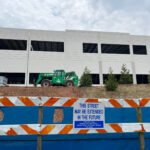
But data center development in the region isn’t without controversy, mostly over the location of the large complexes and their environmental and quality of life impacts. Residents in Prince William County, which already has more than 30 centers and counting, have spoken out vociferously about a recent zoning change allowing new data centers in a rural area adjacent to Manassas National Battlefield. Two data center companies have presented proposals to develop the so-called Prince William Digital Gateway, sparking concerns from environmental groups and the park’s superintendent. (A poll from a parks advocacy group found that a strong majority of Northern Virginians opposed putting the facilities in places where they might disturb parklands.)
Critics say the sheer square footage — single-story, warehouse-style, although experts on the panel said they were beginning to be built with multiple floors — and building heights are intrusive in residential neighborhoods. They cite the added demand on local utilities, and whether the cost of building new electrical or water infrastructure could fall on taxpayers. And they are concerned about the impact of runoff from the centers’ impermeable surfaces on local water quality, with Fairfax County’s water authorities going so far as to oppose Prince William County’s Digital Gateway zoning proposal over concerns that it could affect the Occoquan River watershed, which supplies water to about 800,000 people across both counties.
But the economic boost the data centers bring to the region is hard for elected officials to resist, particularly at a moment when rising office vacancy rates are curtailing another source of corporate tax revenue. Amazon estimates it paid $334 million in taxes to localities in Virginia in 2022, money that augments residential property taxes in providing funding for schools and other county services.
Prince William Supervisor Victor Angry (D-Neabsco District), who participated in the panel discussion, emphasized that point, noting that the revenue helped the county increase government salaries without raising the property tax rate in this year’s budget.
“Data centers have allowed us to really do well in our commercial tax base,” Angry said. “For the first time in like 15 years, we have a flat tax rate.”
“It really has been — people don’t like this term — the golden goose for the county,” he said.
Angry said the county had learned its lesson about putting data centers too close to schools and other residential facilities, though as recently as January it had been considering data center projects residents felt were too close to homes and schools. He said the Digital Gateway was an attempt to move data centers away from higher-population areas.
Angry and other speakers noted the whole industry of businesses devoted to the construction and upkeep of the centers that has sprung up in the region. Amazon alone estimates that its data center operations supported more than 11,000 part- and full-time jobs (over 7,300 full-time equivalent positions) in Virginia in 2021.
Amazon itself is one of the largest corporate employers in the commonwealth. It is partway through building its second headquarters in Arlington, and Amazon Web Services — the division that oversees data center development — has a corporate office in Fairfax County.
In the midst of the public debate, Amazon’s report also seeks to showcase the company’s environmental commitments. The company plans to power all of its operations, including its data centers, with renewable energy by 2025, and it is developing 18 solar farms in Virginia to support that goal locally (solar farms have also been subject to local opposition over their large footprint). Amazon’s data centers are also on track to return more water to communities than they take in by 2030, and the company claims they are more energy efficient than the average U.S. data center.